On 14 June 2025, an anonymous X user known as “Max Tempers” posted a photograph of dozens of bikes and e-bikes in front of a London hotel the Home Office had been renting as asylum accommodation. Some of the vehicles had Deliveroo and Just Eat-branded thermal bags mounted on the back, suggesting that some hotel residents – who as asylum seekers were not legally allowed to work – were delivering takeaways to supplement the £9.95 they received each week from the Home Office.
Tempers called the hotel’s residents “illegal migrants”, and said: “This is the Deliveroo subsidy.” He then identified the hotel as the Thistle City Barbican.
Tempers’ posts attracted significant press attention, putting a target on the backs of hotel residents. The fallout would ultimately include a government crackdown on couriers, far-right protests with anti-fascist counterprotests, an arson attack, and the residents’ eventual eviction.
A year on from these events, the beginning of summer has been met with a now-predictable wave of far-right mobilisation: riots in Southampton and Belfast; fascist marches in London, Sheffield, Liverpool and Brighton; and racist attacks in Edinburgh and Glasgow.
In Southampton and Belfast, the cities which saw the most widespread violence, rioting was buoyed by far-right figures on social media, the right-wing press, and in the case of Belfast, loyalist paramilitaries.
These riots have led to renewed calls for the government to take action against X for its role in inciting far-right violence. Since Elon Musk bought the platform in 2024, he has frequently used it to boost accounts associated with the British far-right, including Tempers and his anti-immigrant agenda.
The Thistle
Tempers wasn’t the first far-right figure to tweet about the Thistle. A month earlier, Tommy Robinson (real name Stephen Yaxley-Lennon) had posted about the “invaders” living there, and in 2024, Britain First had “exposed” it as asylum accommodation.
But more than most far-right figures, Tempers knows how to court media attention and convert it into policy. In February 2025, The Times profiled him for his role in whipping up anger about grooming gangs; that June, the government announced a new public inquiry. Since then, he has popularised the term “Boriswave” – a racist dog whistle used to refer to non-white immigrants who arrived in the UK during Boris Johnson’s post-Brexit premiership. He was even credited with forcing cuts to the Motability scheme, which allows disabled people to use their benefits to lease a disability-adapted vehicle.
The tabloid press found the “Deliveroo subsidy” narrative irresistible. Within a week, journalists from the Express were filming residents leaving the hotel on bikes, calling after them: “Why are you working?” In another video – inspired by the Express – shadow home secretary Chris Philp asked residents if they had arrived in the UK on small boats, and criticised then-home secretary Yvette Cooper for failing to prevent asylum seekers from working as couriers. The next day, the Sun published a front page investigation into asylum seekers working in the UK, which named the hotel repeatedly.
Tempers took the opportunity to note his influence. “Looks like all of SW1 have descended on the Thistle Barbican this week,” he tweeted in response to the Sun’s article.
The UK imposes greater restrictions on asylum seekers’ ability to work than any other European country, with a near-total ban enacted in 2003, and an increasingly strict system of enforcement. Not only are all employers made to carry out right-to-work checks, but since 2016, asylum seekers found to be working have faced criminal prosecution.
Luna*, a support worker for a charity that provides services to asylum seekers, counted several Thistle residents among her clients. She says the reasons people risk prosecution to do paid work are obvious: “How are you supposed to live on £9 a week?”
She added: “This has to pay for going to see your solicitor, and going to therapy. A lot of people actually drop out of therapy because they can’t afford to get to appointments.”
In theory, Thistle residents did not need to pay for food with their Home Office allowance, as the accommodation was catered. However, Luna says she sometimes received photos of inedible meals. She said: “I once saw a breakfast meal of a white bun that was mouldy inside, with plain spaghetti. That was what was supposedly a nutritious breakfast.”
On 30 June 2025, Home Office immigration compliance and enforcement (ICE) officers raided the Thistle. The Sun claimed both the raid and an ensuing Home Office crackdown on couriers were triggered by its reporting.
Streamers, “auditors” and “citizen journalists” had by then made the hotel a regular haunt, harassing residents and security to the extent that the hotel erected fencing to block their access.
Luna recalls becoming concerned about the residents’ wellbeing after one of her clients was secretly filmed by someone claiming to be a journalist. After that incident, she said her client “felt like he'd been tricked” and became “very uncomfortable about speaking to anyone”.
To the streets
The worst was still to come. On 20 July 2025, the Mail on Sunday reported that 41 residents of the Thistle Barbican had been charged with crimes in the preceding three years. The Mail’s dataset included people who had been acquitted. The Sun had published a similar article two days before, naming the Thistle and several other hotels housing asylum seekers. However, the Mail’s reporting – unlike the Sun’s – listed sexual assault among the alleged crimes of Thistle residents.
The article’s publication coincided with far-right protests outside asylum accommodation in Epping, where a resident had been charged with sexual assault. The effect was incendiary.
The following morning, Tommy Robinson tweeted about the alleged crimes, adding to the febrile atmosphere. Tempers also shared the story and took personal credit for inspiring the Mail’s reporting.
Two days later – directly citing the Mail’s article – far-right groups called for a protest outside the Thistle, scheduled for 2 August.
Samuel*, one of the organisers of an anti-fascist counterprotest at the Thistle, said: “This attack was the result of the press stoking up anti-refugee sentiment and concentrating it on a specific target, chosen by far-right organisers on social media.”
The far-right rally was advertised by two Islamophobic groups with ties to football hooliganism: Patriots of Britain and Together for the Children. The former sometimes provides security for UKIP leader and Turning Point UK COO Nick Tenconi – who gave a speech at the protest on 2 August. The latter is a rebrand of the Democratic Football Lads’ Alliance, led by Phil Hickin, an associate of Tommy Robinson.
The Metropolitan Police falsely told the press that local residents had organised the protest. When asked to respond to this story, the Met reshared its press release from last year, but did not dispute Vashti’s reporting.
Stand Up to Racism (SUTR) quickly called for a peaceful counterprotest, informing the police the group would be demonstrating in opposition to the far right. Jeremy Corbyn, Islington Labour and the Finsbury Park Mosque all lent their support.
Samuel, who was part of a group that organised more militant resistance to the far-right protest, called SUTR’s response “woefully insufficient”. He said: “I do not wish to live in a society in which a growing far-right element attempts to attack asylum applicants, while a counter-demonstration politely registers its disagreement, and the people seeking asylum are defended only to the extent that the police view the far-right assault as a public order issue.
“I wish to live in a society in which those seeking refuge are valued and protected by the community around them.”
Luna said she and her colleagues “tried to alert people that they should either stay inside all day or leave very early and come back very late”.
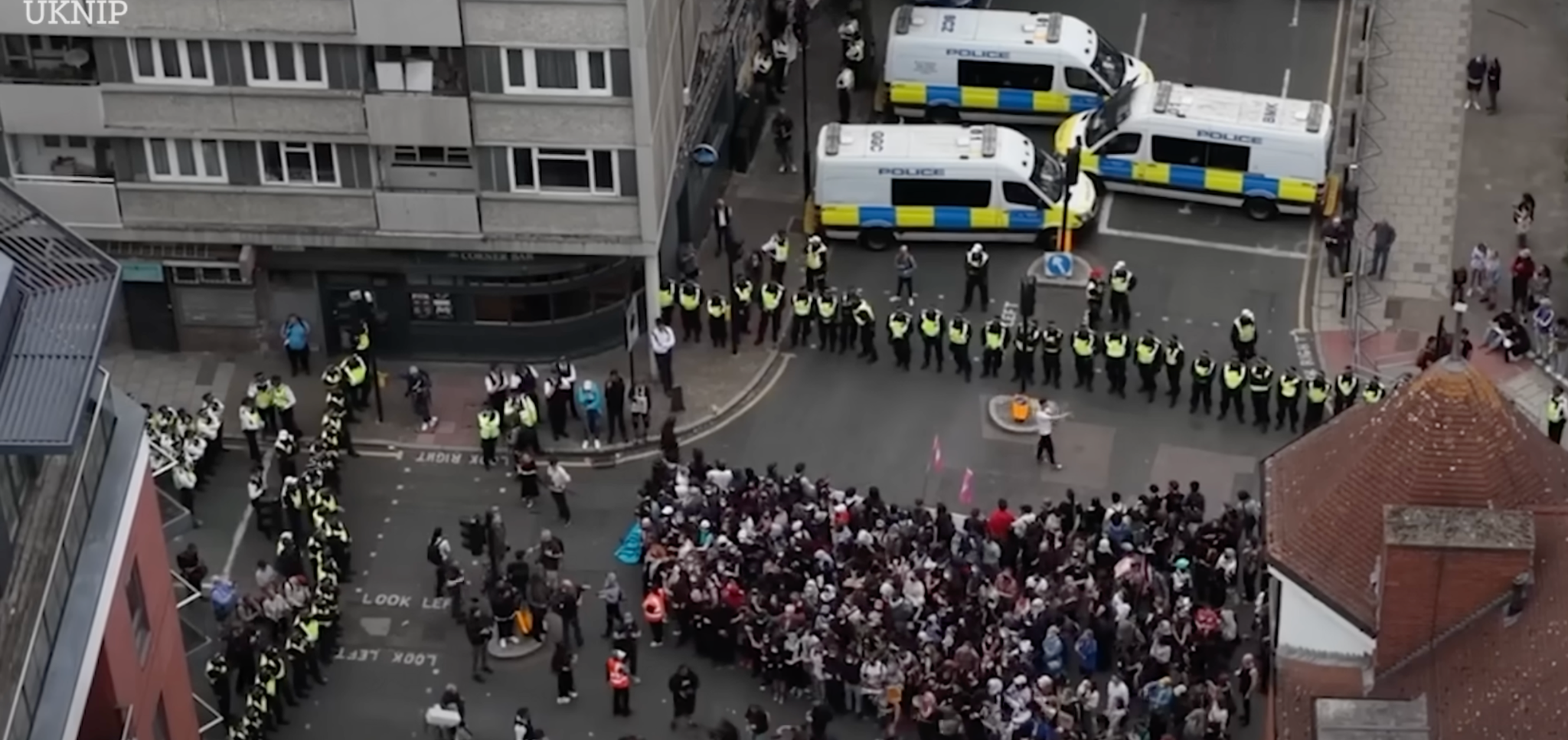
On 2 August, the fascist protest and the SUTR counterprotest assembled in front of the hotel, separated by large numbers of police. An anti-fascist black bloc emerged from a side street chanting “siamo tutti antifascisti” (“We are all antifascist” in Italian) to stand directly in front of the hotel’s entrance.
Some of the residents waved enthusiastically at the anti-racist protesters from the windows. The counterprotesters responded in kind, waving back at the residents and making heart shapes with their hands.
Officers from the Met and City of London Police quickly became aggressive towards the anti-fascist black bloc, which was outside the zone the police had designated for the counterprotest. The police kicked, punched and dragged people out of the crowd, all the while yelling “get back” and threatening arrests. Meanwhile, a few young attendees of the far-right rally sat undisturbed on the rear step of a police carrier.
Eventually the police called in enough reinforcements to surround the anti-fascists, and the bloc was forced to retreat under threat of mass arrest.
Both police forces both declined to comment on the treatment of protesters at the Thistle.
For Samuel, it was clear which group the police regarded as the real threat. He said: “I believe the police view fascist actions as improper expressions of a sympathetic and correct politics, which are treated as annoyances to manage.
“However, far left and anti-fascist organisations are handled as enemies to be removed or quashed by the police, rather than facilitated.”
The aftermath
Returning to work the following week, Luna spoke to several Thistle residents who were profoundly affected by the weekend’s events.
She said: “From that point on we saw a big deterioration. People were really scared. It was really difficult to hear people saying, ‘I thought coming here would make me feel safe, but it's actually not a place I feel safe anymore.’”
Some residents were comforted by the presence of counterprotests, but others couldn’t tell who was on their side, and found the black bloc threatening. Luna said: “The politics are really hard to navigate when you don’t speak the language and are worried about your safety.”
The residents of the hotel had little respite. Smaller far-right protests continued throughout the summer, sometimes unopposed.
Luna said several of her clients would stay in their rooms all day, which she described as “cramped” and “decrepit”, to avoid contact with the potentially hostile people gathering outside.
Others would leave the hotel early and return late. She said: “People were in parks for whole days, and that can be triggering because a lot of the asylum-seeking population have been homeless.” But with their extremely limited access to money, many of the Thistle’s residents had nowhere else to go.
Then in September 2025, the hotel’s landlord, Clermont Hotel Group, served the Home Office notice of its intention to evict the asylum seekers at the end of the year. Residents told the Islington Tribune they feared being sent to military barracks.
Just days later, on the night of 24 September, there was an attempted arson attack on the Thistle. Hotel staff were able to put out the fire and no one was injured.
Mark Neville, 64, who lives nearby, was arrested later that night. He was charged with arson with intent to endanger life, making an explosion with intent to endanger life and possession of a knife in a public place. After a search of his home on 3 November, several other charges relating to illegal possession of weapons, including a firearm, were added.
At a 21 October hearing, Edward Aydin, prosecuting, told Highbury Corner Magistrates’ Court that Neville had attended several anti-migrant protests at the Thistle over the summer, before attempting to burn it down with a Molotov cocktail. His trial will be held at Snaresbrook Crown Court, beginning on 21 September 2026.
The Thistle’s residents were evicted at the end of last year. The Home Office declined to comment on where they were rehoused, including whether anyone had been sent to live in former barracks.
Luna said: “I know one person that we supported was moved out of London. They were actually quite happy to go, but it also meant they can’t access our service.” Other residents she knows were rehoused nearby.
Throughout the summer, Luna said she and her colleagues were “on high alert”. They didn't know why the Thistle had been singled out, and worried other asylum accommodation in the area could be targeted next.
The big picture
Before the Thistle became a national story, the Home Office had already begun stepping up ICE raids, including against people working illegally.
But the media storm created by Tempers, Philp, and the tabloids put pressure on the government to take targeted action. The Home Office hastily called a meeting with the bosses of Deliveroo, Uber Eats and Just Eat to demand new measures to prevent asylum seekers from working on their platforms.
Their companies had already carried out right-to-work checks, as required by the Home Office, but some account holders would rent out access to their profiles, including to asylum seekers.
On 30 June 2025, the Home Office announced that the food delivery companies had agreed to step up surveillance measures on couriers, including implementing more frequent facial recognition checks. The same day, ICE raided the Thistle, arresting several asylum seekers and seizing their phones and bikes. The Sun – likely tipped off about the raid – reported from the scene.
Three weeks later, the Home Office announced it would share the locations of asylum accommodation with the food delivery giants to help them geolocate asylum seekers working on the apps. Keir Starmer, the prime minister, was quoted in the Sun, saying: “The Sun has rightly put the spotlight on migrants working illegally as food delivery riders. And we’re tackling the problem. If a rider is staying at this accommodation, the companies will know and can close down the rider’s account.”
Performative cruelty
The government says these measures prevent illegal workers from undercutting gig economy wages, but the Independent Workers’ Union of Great Britain (IWGB) – a trade union that represents many gig workers, including couriers – disagrees.
Alex Marshall, IWGB’s president, and a former courier, said: “The government’s attacks on couriers are little more than performative and cruel attempts to appease right wing anti-migrant sentiment.
“The claim that different groups of workers are driving down pay lets the real culprits off the hook. The downward pressure on pay comes from business models that rely on insecure work, weak protections and a constant search for cheaper labour, not from vulnerable workers trying to make ends meet.”
Luna said many of her clients want to work to support themselves, but are banned from paid labour. This leaves asylum seekers who do seek out work “ripe for exploitation”, renting Deliveroo accounts from other couriers, or doing cash-in-hand gigs, like cleaning, construction, childcare or sex work.
Marshall added that the government crackdowns also harm many couriers who are working legally. “Immigration checkpoints are racially profiling whole communities and terrorising them on the streets as they work. Flawed facial recognition systems can wrongly lock riders out of their accounts, cutting off their only source of income with little warning,” he said
A spokesperson for Just Eat said: “In extremely rare cases where someone may be incorrectly removed from our network, we have clear processes to fix any issues and get them reinstated. Just Eat is fully committed to tackling any attempts to provide delivery services illegally via our platform and we continue to work closely with the Home Office and industry partners.”
Deliveroo declined to comment. Uber did not respond to a request for comment.
Since June 2025, the Home Office has made arresting and deporting people found to be working illegally a central plank of its communications strategy.
In October, Tempers shared an LBC video of migration minister Mike Tapp on a ride-along with ICE. The video shows the arrest of a man working in a car wash, allegedly against the terms of his health and care worker visa.
“Worst visa in the world strikes again,” tweeted Tempers.
“Frozen it,” responded Tapp, whom Tempers referred to as his “treasured mutual”. The minister still follows Tempers today.
For many years the right-wing press has helped to launder far-right ideas into the political mainstream. However, with the rise of posters like Tempers, these media middle-men are starting to look obsolete.
Government ministers may not yet be taking cues directly from anonymous racist posters, but they certainly seem eager to please them.▼
The Home Office declined to comment. Tapp and Tempers did not respond to requests for comment.
*Name has been changed.
Author
Sasha Baker is an investigative journalist.
Sign up for The Pickle and New, From Vashti.
Stay up to date with Vashti.