Abraham issues
An interview with Matan Kaminer and Ben Schuman-Stoler, hosts of the new podcast Bad Cousins.
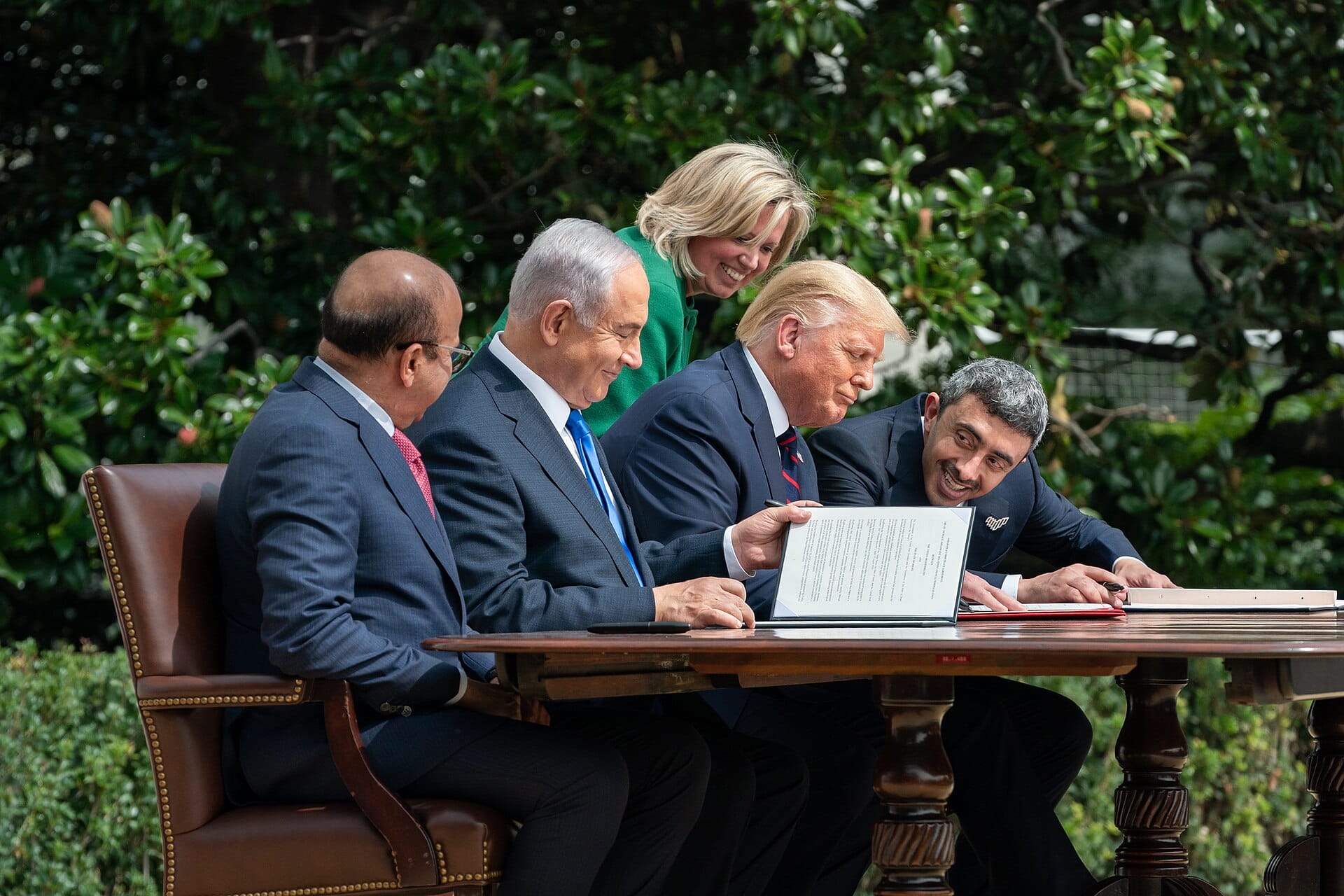
In a 2023 article for Millenium, Matan Kaminer, an anthropologist and lecturer at Queen Mary University London, put forward an “Abrahamic” lens for understanding geopolitics in the Middle East, drawing on the namesake of the Abraham Accords to examine what he calls a relationship between “bad cousins”: Jews and Arabs. With co-host Ben Schuman-Stoler, Kaminer expands this analysis in a new podcast of the same title, Bad Cousins, produced by Berlin’s Kollo Media.
In understanding Abraham, Kaminer and Schuman-Stoler hope to reveal the complexity of Jewish, Muslim, and Christian cultural traditions pertaining to Abraham, highlighting the places where they converge and diverge, as well as the thorny contradictions of the story itself, and the ways in which Israel has seized on a particular conception of the patriarch to justify its horrific campaign of genocide and ethnic cleansing. Ultimately, the hosts contend that these traditions hold within them possibilities for radical reinterpretation.
I recently spoke with Matan and Ben about the show, which concluded its first season in April.
In our conversation, I questioned the usefulness of the Abrahamic interpretive framework, including whether Jewish engagement with the myth can’t but uphold Zionist claims to the land. We also discussed the role of theology and mythmaking in geopolitics, the place of Abraham in the discourse of the Christian right, and what a liberatory reinterpretation might look like.
You can listen to Bad Cousins online or wherever you get your podcasts. This interview has been edited for length and clarity.
– Kendall Gardner
Kendall Gardner (KG): How did Bad Cousins come about?
Ben Schuman-Stoler (BSS): I run Kollo Media, an audio publisher here in Berlin. I read Matan’s paper when it came out and we’d spoken about how these ideas would work in an audio experience, to go deeper into each section of the argument. It felt even more pressing and important to talk about these themes in the aftermath of 2023, so we started planning the podcast at the end of 2024 and have released episodes once a month since last fall. [The finale of Bad Cousins aired on 21 April 2026]
Matan Kaminer (MK): If at any moment, I felt like this story belonged to the past, particularly as the Abraham Accords themselves seem to have been superseded, the broader conceit of the show – the need to think more seriously about the role that religion plays in current affairs – has only become more obvious as time has gone on. After all, we’re now living in a world where the US’ self-proclaimed “Secretary of War” and the Pope are having theological disputes. In a way, we’ve even had trouble keeping up. That was the reason why we ended up doing an episode on the so-called “Purim War”, which doesn't really fit into the general arc of the Abraham mythology, but we felt we had to deal with it in real-time.
KG: That leads me to my initial question: what does an understanding of the Abrahamic myth bring to an analysis of the Abraham Accords that we can't get from other interpretive lenses, like capitalism, imperialism, etc?
MK: The most immediate answer to that question, evidenced throughout the series, but especially in the interviews that featured in episode two, is that everybody in the Middle East already understands this framework as one in which a fractious family is being brought back together. Whether they agree with that framework or not, and whether they're religious or irreligious, they all understand it. For people outside the region, this interpretation is not as obvious. If you ask them why they think the Accords are named after Abraham, they'll usually say something about how Abraham represents monotheism and universal values. That understanding is only one part of the story, and it’s not even the most salient part for people in the Middle East, for whom the family framework is much more important. To say this, is not in any way to endorse, sugarcoat, or flatter that framework because, as feminist scholars teach us, the family is not necessarily a wonderful thing. The family can be a very oppressive institution, and therefore, thinking about geopolitics in these terms is not necessarily a positive move in and of itself. Another reason for digging into this framing is that the Abraham Accords themselves are bad, hence, the ideological framing that justifies and naturalises the political thinking behind them is also worth criticising.
But that doesn’t mean the story ends there. There are moments within the Jewish, Islamic and Christian traditions, and in the liminal spaces between them, where a different interpretation of the story can come forth. Even though I'm not a religious person myself, in the ordinary sense of the word, these traditions and all their interrelations are very personally meaningful to me, and in discussing them with people – Jews, Christians, and Muslims – I want to think collectively about what to bring out of them in an alternative fashion, one that help us to create a politics that we want to carry forward, in a vein that is not secularised. To me, that’s an endeavour worth pursuing.
KG: From a left perspective, I think you’re right that we shouldn’t fully secularise our analysis, as doing so can eclipse people’s common understandings of politics, which aren’t often rooted in the systems that academics use to analyse these events. But I’m still struggling with the relationship between a “biblical” understanding of the region and a political one that recognises the Middle East as fundamentally constructed through modern systems like colonialism, capitalism, and nationalism. How does the Abrahamic myth work together with these other tools of analysis, or doesn’t?
MK: That’s a very good question and one that I don’t have a final answer to either. I’m a dyed-in-the-wool Marxist after all, and I’ve been an activist in secular, radical left movements my entire life. My main line of research is on migrant workers from Thailand in Israel – a secular, political-economic topic if there ever was one. I’m very comfortable thinking in these secularised, materialist terms about the world. But if you want to phrase it in Marxist terms, it’s a question of ideology. What is the actual material impact of the way people think and talk about the world? Within the Marxist tradition, there are various answers. I gravitate towards an Althussarian, structuralist understanding, in which capitalism is not just an economic system, but a total system that structures the way the world is organised into various spheres, like economics, politics, religion and culture. The very division of social life into separate spheres, like the secular and the religious, is a product of modernity and capitalism. Throughout the 20th century, both leftist and liberal politics had a fantasy of neutralising religion as a political factor. But I don’t think this is tenable and it never has been, not in the Middle East, or anywhere.
In the first episode, Dana El-Kurd brings a perspective that I respect, saying we need to have a political discourse that abstracts from all this to clearly understand the Palestinian situation as one that is about land and liberation. But I don’t think it’s going to work, not with Israelis or Palestinians. For example, some people argue that for Hamas, Islam is really just a framing or window-dressing for what is fundamentally a secular nationalist political project. I don’t think that's true, and I think those people are deluding themselves. If we want to be good dialectical materialists about it, then we need to have an account of how religion interacts with these political forces. It’s not intellectually honest or politically effective to pretend that it doesn’t.
KG: By forcing religion out of politics, we don’t take people at their word when they describe how their belief systems inform their politics and their worldview. Secularisation creates a hierarchy of what type of interpretive framework is true or most useful. But I do see a risk in using the Abrahamic myth to understand the relationship between Israel and the Arab world today because it might inadvertently reinforce a settler-colonial logic. Patrick Wolfe, a scholar of settler colonialism, describes the way early Zionists sought to distance themselves from their European traditions as a “logic of elimination by replacement”. He explains that Jewish settlers naturalised themselves by claiming to belong to the same land as the Indigenous population. To me, analysing the occupation of Palestine through the Abrahamic myth risks doing the same thing, ultimately propping up settler permanence in a way that validates the Zionist project.
MK: There are resources within these myths that enable us to read them from a decolonial perspective, and we don't have to start from zero if we want to do that. For example, it is very well-attested within Jewish traditional sources, including ultra-Orthodox (Haredi) ones, that Abraham is a figure of an immigrant, or a ger, not in the modern sense of that term in Judaism, a convert, but in the original sense, an alien or immigrant in the country. Abraham himself says this when he purchases a gravesite from the Hittites, who are the indigenous people in the land. He says to them, “I am a migrant and a resident among you. Please sell me some land.” This is the man who has supposedly been promised this land by God for his progeny. Zionists, including Christian Zionists, are very obsessed with God’s promise of the land to Abraham. But we could, and we should, give equal weight to the verse in which Abraham says, “I am an immigrant.”
The contemporary haredi thinker Rabbi Yosef Kaminer builds an entire political program on the understanding that there is only one sovereign in the land and that that sovereign is God. All of us who live in it, or who wish to live in it, must respect the rights of those others who we consider aliens, living in equality and peace with them.
Now, is this enough from a decolonial perspective? I don’t think so. Avi-Ram Tzoreff, who was our guest in the final episode, points out that just saying “let's zero everything out and everybody can be equal in the land” is not enough. Palestinians have suffered historic crimes at the hands of the Zionist project and there needs to be reparation and return. It’s not enough to say that everybody who lives here now can be equal and that’ll be the end of it. We need to keep looking for more resources. For Avi-Ram, a Midrashic myth is one of these sources. In the times of the Messiah, as the Midrash says, all the cities that have been destroyed will be rebuilt, including Sodom and Gomorrah. And if Sodom and Gomorrah will be rebuilt, then kal va-homer all the Palestinian cities and villages that were destroyed in the Nakba should also be rebuilt. The tradition is rich enough to find a lot of what we need, and I think it’s very powerful.
If we’re discussing this topic with Jews, there is this idea that messianism is an attribute of the extreme right, which is in power in Israel today. But one of the only encouraging political things happening in Israel today, as far as I’m concerned, is the emergence of the Faithful Left. Most of these people are coming out of the religious Zionist milieu. They have a real chance to wrest that tradition back and say “No, messianism isn’t about some temple landing from the sky in the middle of Jerusalem and destroying al-Aqsa. A real messianic vision is one in which the residents of the land live in peace and equality with each other.” Many parts of the tradition corroborate this idea, we’re not making it up. It’s there.
BSS: When we did the live event to launch the podcast in Berlin, we had a very critical audience. One piece of feedback was like “these Jews with their Bible. Can we just leave it? It’s annoying. Why don’t you stop the genocide before you talk to me about Abraham?” There’s a line of criticism that not only are we not helping, we’re making things worse by distracting from the material argument. Why make something about myths in this moment? I think it’s important to name that criticism, because even if you believe that addressing these myths is a complete waste of time, the stories are being referred to whether we want them to be or not. Does the Bad Cousins framework help Zionist intellectual entrenchment by increasing hits on bible story topics? I don’t see it like that. We’re actually looking at these myths and saying things like, “hmm, this is a troubling verse in the Bible that seems to support a far-right cause.” [To say] that's somehow actually supporting them is ridiculous, no?
KG: I think both of you are right in saying that the people we’re against are doing it anyway, so we also need to be conducting this analysis from our own interpretive framework. But I have an immediate impulse against mythmaking if it creates a Jewish connection to the land over a Palestinian one. I don’t think that that's what the Abraham story does – you both make that point throughout the podcast – but when these stories are being used to those ends, how do we go about reclaiming them when we’re not the ones facing the brunt of the resulting oppression? What does a reinterpretation of the Abrahamic myth mean for Palestinians in Gaza who are facing the exterminatory logic that this myth is fuelling?
MK: You’re absolutely right in your interpretation of the dominant understanding of the Abrahamic myth, as instantiated in the Abraham Accords. But what we need to pay attention to here is that this understanding is not only a Jewish Zionist one, or even a Christian Zionist one: we are seeing the emergence of what some critical observers are calling an Arab or Muslim Zionism as well, centred around these Gulf countries and their apparatuses of intellectual production. This Zionism erases Palestinian existence to speak on behalf of the Muslim Ummah or the Arab people. By talking about “making peace with the Jews”, they reify an understanding of Israel as the land of the Jewish people and Arab countries as the land of the Arab peoples.
But again, this is only one reading of the story. From both a Jewish and Islamic perspective, there is no need – there never has been, and there isn’t one now – to deny the fact that there’s a Jewish connection to the land. The political ramifications of that connection are a different discussion, and one that needs to be had with clear sensitivity to our historical conjuncture, in which Israel is committing genocide against the Palestinians.
There’s a theological basis for treating decolonisation not only in this formal sense of kicking out the colonisers and establishing a nation-state, which Fanon and other decolonial theorists always critiqued. There’s a much deeper socio-economic transformation that needs to occur – and in the world today, where so many people need to migrate in order to survive, the questions of decolonisation and open borders should all be related to one another. I’m not saying we need to open and shut this discussion all at once, but there are theological resources in Judaism, Islam, and Christianity for this idea.
BSS: I find that very convincing. Why don’t we, the progressives, get to provide an alternative version of things? The negative reading of the Abraham Accords is obvious, this breakup of “Jews in Judea” and “Arabs in Arabia” that gets to be promulgated around. It doesn’t have to be like this.
KG: I’m in support of a mutual relationship between decolonisation and open borders, but for decolonisation to be meaningfully achieved, power has to materially transfer out of the hands of the colonisers and into the hands of the formerly colonised. I do think the Abrahamic myth – and the idea of a Jewish connection to the land – really conflicts with this anti-colonial imperative.
MK: I think you’re right to worry. But again, we don’t need to negate what we’ve been calling “the Jewish connection to the land” out of this sort of concern. Why? Because we can disconnect the question of a connection to the land from the question of sovereignty. Many people have “connections to the land”. Even Pete Hegseth has a connection to the land. I don’t need to deny that. It doesn’t mean that he gets to be sovereign over it. Once we’ve decoupled these two things, then there’s a lot more freedom to explore the different kinds of connections that people have to the land.
As Salman Abu-Sitta says, return is not about turning the clock back: it’s about restitution, reparations and rebuilding. But maybe there is a point of contention between me and you here because as far as I’m concerned, decolonisation doesn’t mean that the settlers must leave. There are various outcomes that we can see in history, and the Algerian outcome is not the only possible one. It wasn’t even the one that was always favoured by the Algerian resistance movement. So I don’t think it’s politically necessary or viable to see that as the only possible outcome. It’s been impossible to eliminate the Palestinians, but it’s also going to be very difficult to eliminate the Israelis.
KG: Who has the power to make that choice? My political vision is one where the group historically dispossessed from their land regains the power to make that choice, and what they decide to do is part of a political project of restitution. If settlers want to be part of this process, then they must be open to the possibility of leaving because it’s evidence of their real relinquishment of power. Creating this perspective is part of the transfer of power in a settler-colonial context.
MK: I think the missing thing in this discussion is the question of restitution. How the crimes that have been committed are to be atoned for is a huge question, and you’re right that we haven't really gotten into it in the series. There are theological resources for this as well, so if we do another season, maybe we’ll be able to get into it.
BSS: Matan, you make a point in the show that it’s difficult to debate if we get pulled into black and white counterarguments. We’re confronting a worldview that all three of us oppose, and we shouldn’t allow the terms of engagement to be “either all the Jews leave” or “all the Palestinians do”. I think we’re allowed to reject that starting position. That framing doesn’t help us to create coalitions on our side. I think one of the great things about the show is how many examples we provide of complexity, dynamism and diversity being the norm in the region. It’s not helpful to accept this black and white, zero-sum, Mordechai or Haman, us or them mindset. That’s exactly what the soldiers are being told to justify their killing. It’s not a mindset that I accept.
KG: I don’t accept it either. I’m just very sensitive about what a Jewish perspective on Palestine’s future even means. When talking about land claims and the future of Palestine, I aim to be deferential to the Palestinian perspective. But I want to return to Christian Zionism because I thought the podcast makes a valuable contribution to understanding why Evangelicals in the US have an impulse to read the Middle East through a certain lens. Can you say a bit more about how the Evangelical right, particularly represented by some members of Trump’s foreign policy establishment, leverage this theological understanding to pursue their own aims?
MK: There are basically two ways in which Christians have historically read the Old Testament. One of them, which has been dominant, is an allegorical one. In this reading, everything the Old Testament says about Israel is transferred to apply to the people of the Church, following the coming of Christ. Then there’s another fundamentalist or literal reading, which sometimes takes place in parallel. In this reading, everything that’s said about Israel is taken to refer to a literal entity named Israel, such as the state that exists today. However, as we discuss on the show, this reading precedes that state by about a century, and is actually one of the sociopolitical forces that helps to bring about its existence. This “restorationist” project precedes Jewish Zionism and begins in the British Empire in the mid-19th century, as European powers scrambled to seize bits of the collapsing Ottoman Empire. These powers justified their land claims through establishing responsibility for religious minorities within the borders of the empire. The British Empire got stuck because they didn’t have an obvious population to protect.
To simplify a little bit, the literalist reading of the Old Testament provides a solution to this problem through prophecies about the people of Israel returning to their land. Now, I’m not saying that the British made Zionism up for the Jewish Zionists, but they obviously encouraged it. There have been ups and downs in the relationship between Western imperialism and Zionism, but it’s been a romance through and through, with the imperial protection passing from the British to the Americans in the second half of the 20th century.
Evangelicals like Ted Cruz, for example, love to quote from the Abraham story in Genesis, “those who bless you shall be blessed, and those who curse you shall be cursed.” There’s this understanding of Israel as someone whose side you’d better be on if you want God to like you. But I think it’s important to note that we’re also seeing the Christian right rip itself apart over Israel today. Christian Zionism is no longer hegemonic on the Christian right in North America, or anywhere. This is of course related to the antisemitism that has always been there, but it’s also because of a resurgence of the allegorical reading, in which Israel is not the state of Israel, but actually the Church. Catholics understand Israel this way, allowing them to be more distanced. But so does Tucker Carlson, and he’s not Catholic, he’s an Episcopalian.
BSS: We talk a lot about the historical development of Abrahamism within the Vatican. It was a completely different context to the theological alliances we have now, as it occurred at a time [during the Cold War] when Islam was associated with anti-communism. We don’t go as deep into Christianity as we could and would like to in the next season. The new Pope in particular has been doing some interesting things.
KG: I resonated with the liberatory potential of theology at the end of the podcast. As someone who grew up being like “this is why I'm a leftist” at Pesach, I do believe our principles are reflected in our traditions, to some extent. A lot of people on the Jewish left feel that way, as do people on the left in a variety of religious traditions. But it’s difficult to hold onto that feeling when you’re confronted with the reality of Israel using these stories to commit atrocities. Who gets to decide if these stories and symbols are liberatory or oppressive? If we can, should we?
BSS: Having two sons, I feel that if I completely turn my back on these traditions, it’s a form of failure. We have a chance to use our imagination, to stick our chests out and think about what we want to carry forward, and start fighting with the people who disagree. It’s a good thing when I engage with the Jewish community from a different perspective, and my kid has a different perspective. It shows that there are other ways to look at it. But it’s hard, and it requires thought and conflict. Thinking about religious myths, we can find ways to engage with them to support progressive arguments, creating a way for more people to follow. That’s something to be proud of. We have to be smart, focused, and imaginative. And for that, I think that you have to know the stories.▼
There’s no corporation or big advertisers behind Vashti – we're a workers' cooperative and rely on small donations to keep running. Support our journalism to help break the consensus.
To donate once or monthly, click here.
Author

Kendall Gardner is an editor at Vashti and a doctoral candidate in political theory at the University of Oxford.
Sign up for The Pickle and New, From Vashti.
Stay up to date with Vashti.