As the government stalls, TERFs are removing trans people from British life
It’s time for the left to build a culture of noncompliance.
It’s now been nine months since the UK supreme court ruled that the terms “man”, “woman”, and “sex” in the 2010 Equality Act should be interpreted to refer to what they call “biological sex”, rather than a person’s lived gender. While it’s abundantly clear how the anti-trans lobby believe this judgement should operate – trans people are to be stripped of legal protection against sexist discrimination and the right to be included in women-only or men-only spaces; in the eyes of this law, she or he is not to be considered a woman or man at all – the government has unexpectedly stalled the publication of its own practical guidance for the exclusion and erasure of trans people from daily life, leaving business and services without advice on how to implement the ruling.
For anti-trans activists, this void has presented an opportunity. Rather than wait for approved guidance from above, well-funded TERF groups like Sex Matters have sought to impose their own maximalist reading of the law on pliable civil society organisations and complicit political parties. Using intimidation and threats of legal action, their hope is that a widespread culture of fear will convince others to follow.
In late August, for example, Sex Matters filed a legal case against the City of London Corporation in an effort to ban trans women from using Hampstead Heath ladies’ pond. In-mid December, the high court heard the group’s transphobic arguments but has not yet ruled on whether they can continue their challenge.
Also in December, Girlguiding UK announced it will no longer accept trans members following a report that an anonymous parent had threatened legal action. The next day, the Women’s Institute published its own press release announcing the purge of trans women from its own membership. A few days later, the Labour Party stated that trans women will be barred from the party’s Women’s Conference in 2026, following a “comprehensive legal review”.
As the right advances, it’s crucial that the anti-fascist left use this window to mount its own pressure campaign – one that builds toward trans liberation by challenging unlawful interpretations of the decision at every turn, and organising to roll back the impact of the shameful ruling itself. There’s no time to waste.
A benign acronym with a dangerous agenda
The official guidance on the law – known as the Equality and Human Rights Commission’s (EHRC) code of practice – is intended to support businesses, public bodies, charities and community organisations to interpret and implement the supreme court’s ruling in everyday contexts. The process to final approval is mostly straightforward: once the draft has been prepared by the commission, it is sent to the equalities minister (currently Bridget Phillipson) for review. When Phillipson is content with the guidance, it will be laid before parliament. If parliament does not disapprove, it will come into force with the legal status of a non-statutory guide.
The EHRC may have a nice, neutral-sounding name, but don’t let that fool you. Since its establishment in 2007 as a regulatory body to enforce the 2006 Equality Act, it has received extensive criticism from international human rights bodies for its longstanding anti-trans bias. In 2023, the Global Alliance of National Human Rights Institutions launched a review of the Commission’s UN-accreditation and urged the EHRC to reevaluate its approach to LGBTQ rights. Little, it seems, has changed.
Following the April 2025 supreme court decision, the EHRC rushed out interim guidance on the ruling that has had devastating real world effects on trans, intersex, and gender non-conforming people, as some employers and service providers jumped to implement exclusionary policies. The guidance – which is currently subject to a judicial review brought by the Good Law Project on the basis that the EHRC either violated the law itself or breached the Human Rights Act – was ultimately withdrawn in October.
The final approval process, however, has seemingly reached a standstill, as a dispute between the EHRC and the government bubbles to the surface. In December, the outgoing EHRC chairwoman accused the government of delaying the guidance’s publication, claiming that the draft has been with Phillipson since April. The government, meanwhile, says that it only received the guidance in September, and, according to Phillipson, has been “taking the time to get this right”. On 7 January, Phillipson placed blame for the delay on the EHRC, stating that the commission has been slow to respond to requests for additional information.
There are reasons to suspect that Phillipson may be reluctant to move forward. For example, in a written submission to a high court challenge in November, Phillipson considered the Good Law Project’s claim that the EHRC’s interim guidance on gendered toilets “apparently” adopted a trans-exclusive approach and detailed the legal issues that could arise if such an approach were taken in general.
Phillipson did not, however, offer her support for either side in the case, and she is not necessarily an ally to trans people; in April, she stated that the supreme court ruling brought “welcome clarity and confidence for women and service providers.” At the time of writing, Phillipson still has the power to reject the guidance or ask for significant revisions, but her opposition is by no means guaranteed.
Now everyone’s a cop
Opposition, however, is urgently needed. Extracts of the final draft leaked to the Times in November indicate that the code is very much like the now-withdrawn interim guidance. It states that trans people using single-sex spaces can be questioned “based on how they look, their behaviour or concerns raised by others”, and that this questioning would not amount to discrimination in a legal sense.
In effect, this would deputise all of us to police each other’s genders in public – to monitor and question how we look, how we behave, how we move through the world. It recalls that omnipresent voice on public transport telling us to make a report if we “see something that doesn’t look right.” For transphobes in public spaces, the cop in their head would have a new mandate.
One response to the EHRC guidance has been to call it “unenforceable”. This was the tack taken by a group of backbench MPs who wrote to business secretary Peter Kyle in October to complain that the guidance was creating a “legal minefield” for companies. Whatever the concerns for business owners, focusing solely on questions of enforcement is missing the point.
Compare the guidance to another historic piece of anti-queer legislation in the UK: section 28, the Thatcherite law that banned schools and local authorities from “promoting homosexuality”. Despite being in place for fifteen years – between 1988 and 2003 – no one was ever successfully prosecuted under section 28. It is remembered not for its enforcement but for its chilling effect on queer communities in Britain. It served as a symbol of state institutions’ disdain for queer life and emboldened homophobes and transphobes in the media, on the streets, and in the halls of power. The same is true of the EHRC guidance; its status as the default position of the state creates a climate of fear among trans and gender-nonconforming people.
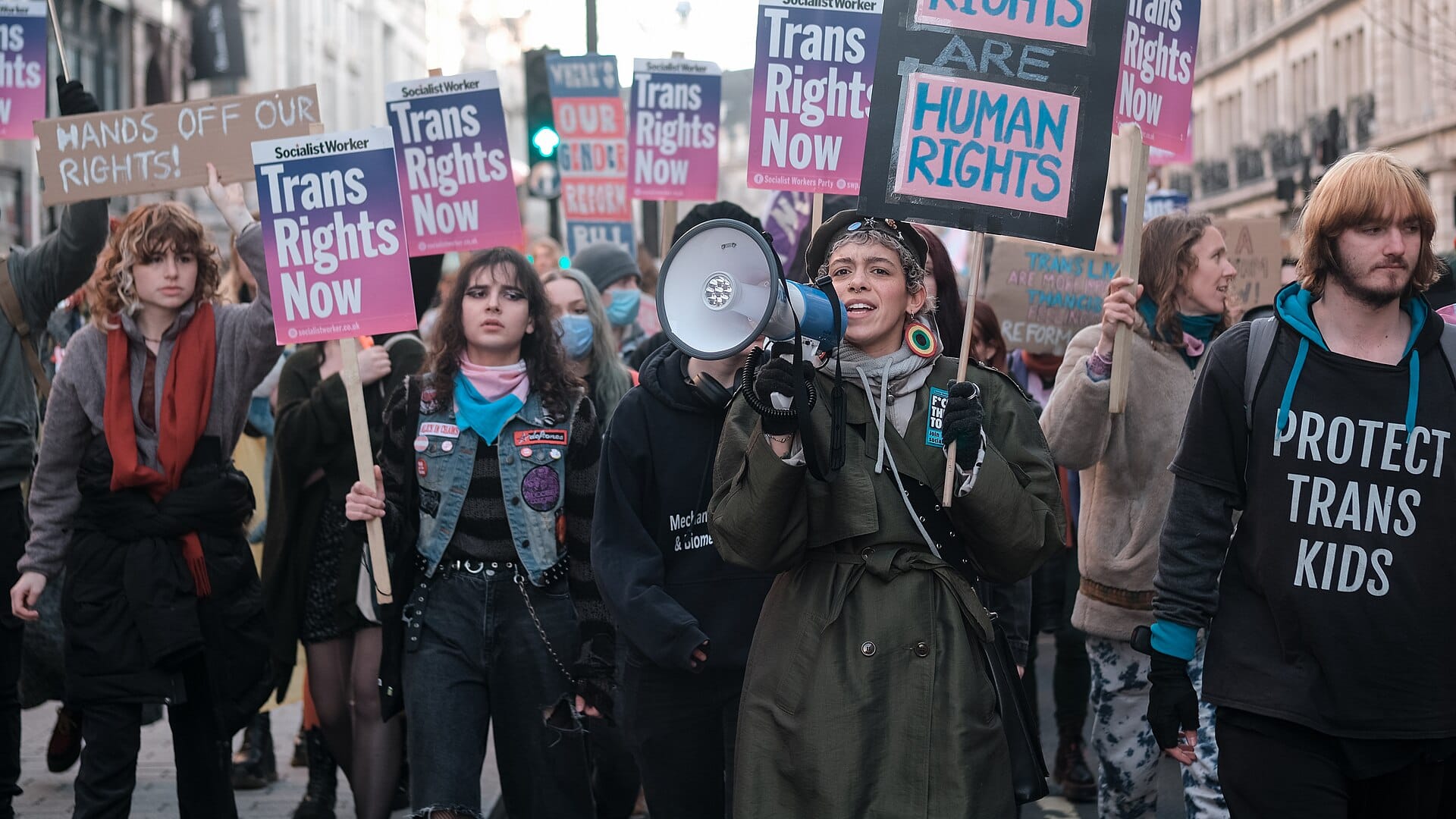
Just as a previous generation mobilised to challenge section 28, trans and queer groups are resisting this climate of fear, and organising to scrap the EHRC guidance entirely. In April, forty thousand people marched in central London to oppose the supreme court’s decision. In May, the youth-led direct action network Trans Kids Deserve Better occupied the offices of the EHRC in London and in Glasgow.
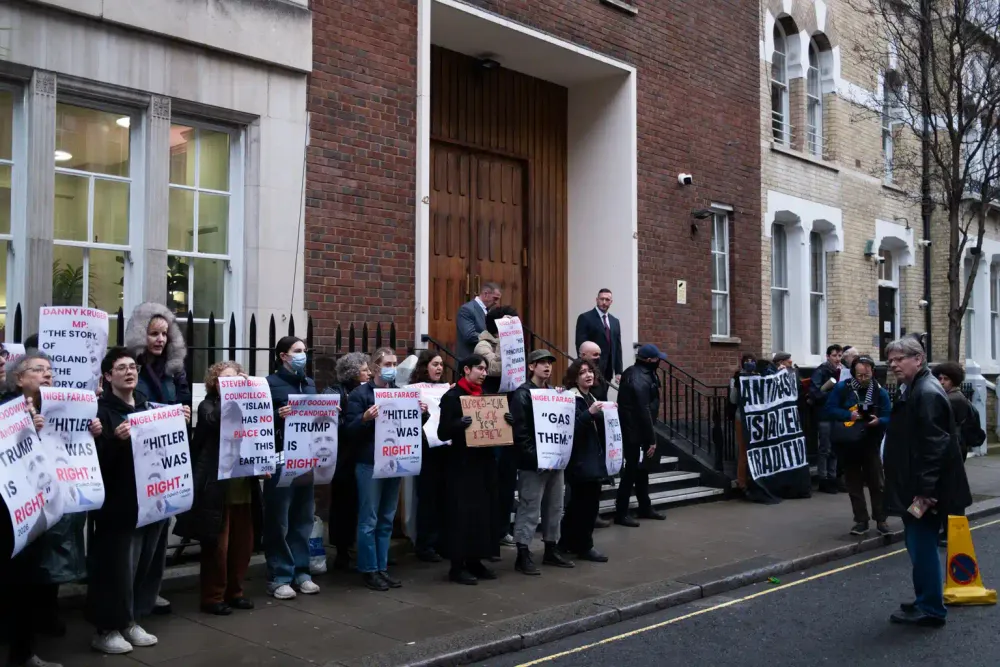
The Dyke Project – a collective of trans and cis dykes organising against transphobia and other forms of fascism, of which I’m a member – disrupted a gathering of anti-trans lobbyists and academics at UCL in August, where Akua Reindorf, a barrister and former EHRC commissioner who has represented “gender critical” groups and activists including Sex Matters, LGB Alliance, and Julie Bindel, had been scheduled to speak. Since October, we’ve organised a regular picket outside Phillipson’s cabinet and Department of Education offices, alongside members of Trans Kids Deserve Better, Lesbians and Gays Support the Migrants, Queers for Palestine, and the Trans Advocacy and Complaints Collective. We’re demanding that Phillipson not only reject the EHRC draft, but that she amend the 2010 Equality Act to undo the damage of the supreme court ruling and give trans people full protection under law.
The weaponisation of lesbian identity
We’re also confronting the trans-exclusion movement at the source by challenging one of its central narratives. Lesbian groups play a particularly prominent role in making the case for excluding trans people from public life by appealing to women’s safety. Scottish Lesbians, the LGB Alliance, and The Lesbian Project, a lobbying group co-founded in 2023 by journalist Julie Bindel and academic Kathleen Stock, all supported For Women Scotland’s supreme court case. According to Bindel, these groups argued in their written submission to the court that “Lesbians are not attracted to certificates, but to other women”, referring to Gender Recognition Certificates.
Claims about the nature of lesbian desire may seem out of place in legal proceedings – lesbians, in my experience, are not attracted to legally defined protected characteristics either – but in fact the weaponisation of lesbian identity has been a key tactic of anti-trans agitation over the past half-decade.
The LGB Alliance, for example, was founded in 2019 in response to what its founders Kate Harris and Bev Jackson describe as pro-trans bias at Stonewall, the UK’s largest LGBTQ charity, and a perception that lesbians “fin[d] themselves abandoned by their own movement”. The second line of Scottish Lesbians’ “About Us” page states that “Lesbians are exclusively same-sex attracted females. We do not recognise any other definition.” Even For Women Scotland, which is not an exclusively lesbian organisation, was co-founded by Nicole Jones, who sits on the advisory board of the Lesbian Project. Similarly, Sex Matters regularly appeals to the “disappearance” of lesbian groups and published a 2023 paper titled “Lesbians without liberty”.
The idea that there is some kind of natural conflict between justice for trans women and safety for lesbians (with no overlap between the two) is now treated as common sense by mainstream media outlets. In 2021, for example, the BBC published an article which claimed that (cis) lesbians “feel pressured to have sex and relationships with trans women”.
Lesbians even pop up in the EHRC’s interim guidance, in which they state that “a women-only or lesbian-only association should not admit trans women.” If you feel that telling queer women who they should or should not include in their lesbian book club sounds like overreach, you’re not alone.
Of course, this conflict is politically constructed. We at the Dyke Project are far more representative of the views of lesbians across the UK than the members of these lobbying groups. A 2023 YouGov survey found that 84% of cisgender lesbians surveyed said that they had “fairly positive” or “very positive” views of trans people.
This tactic's success speaks to the continuing power of “women’s safety” as a cudgel to target other groups. It also lies in the fact that anti-trans lesbians groups have had access to significant financial resources – often from wealthy non-lesbians, like JK Rowling – and prominent media backing to legitimise their noxious views.
It falls to us
When it comes to the fight between trans-exclusionary lesbians and their allies on the one hand, and trans and pro-trans lesbians and queers on the other, we are, to paraphrase Malcolm X, not outnumbered but out-organised.
As dykes, we know that the law will not protect or liberate us, but we must not abandon it as a site of struggle: laws play a role in creating social realities, and this guidance will have far-reaching effects on our communities. It’s important to understand that this is much more than a “bathroom ban”; it has implications for trans people in schools, hospitals, offices, universities, women’s refuges, charities and prisons.
It’s not surprising that charities with limited resources like the Women’s Institute or Girlguiding UK would err on the side of excluding an already disempowered group rather than risking a potential lawsuit from a well-resourced and highly litigious anti-trans lobby looking for any signs of noncompliance.
It falls to us, as queer and trans organisers, to take up the challenge of building lasting power across our private and public institutions. This means organising in our trade and tenant unions, bringing demands to councils and local authorities, pressuring the pubs, bars, gyms, venues, sports clubs and other community spaces where we spend our time and money to side with trans people against the anti-trans right, and galvanising to support them when they do. It means finding the strength to build a culture of noncompliance with anti-trans legislation, and shouldering the risks and the rewards together. Now is the time to get involved.▼
Author
Catherine Kelly is a writer and organiser from Dublin. She lives in London.
Sign up for The Pickle and New, From Vashti.
Stay up to date with Vashti.