Everyday dissent
Becoming a British citizen in a time of overwhelming repression.
On 5 July 2025, the UK Parliament voted by a vast majority (385 in favor, 26 against) to proscribe the direct action group Palestine Action. Founded in 2020 in the conviction that it was necessary to go beyond marching on the streets to protest Israel’s occupation of Palestine, Palestine Action targeted the British factories of Israel’s arms company, Elbit Systems, as well as other firms allegedly involved in Elbit’s supply chain and in financing the Israeli arms industry.
Proscription meant that Palestine Action would henceforth be classified as a terrorist organisation. All expressions of support for the group would be criminalised, according to the same laws that apply to terrorism itself. Statements of support for the group could receive up to fourteen years in prison.
One week after this momentous vote, I found myself browsing the shelves of a Lidl grocery store in the city centre of Bristol, a town I had come to love for its staunch pro-Palestine activism. Every week, since the beginning of the Gaza genocide, the people of Bristol have turned out for Palestine in crowds of hundreds and often thousands, marching all the way from Easton Jamia Masjid to the City Council headquarters. Having immigrated to the UK ten years earlier, I had adopted Bristol as my home. As I exited the store, a south Asian security guard made eye contact with me. His stare was polite but intense, and it made me nervous.
I slowly met his gaze. Something about his eyes told me that it was a friendly, if peculiar, stare. I stared back, trying to gauge what it meant. Finally, he pointed at a newspaper rack facing the entrance. The newspapers featured an elderly woman, later revealed to be 83-year-old Sue Parfitt, a vicar and peace activist from Henbury in Bristol, being manhandled and arrested by the police.
As we stared together at the newspaper rack, the guard pointed to my chest. I remembered the badge I was wearing, a white circle the size of my palm that featured in large block lettering the words FREE PALESTINE. Beneath these letters was the Palestinian flag. The security guard didn’t want to risk being overheard, so he had resorted to pointing.
“This country is crazy,” I said, relieved to have finally understood his meaning. “There’s no telling what they’ll do next.”
He nodded and pointed again to one of the newspapers. “Now they’re arresting priests.”
I nodded back. There was not much that we could say about Palestine Action in a public setting, especially while he was on duty. I did not want to get him in trouble. I smiled and went my way, grateful to have made a connection with a fellow supporter of Palestine solidarity.
As I walked home, I felt as if I had joined an underground network. While members of this network were not free to speak our minds, we would never compromise on our beliefs. The more of us there were, the stronger were our chances of resisting state suppression.
Two months later, another encounter with a security guard expanded the underground network that was developing throughout my city in response to the crackdowns on pro-Palestine speech. The time had arrived for me, after ten years of residing in the UK, to apply for citizenship.
I could have applied earlier, but until 2025, there was no sense of urgency. I thought I had all the time in the world. As a US citizen, my passport gave me entry into most countries.
However, as the crackdown on pro-Palestine activism in the UK coincided with the intensification of anti-immigrant rhetoric by the Labour government, I began to wonder if this hostility might not extend to me. On 12 May 2025, Keir Starmer delivered what has been called his “Rivers of Blood” speech, given its echoes of Enoch Powell’s infamous 1968 speech which framed immigration as a civilisational threat. More indirectly, Starmer’s speech similarly framed immigration as a source of social stress. While anti-immigration rhetoric was escalating, students were having their visas revoked for participating in pro-Palestine protests.
I hoped to apply for UK citizenship before the Home Office officially resorted to anti-Palestine political vetting as a matter of public policy. Yet I also worried that I may have already put myself at risk through my public statements. I had publicly opposed the proscription of Palestine Action and criticised the politicians responsible for it. My article opposing the proscription was published immediately after it took effect. I had also published a book directly criticising the government’s handling of the IHRA definition of antisemitism. I worried that my chances of obtaining UK citizenship were already at risk.
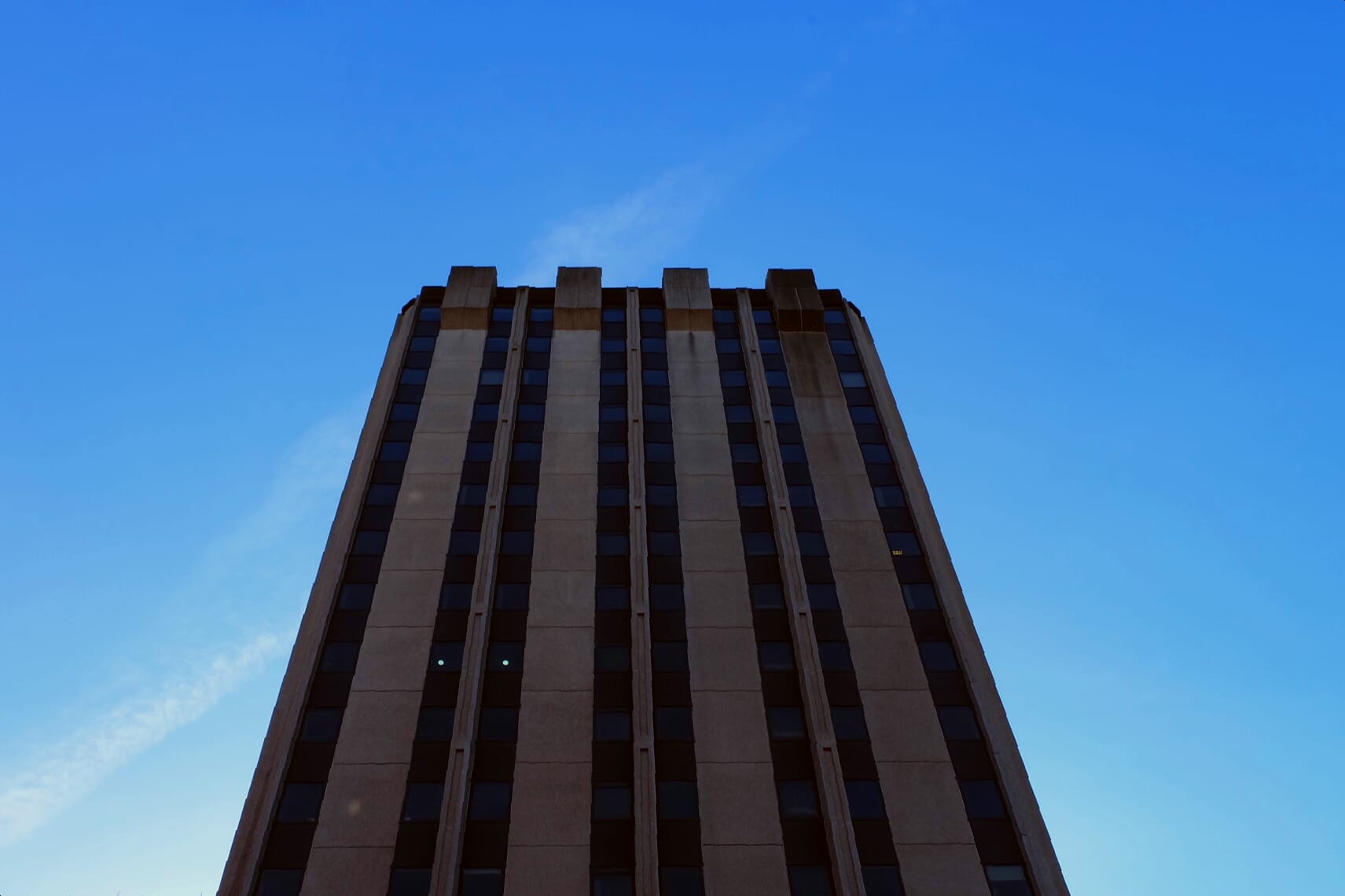
With these anxieties weighing on my mind, I approached Castlemead, the eighteen-storey office building that houses TLScontact, the third-party subcontractor to which the Home Office has outsourced the processing of visa and citizenship applications. As I entered the building, I noticed with surprise that I was wearing the same Palestine badge that the Lidl security guard had noticed displayed on my burgundy dress. Wearing it had become second nature to me, and normally I didn’t give it a second thought. In this new official context, however, I was afraid that the wrong people might notice.
My muscles suddenly went stiff, an effect of stress. Built during the 1970s, Castlemead is a textbook example of British architecture in the brutalist style: jagged edges and a mute grey palette that accumulates darkness as the eye moves along its edges. A fortress of modernist bureaucracy, it stood between me and my British citizenship, its mud-coloured facade dulling the senses.
What if the Home Office reviewed my social media activism and factored my pro-Palestine statements and my criticisms of UK complicity into their decision? I resolved to place my hope in fate, and trust that the UK had not yet fully turned into a police state. In any case, I had no choice.
While I waited, I reflected on what else I could do to secure my citizenship. Compromises had to be made, I told myself. I heeded the fearful voice inside me, and removed my FREE PALESTINE badge, just for the biometric portion of the appointment. I stuffed it neatly into my bag, tucking it into the top pocket so that I could restore it to its rightful place as soon as I exited the building.
I went through the motions that thousands have undergone before me, from Afghan and Sudanese refugees to members of Europe’s elite. The only visa appointment centre in Gaza closed on 8 October 2023, yet the British government still insists that Palestinians must provide their biometric data in order to be accepted at the UK border. Unless Palestinians can make it to Egypt and secure one of the few biometric appointments there, this brutal visa and immigration regime continues to prevent scholars and family members of British Palestinians from escaping genocide in Gaza and reaching their universities or family members in the UK.
I left the office and made my way, via the elevator, to the ground floor. On my way out, the security guard signalled to me to sign out. Like the Lidl guard, he was south Asian. He scrutinised me more carefully than he had done before, as if something about me had changed. Then he asked me:
“What happened to your badge?”
My mind flashed back immediately to the encounter with the guard in Lidl. I realized what he was referencing.
I smiled sheepishly and said, “You know what this country does to people dressed like that. I was afraid of the consequences.”
He knew exactly what I meant. There was no need to elaborate; we were operating under the same pressures. A smile flashed over his face and then he became stern again.
“You must speak up for what you believe in,” he said.
I smiled, happy to be called out in this way. He was not wearing any insignia of Palestine solidarity, and I had not guessed that he had noticed my badge. I usually feel invisible when I roam through the streets of Bristol and wait in corporate offices. When these guards signalled to me that they saw what I was wearing and appreciated it, I felt seen, in the literal sense. When the second guard pointed out the badge’s absence, I was reminded that I had gone too far in concealing the person who I was.
It was easy to understand why these guards did not wear badges of solidarity. Ever since the beginning of the genocide, NHS workers had been fired for wearing badges, bracelets, and pins expressing support for Palestine. Agreeing not to wear such insignia on their uniforms is a condition for many kinds of employment, including theirs.
I had privileges that these guards did not have. It was my responsibility to make good use of my freedom: not to remove the badge out of cowardice, but to proudly stand up for Palestine at all times and in all places, regardless of what the authorities might do to me. What is the point of having the privilege to express yourself politically if that freedom is not used well?
That day was one of the few times in my life when I was delighted to be reproached by a security guard. He had reminded me of what I believed in and what I stood for, and of why I wore that badge in the first place. He was right: I should not have caved in, and I was grateful that he was there to remind me that there is a better way. Even as he was calling me out for cowardice, it marked a rare moment when a complete stranger was there to remind me of the person I wanted to be. His reproach made me feel like I was finally a member of my community, my adopted hometown of Bristol. The city might demand much of me, but its demands were grounded in justice.
In their silence and gestures, those guards enacted a form of everyday dissent that would later find formal expression in the courtroom, where juries refused to do the bidding of the state.
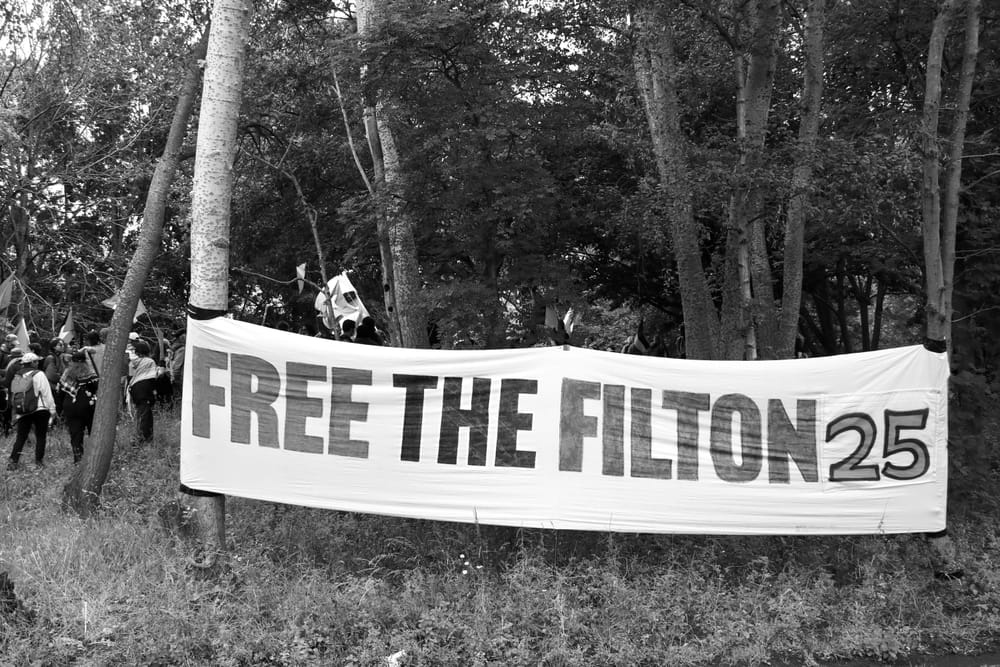
In the months that followed my citizenship application, the state’s attempt to criminalise Palestine Action fractured under legal and civic pressure. On 13 February 2026, the High Court found the proscription to be unlawful. Five days later, a turning point arrived in the case of the Filton 24, a group that broke into the offices of Israel’s largest weapons manufacturer, Elbit Systems, in the Bristol suburb of Filton in August 2024. A jury acquitted the first six defendants in the Filton 24 trial of aggravated burglary, while not issuing a verdict on some other counts. The Crown Prosecution Service has announced that it will be seeking a retrial in February 2027 for the defendants for whom the jury did not reach a verdict.
The atmosphere of fear persists, and the state continues to use all means at its disposal to suppress resistance. The government is appealing the High Court’s decision on proscription and has continued mass arrests of those offering public support for Palestine Action in the interim. In early May, a retrial found four Filton activists guilty of criminal damage. A court will seek to sentence these activists as terrorists despite them not being convicted of terror charges – a possibility that was kept secret from the jury. Meanwhile, political and communal leaders cast public support for Palestine as a threat to Jewish life in Britain, even to the point of recommending emigration to Israel. Under the current proscription regime, even describing Palestine Action’s impact has become legally fraught. This is how censorship works before prosecution begins. All this narrows the space in which Palestine solidarity can be publicly recognised.
Nonetheless, the state’s initial defeat by the courts and juries reveals something essential about the limits of state power: even at the height of repression, law is a contested terrain, a tool for justice as much as a means of control, and ordinary citizens have the power to refuse complicity in genocide.
I am grateful to the guards for the lesson they taught me. So long as British citizens resist their state’s complicity with Israel’s aggression, becoming British will mean more to me than an obligation I have to a nation state. The state’s crackdown on those who dissent from its pro-genocide policies cannot stop this groundswell of solidarity. Nor can its efforts to curtail jury trials, one of the key guarantors of democratic legitimacy.
My encounters on the streets and inside the bureaucratic buildings of Bristol taught me something I had not fully understood before. Membership in national collectives is, inevitably, a process of self-alienation, but citizenship need not be reduced to state power. A country is more than a state, and a people is more than the government that claims power over them.
Local politics, meanwhile, generates a richer sense of community: grounded in everyday life, the solidarity it nurtures is not so susceptible to alienation or control from above. To the extent that becoming a British citizen consolidates my identity as a resident of the city of Bristol, I happily accept this rite of passage. Being Bristolian has more meaning for me than does any citizenship, including the citizenship I have acquired and the citizenship into which I was born.
When I walked out of that gloomy brutalist building on that rainy day in October, I realised that there is more to being British than what establishment politicians and the Home Office guidelines state. There is more to being part of England than the anti-Palestinian fearmongering of politicians who insist on “Israel’s right to exist” as if it were a magic spell. There is more to being Bristolian than the white racist values that underpin the Life in the UK test that every applicant for citizenship (and Leave to Remain) must pass. For the first time in a long while, I felt hopeful: about the city where I live, the land on which it rests, the connections it can forge with the world, and the future of pro-Palestine solidarity.
These fleeting connections with the security guards who noticed my Free Palestine badge and the one who called me out for its absence did not stop the Gaza genocide. But their words – including even their reproaches – gave me the strength and courage to continue with my protests. They reminded me that when I stand up for Palestine, I speak as a resident of Bristol, the same community where many members of the Filton 24 were raised, and where they embarked on their decision to act to stop a genocide, an action for which they have paid a heavy price.
These security guards – their reproaches, their attention, and the seriousness with which they took my mild expression of Palestine solidarity – showed me that I belong to a movement, and to a global majority, who oppose genocide and support Palestinian liberation. In whatever country I reside, my true homeland is any community that creates a space for a free Palestine.▼
Rebecca Ruth Gould’s work spans Palestine, prisons, literature, and political freedom. She is the author of Erasing Palestine: Free Speech and Palestinian Freedom (2023), Writers and Rebels (2016), and, with Malaka Shwaikh, Prison Hunger Strikes in Palestine (2023). Her essays have appeared in the London Review of Books, Middle East Eye, and The Nation. She publishes The Textual Materialist newsletter on Substack and is currently developing We Love Life: A Family’s Story of Surviving the Gaza Genocide, a collection of writing on Gaza with The Lighthouse Collective. She is Distinguished Professor of Comparative Poetics and Global Politics at SOAS, University of London.
Author
Sign up for The Pickle and New, From Vashti.
Stay up to date with Vashti.