We are in the midst of a global fascist resurgence. It hardly needs stating that this is a major concern for Jews. Given how fatal fascism proved for us in the mid-20th century, you’d imagine that British Jewish organisations, especially those nominally dedicated to combatting antisemitism, would be on the frontlines of the fight against it. Yet they remain silent, refuse to name the current enemy as fascism, or focus on issues that are totally irrelevant to it. What the hell is going on?
Farageist fascism
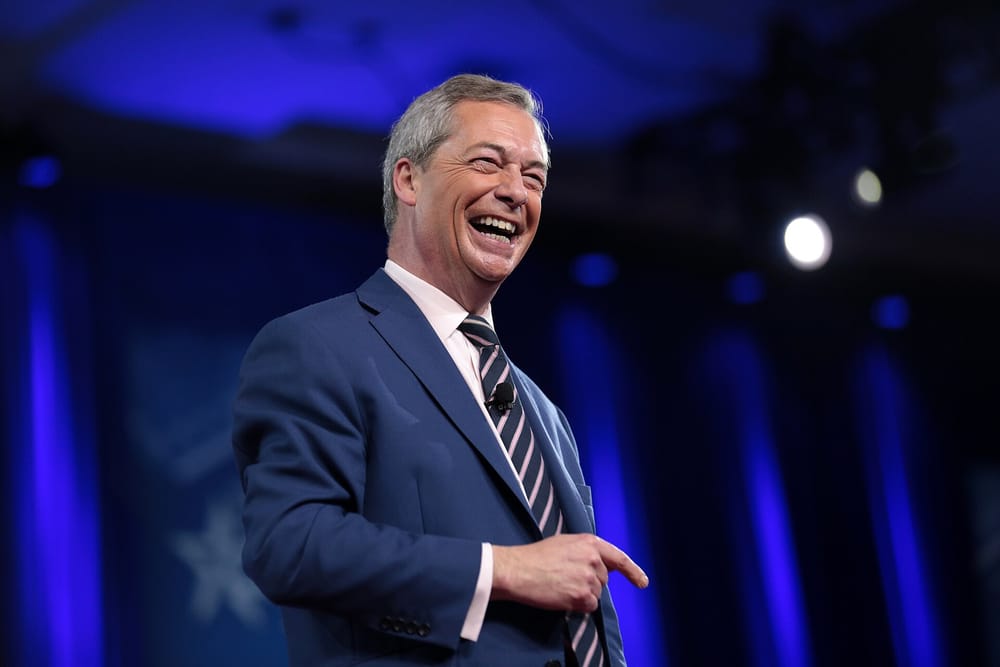
First, the silence. This has been the response to revelations that Nigel Farage was a committed racist and fascist while at secondary school, between the ages of 11 to 18. A large body of testimonies have emerged of Farage racially abusing a range of fellow pupils – including Jewish students, to whom he reportedly made gassing noises or told them that Hitler was right – as well as uttering support for Oswald Mosley and the National Front.
In response to media questions, Farage has declined to offer total denials, claiming instead that he “hadn’t done it in a hurtful way”, and that the BBC had no grounds to criticise him since they showed “racial sitcoms” like Love Thy Neighbour and The Black and White Minstrel Show during his schoolboy days. He also claimed that the accusations were made due to his former classmates “holding different political views” – adding that one view he held then was thinking that “Enoch Powell was right to talk about not having vast community change”. This ostensibly inconsequential comment supports Powell’s 1968 Rivers of Blood speech, which aimed to prevent the passing of the second Race Relations Act, and thus maintain racial discrimination in law.
Unsurprisingly, liberal commentators and politicians have framed the row in terms of bullying, inconsiderateness, and personal prejudice. But it’s much bleaker than that. Farage was campaigning for fascism: he was promoting forced or induced migration back to countries of origin for people who were British citizens, supporting the crimes of the original fascists including the Holocaust, whitewashing the British fascism of Oswald Mosley and his Blackshirts, and backing the UK’s most famous racist parliamentarian, Enoch Powell, who was, at the very least, fascist-adjacent. This is not a matter of juvenile name-calling, but of a fully-fledged young fascist, as one of his teachers observed at the time.
And it certainly continued after school. Farage is said to have made racist jokes while working as a city banker, and in the late 1990s took over the then technocratic and anti-federalist UKIP and turned it into an anti-migration vehicle, causing the resignation of its founder Alan Sked. In 2015 Farage implied he would seek to overturn the UK’s racial discrimination laws, true to Powell, his political model. Migration has remained Farage’s primary campaigning issue with all his political vehicles: UKIP, the Leave campaign, the Brexit Party and now Reform. If Reform’s current politics are not fascist, they are closer to it than any party with parliamentary representation has been in Britain for a very long time.
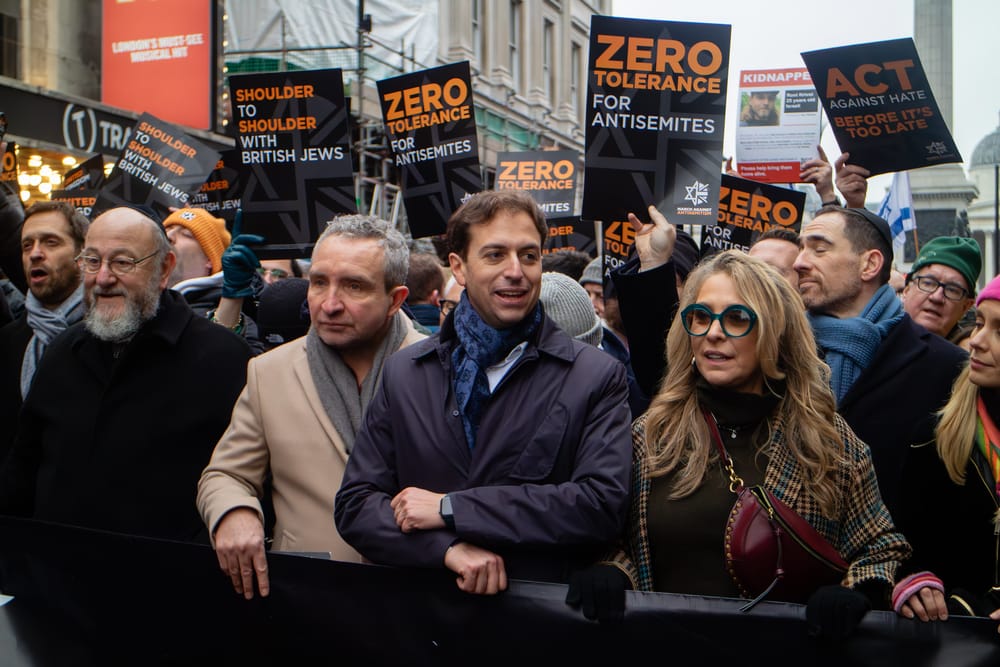
This should have been an easy issue for Jewish organisations to deal with. Bodies like the Board of Deputies, the Jewish Leadership Council and the Community Security Trust are already highly focused on antisemitism and issue statements when they perceive the merest sniff of it; a leading politician having engaged in pro-Nazi, pro-Holocaust behaviour in their youth ought to have been a slam-dunk affair.
It is difficult to say what they would have done had such revelations emerged about Jeremy Corbyn, since they already branded him an existential threat to British Jews based on no evidence – but it’s safe to say that they would have been screaming from the top of their lungs on every conceivable platform. Yet when it has come to Nigel Farage, these organisations have said absolutely nothing. Nada. Shum davar. Gornisht.
The self-styled communal leadership, and the bodies dedicated to combatting antisemitism have declined to comment on a key instance of antisemitism, even after Reform deputy leader Richard Tice called Farage’s Jewish school victims liars on national radio. A recent testimony movingly recalled how a Jewish student quoted Shylock’s “If you prick us” monologue to defend himself against Farage’s antisemitic verbal barrage. If such a moment doesn’t spur Jewish organisations to speak out, then surely nothing will.
In truth though, they have been willing to give Farage’s fascism a free pass because they share his Islamophobia, and thus only see antisemitism as a foreign-import brought over by Muslim immigrants, rather than something that emerged from the British fascist tradition indigenous to the United Kingdom.
Farage’s schooldays were the last period when antisemitism was widespread in elite British school and social circles, and the last era where the far right consistently targeted Jews. Jewish leaders are so relieved that the primary target has moved on to Muslims and Palestinians that they are willing to pretend that era never existed, even when it threatens to trespass into the present.
Salafist fascism
Next comes the choice to focus on irrelevant issues rather than take on the fascist threat, even when it poses a physical danger to Jews. Recent months have seen two lethal attacks on religious Jewish targets – Heaton Park Synagogue and Bondi Beach – and the successful prosecution of two men for planned gun attacks on the Manchester Jewish community. All the attackers were either affiliated to or inspired by Islamic State (IS).
This is a significant point – to describe them merely as antisemitic attacks is analytically almost useless since antisemitic movements have taken extremely diverse forms across history. IS is a very specific organisation or network, with a very specific Salafist ideology. In its 2014-2019 heyday it controlled large swathes of territory, which it governed in authoritarian terms, seeking to restore what it viewed as the original Islamic societies of the seventh century.
Despite this professed nostalgia for late antiquity, IS is a deeply modern movement, relying on modern forms of guerilla warfare, modern communications, and a twentieth-century ideological framework. As some scholars have argued, it can credibly be viewed through the prism of fascism. Key features that link it to fascism include authoritarian rule which cracks down on social freedoms; territorial expansionism; an attempt to restore a mythical glorious past, including reconquering territories that it believes were unjustly stolen (when the Ottoman empire and its associate Caliphate were dissolved); violent attacks on ethnic and religious enemies; attempts to control dissident members of the national/religious in-group; and reliance on a single or group of powerful and charismatic leaders in the place of parliamentary democracy.
There are important differences between IS and the fascist movements of the 1920s and 1930s – an obvious one being that the latter tended towards paganistic atheism while the former is known for its fervent espousal of Islam. But even here the differences are less than they first appear; Italian and German fascists drew on religious themes when it suited them as part of their romantic nationalist discourses, while IS shuns mainstream approaches to Islam, favouring its own idiosyncratic and fundamentally modern interpretation.
Many commentators on all sides have jumped to the assumption that the recent attacks in the UK and Australia were motivated by Gaza. But the IS link should lead us to question this notion. IS and IS-inspired militants launched a wave of terrorist attacks in the 2010s outside the group’s strongholds of Syria and Iraq, long before October 7 and the current war on Gaza. From the Jewish Museum of Belgium shooting in May 2014 to the Manchester Arena bombing of May 2017, to the 2023 bombings of a Catholic Mass at a university in the Philippines, thousands have been killed in such attacks, which targeted Jews, but also Kurds, Shia Muslims, Christians, westerners, and anyone else IS saw as an enemy group.
This – rather than the Gaza war – is the most relevant frame in which to understand the recent attacks on Jews in Manchester and Australia. I have no doubt that the attackers were aware of, and to some extent motivated by Gaza, and by Palestine more generally. However, IS instrumentalises Palestine to recruit and radicalise Muslims and bring them into its fold.
A report by the Palestinian thinktank Al-Shabaka in 2016 showed that IS messaging on Palestine talked a great deal about Al-Quds (Jerusalem) and Al-Aqsa, but said very little about statehood, refugee return, human rights or the siege of Gaza. In common with some western antisemites, IS opposes Zionism not because it is a form of settler-colonialism which has disenfranchised Palestinians, but because it is Jewish and in control of an area the movement understands as “Islamic land”.
It is for this reason that attempts to bracket Hamas and IS together under the umbrella of “Islamism” are so deeply flawed. The two are sworn enemies who have fought each other militarily. Hamas is a nationalist Palestinian movement with a religious bent; the only territory it seeks to rule is in historic Palestine. IS is a revolutionary movement which seeks to rule over the entire Middle East, if not further afield. To conflate the two is like claiming there was no fundamental difference between the Nazis and the British empire, since both were ostensibly Christian European powers.
Having spent so many years branding groups like Hamas “Islamofascist”, and proclaiming that #HamasisISIS, Jewish and Zionist bodies are unable to appreciate the existence of actual fascist terrorists who attack Jews anywhere in the world, while claiming to act under the banner of Islam. The 2025 report The Present Day, written by the Israeli Forum for Regional Thinking distinguished between global jihadist organisations like IS who are “not committed to civilians” and whose ideological goals are unlimited, utopian, or nihilistic – and “national Islam”, in which it included Hamas, characterised by “conservatism, rooted in territorial sovereignty, popular support, and adaptability”. A widespread tendency to elide such differences, and present them as part of an undifferentiated “radical Islam” has not only facilitated genocide in Gaza (since it has formed the underpinning for treating all Gazans as legitimate targets), but blinded Jewish organisations to the specific threat posed by IS.
Jewish bodies have failed to raise the alarm about this fascist movement which combines conspiratorial antisemitism (including believing that Shia Islam was invented by Jews to sow discord amongst Muslims) with lethal attacks on Jews. Instead, they have sought to tie them to the broader Palestine solidarity movement and utilise the attacks to campaign against slogans like “globalise the intifada” and “from the river to the sea, Palestine will be free”, despite the total lack of evidence that the perpetrators ever attended Palestine marches or uttered these slogans. Jewish organisations are chasing irrelevancies; desperate to connect these atrocities to the Palestine movement they are ignoring the fascist threat under their noses. Since they only care about Israel advocacy, they have little to say about fascist antisemitism that isn’t centred on Palestine/Israel, even when it is proving a substantial threat to Jewish life around the world.
Trumpian fascism
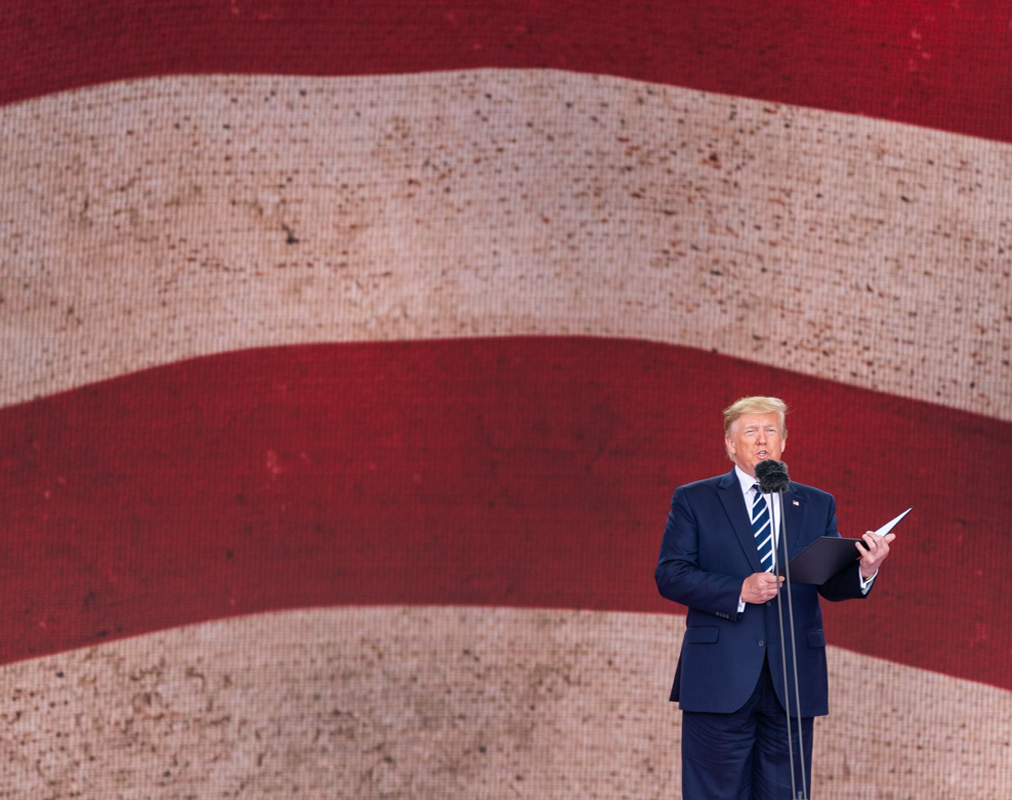
Finally, we have the refusal to name fascism, even when it is staring us in the face. The first Trump term, with its alt-right conspiracy theories and flamboyant promises, seems in retrospect to have been a mere trial run for what is now a fascist takeover of the United States. We have an egomaniacal leader who tried to overturn the 2020 election and now believes he can hold onto power indefinitely; a crackdown on universities as sites of progressive resistance; the turning of ICE into a modern-day SS that persecutes, kidnaps and assaults people across the nation; the kidnapping of foreign presidents; and the repeated threats of invading neighbouring countries, such as Greenland and Canada. The ICE shooting of Renee Good on the streets of Minneapolis, less than a mile from where George Floyd was murdered, represents a shocking new nadir.
Elon Musk has emerged as a key facilitator of the new fascist movement and is increasingly becoming a contemporary Henry Ford – a billionaire plutocrat who uses his wealth to publish fascist media, including repeated antisemitism. It has recently emerged that Musk’s Grok AI service has generated sexual abuse images of children, and of a descendant of a Holocaust survivor, who it depicted in a bikini standing outside Auschwitz. If incidents like this do not inspire US Jewish leaders to act, it is hard to imagine what will.
While I appreciate that British-Jewish leaders cannot be expected to defeat US fascism, there are several things they could do. First, they could urge Keir Starmer to stop cosying up to Trump and to criticise his policies, particularly in relation to ICE and to Venezuela. We know that Starmer prides himself on being responsive to Jewish concerns; if he thought that British Jews sought a more forceful response to Trump it could have an impact on him.
Second, they could distance themselves from the way the Trump administration has instrumentalised antisemitism to further its goals, such as gaining control of universities and justifying the kidnapping and internment of non-citizens such as Mahmoud Khalil. British Jewish bodies would find such a move difficult, since it would represent a complete volte-face from the position they have taken in the UK, where they have been cheerleaders for precisely this kind of instrumentalisation.
Third, and by far the easiest, would be for these organisations to leave X, and to state publicly that they are doing so because of the fascism and racism the platform now promotes. It beggars belief that the Board of Deputies, Jewish Leadership Council, Community Security Trust and Holocaust Education Trust still post regularly on X and do not seem to realise the moral hazard that such ongoing engagement represents.
Last, they could loudly reject the bizarre calls, made by Trump’s Manchester-born lawyer Robert Garson, that British Jews should be given asylum in the United States due to the supposed wave of antisemitism engulfing the UK. This invitation needs to be forcefully rebuffed: we will find no sanctuary in a fascist state.
Separating antisemitism from fascism
What unites the failure of such bodies to condemn these various forms of contemporary fascism is that in each case their sole priority is Israel advocacy; they only campaign for causes that will further that goal. If an antisemitic incident appears to be motivated by Palestine/Israel, or by anti-colonial violence, it will be emphasised in all its specific, gory details. If, however, an antisemitic incident is motivated by fascist ideology (whether of a white supremacist or an Islamist flavour), it will be generalised and its distinctive features played down. Jewish bodies appear to believe that antisemitism can be bracketed off from fascism, rather than confront the fact that the two are utterly entangled. As a result, the world of anti-antisemitism has little to nothing to say about fascism; how we might combat it; how it targets Jews alongside Muslims, immigrants, trans people and more; how it often has little to do with Palestine/Israel and much more with the politics of the 1930s and 40s.
In order to genuinely take on fascism we would need to act very differently. We would deny it all legitimacy and challenge its assumptions at every turn. We would support immigration, without arbitrary limits, such as the current UK Labour government is imposing, and call for immigrants to have equal rights to native-born citizens everywhere. We would unequivocally support trans rights, since, as Judith Butler pointed out in 2021, the “gender-critical” movement has proved to be a harbinger of fascism. We would forcefully oppose genocide everywhere, since, as Hannah Arendt argued, we do not have the right to decide with whom we share the earth. And we would forcefully oppose the nexus of far-right governments who are set on trampling on rights everywhere: Trump’s USA, Netanyahu’s Israel, Modi’s India, Meloni’s Italy, Orban’s Hungary, MBS’s Saudi Arabia, and more. There is no room for compromise with such fascists. In the 2000s we heard many warnings of appeasement in relation to Saddam Hussein and Osama bin Laden; they ring truer in relation to the way centre-left and centre-right governments genuflect to the current fascist wave. And we would resist the widespread elision between national Islam and global jihadist groups; we cannot defeat the latter without separating them from the former.
Jewishly, our task is both simpler and more complex. We need to acknowledge the way Jewish safety is being leveraged by western fascists to justify and support their projects. They constantly present Jews as under threat in order to crack down on protests, limit free speech, arrest and deport immigrants, and sell arms to and support oppressive regimes – when it is in fact these regimes that pose a threat to us. Our task is to refuse this embrace, and remind the world that before the current obsession with the Palestine movement it was primarily fascism that threatened Jews; that presented us as a threat to the well-being of the nation, that sought to discriminate against us, expel us and eventually murder us.
Just because some fascists are currently posing as our defenders it does not mean they have become our friends. And just because many Zionists are determined to depict Palestinian nationalists as supposed “Islamofascists”, it doesn’t mean we should accept their distorted analysis and ignore the real Salafist threat that has nothing to do with Palestine/Israel. The world knows that we were once among the primary victims of fascism, so people look to us for leadership as to what to do when it seems to have reappeared. If we sugarcoat it, and say that there is nothing to worry about, and that the real threat is from anti-colonial and anti-racist movements, then fascism continues to get a free pass and nothing changes. If however, we name fascism, in both its white-supremacist and Salafist forms as the primary threat to our wellbeing, we might be able to join others in building a coalition to defeat it.▼
Author

Joseph is an historian, writer and musician. He writes the newsletter Torat Albion on British Jewish issues.
Sign up for The Pickle and New, From Vashti.
Stay up to date with Vashti.