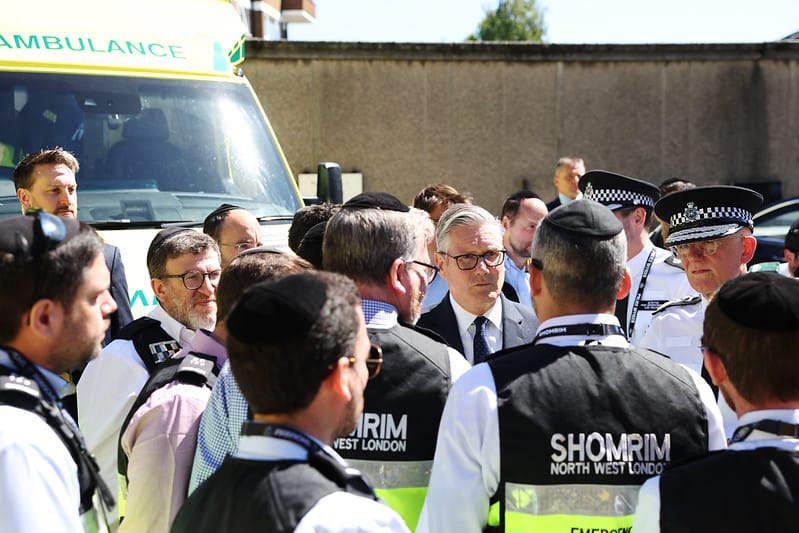
Last Thursday, 45-year-old Essa Suleiman stabbed three men, a Muslim Somali man in Southwark, south London, and two Jewish men in the north London neighborhood of Golders Green. Suleiman, who has a history of serious mental health issues, has been charged with three counts of attempted murder and is remanded in custody. The stabbings in Golders Green marked the fifth attack on either Jewish people, communal infrastructure, or synagogues since mid-March in north-west London, which includes arson attacks in Hendon at the former Jewish Futures building, on Hatzola ambulances in Golders Green, at Kenton United Synagogue, and at Finchley Reform Synagogue.
In the aftermath of Thursday’s stabbings, Jewish communal institutions, the establishment media, and government figures including prime minister Keir Starmer have rapidly escalated their demonisation of the Palestine movement, vilified ascendant Jewish Green party leader Zack Polanski, and called for sweeping restrictions on civil liberties – all in the name of fighting antisemitism.
On Monday evening, contributing writer and postdoctoral fellow at the Birkbeck Institute for Antisemitism Joseph Finlay joined Vashti executive editor Evan Robins and managing editor Asha Sumroy for a wide-ranging conversation on the past month’s attacks, the rightwing narratives accelerating ongoing repression, and the efforts to discredit the Greens ahead of tonight’s consequential elections. This discussion has been edited for length and clarity.
Evan Robins: How do you make sense of, and contextualise, the attacks of the past month?
Joseph Finlay: It’s been a grim week, and a grim few weeks. I want to recognise that. We’re part of this community too, and we do feel it. I want to start with three things. One is an urge for people to wait and see what comes from investigations and court cases. It’s really important to find out exactly what happened in each individual case, and not jump in with preexisting pet projects, ideologies, solutions, whatever it is. We need to be really precise and not just talk about these attacks in generalised, overarching ways, as if antisemitism were a hovering cloud that acts with its own agency.
My second, related point is that we shouldn’t merge all of these different events into one. [In the last few weeks] we have had attacks on property, arson attacks, and now we have stabbing attacks. Then, there are a whole bunch of other things [that are also invoked], like people shouting abuse at Jewish people, people shouting “Free Palestine” at Jewish people, people writing things on social media that we might say is not very nuanced, but is actually fine, people going on marches, which is fine, saying slogans that are mostly fine. The analysis that blurs these together is really, really unhelpful.
The third point I want to emphasise is that we’re not alone. It’s a choice to only connect up attacks on Jews and create a narrative of antisemitic attacks. But there are tons of attacks on Muslims, including arson attacks, car ramming attacks, and violent attacks. There are plenty of attacks on trans people, plenty of attacks on immigrants, plenty of attacks on women. If we choose to see it, the existence of a multi-extremism, multi-violence, can be our narrative, right? I think that will help us feel left less alone and I think it also avoids us reaching for authoritarian solutions, and also nationalist solutions, which say the only way we can be safe is to have our own space, our own territory, our own army, etc.
Asha Sumroy: I’m with you on all of those things, Joseph. From Jewish people that I’ve encountered recently, including some peers in age and politics, there seems to be a sense that something new is happening [with antisemitism]. And as a result, their fear, and their uncertainty around that fear, is increasing. I’m seeing people grappling with whether they think it’s right or not to feel it. I’m trying to make sense of that, too. To me, if there is a “newness” to antisemitism right now it’s in the culmination of years and years, but particularly in the last few years, of a very purposeful and focused conflation of Zionism with Judaism in the context of Israel’s livestreamed genocide in Gaza. It’s in the way this conflation is put to use by the right, the British and the Israeli governments, the mainstream Jewish institutions, and the Israel lobby to increase support for Israel.
ER: I agree that two and a half years of Israel’s genocide paired with the unrelenting conflation of Judaism and Zionism is the primary material and historical change that has increased the risk to Jews around the world.
But in practice, I think the source of this pervasive sense of newness, at least as it exists in the mainstream Jewish community and as spread by the media and political classes, comes from the consolidation of a very insidious, false explanation for these attacks, which is a narrative of rising pro-Palestine, anti-Jewish domestic extremism that builds chronologically from 7 October and leads to this exact moment. Phil Rosenberg, who is the president of the Board of Deputies, went on BBC Politics and laid out this view very concisely: “It’s clear how we got here. Horrible, horrible language being used on demonstrations and online without consequence. These paint attacks [referring to Palestine Action], then arson, then stabbing attacks.”
There’s also another source of narrative newness, operating parallel to this account, which is the panic around an alleged Iran proxy group, called Harakat al-Shab al-Yamin al-Islamiyah (HAYI). The group first emerged online in mid-March and has claimed responsibility for several of these attacks and others on Jewish sites across western Europe over the past two months.
The problem is that there’s no conclusive evidence, at this point, that such a group is actually involved in these attacks, that it is linked to Iran, or even a clear sense of what this group is and how it really operates, though analysts increasingly believe that it operates by using intermediaries to recruit young people to carry out low-level attacks. In some cases, however, this really does seem implausible. For example, the group claimed responsibility for the stabbing attack in Golders Green, but this appears completely disconnected from the facts of the situation.
There are of course ongoing investigations into HAYI that may resolve all of these questions in time, but I have seen no evidential basis, so far, on which to unequivocally assert anything like, “We have a very specific problem here. An IRGC cut out is recruiting disaffected Islamist-radicalised men, many long known to the police and negligently left ambling about, to conduct a targeted intifada against the London Jewish community”, as one prominent British Jewish commentator recently did on X. I’m not sure what this premature certainty gets him here, other than an excuse to create a sense of unprecedented danger, use Islamophobic language, and implicitly tar the Palestine movement.
JF: I find the kind of explanation that starts with 7 October to be really dangerous because it allows you to throw out the window all your prior understandings [of dealing with antisemitism], and say, “Well, we’re in a new category, so we have to think anew.” And it kind of sounds to me like what the Nazi lawyer Carl Schmitt talked about with the state of exception: all our restrictions are off the table now. And as a historian, I really don’t buy it. I’ve previously talked about the series of fascist attacks on Jews in the 1960s, including swastika daubings and arson attacks. There have also been synagogue attacks before, which were actually covered up by the community. Interestingly, the position of the organised Jewish community in the ’70s and ’80s was to play down that stuff and say it’s nothing, and that’s a very different discourse. So I really kind of don’t think we should accept the “everything is new” line. I really think we should try and draw connections to the past and see what we can learn from it.
I also believe a key part of our role right now is to draw attention to the outrageous weaponisation of our trauma by politicians as part of their own political projects. For [prime minister] Keir Starmer, that’s to support his political survival, and probably similarly for [Conservative leader] Kemi Badenoch. For [Reform UK leader] Nigel Farage, it’s to gloss over his schoolboy antisemitism and fascism. And I think we really need to remind people all the time that you cannot trust these people. They are not on our side.
ER: Relatedly, Asha, I want to put this quote to you from Sarah Sackman, who’s the Labour MP for Golders Green. Earlier this week she spoke to The Times and complained that there’s been a notable lack of vocal solidarity with the Jewish community from what she calls “the moderate majority”. She also said that “you would expect anti-racist organisations, trade unions, and cultural leaders to speak out”.
First of all, there’s a question of whether this is a fair accounting of the situation. I think plenty of people have spoken out in horror at what happened. But leaving that aside, Sackman’s statement raises the question of how the left, including Jewish leftists, can actually express solidarity with the Jewish community without, to take the words of Gabriel Winant, amplifying the propaganda machine that is calling for an unprecedented restriction of civil liberties in this country? And what do we do if the mainstream Jewish community won’t recognise anything short of giving license to anti-democratic crackdowns as an expression of solidarity?
AS: There are groups that have shown really tactful and careful solidarity. Solidarity that is felt but is also useful. I think the trap we can fall into is looking for recognition after painful events from big institutions that are acting among the “big P” politics of it all and are responding in relation to the dominant discourse, as if to not be called out.
But on the level of grassroots organising, intersectional solidarity is clear to feel and express. The Dyke Project’s statement was a perfect example. It easily embodied what solidarity actually looks like. It wasn’t tokenistic acknowledgement of horrific events in case of being called out for not doing so, but a purposeful statement that effectively acknowledged that weaponising these attacks, the fear that they produce, and even weaponising Jewish identity itself in their wake, is violence against all of us. It also concisely elaborated on how the conflation of Jews and Israel feeds antisemitism, and it was purposeful in talking about how communities are being pitted against each other – instead insisting on a united and intersectional solidarity against our shared enemies (fascism and the state). And it does all of this in a way that doesn’t avoid the pain of the attacks, but fuels determination, solidarity and strength in anyone who is feeling despondent and scared in the face of them, and without playing into Jewish exceptionalism.
Then there’s the question of what we do as the isolated Jewish left to engage more with the wider Jewish community who may not recognise, as you say, anything short of giving license to fundamentally anti-democratic moves as a response. Part of this will always be interpersonal. For me I’m thinking about what can be done on a family level, for those of us lucky enough to still have avenues for dialogue with Jewish family who do not have the opinions we do, and how to engage with the wider liberal Jewish community. Is pouring energy into and risking interpersonal severance from these spaces going to lead to a disruption of popular Jewish support for draconian crackdowns? I don’t know. Probably not. But to not try to speak to them, and to not re-elaborate our own anti-racist solidarity by insisting that real solidarity will only be found from and through other minoritised groups, is to isolate ourselves from ourselves and from the anti-racist whole.
JF: When I see all these comments that the anti-racist left should speak out, my question is always, well, who do you mean? I want names of organisations. Because normally they have spoken out. And this vague, generalised comment conceals that fact.
ER: Let’s take a look at responses that are not expressions of true solidarity, which is what we’ve seen from a number of figures in and around the government in the wake of the stabbings. We can come to Keir Starmer in a moment, but let’s start with Mark Rowley and Jonathan Hall.
Last weekend, Rowley, the Met police commissioner, submitted a proposal to home secretary Shabana Mahmood for a special police force to protect Jews, consisting of about 300 extra neighborhood and armed officers. He’s also considering whether to ban the Nakba Day march, which he has essentially equated with Tommy Robinson’s “Unite the Kingdom” anti-immigration fascist march. Rowley subsequently went on Good Morning Britain to spread the narrative of the menacing marches by falsely claiming that “many…set out with an intent to march near synagogues”. Ryvka Barnard from the Palestine Solidarity Committee replied that “None of our marches or proposed march routes has ever targeted a synagogue or even directly passed one along its route, and the Met Police knows that.”
Rowley also publicly rebuked Zack Polanski with an open letter, deemed by many to be a blatantly political intervention less than a week prior to the 7 May elections, after the Jewish Green Party leader shared a post on X criticising police officers for kicking the suspect, Essa Suleiman, in the head during his arrest in Golders Green.
Finally, Jonathan Hall, the UK’s independent reviewer of terrorism legislation, went on Times Radio and said “we may have reached a point where we need to have a moratorium on the sorts of marches that have been happening” and added, incredibly, that “it’s clearly impossible at the moment for any of these pro-Palestine marches not to incubate within them some sort of antisemitic or demonising language”.
I’ll hand it over to both of you to comment on these proposals and statements, but I’d just like to state unequivocally that the Palestine marches are not antisemitic and are in no way responsible for the recent attacks.
Ok – go ahead.
JF: The whole thing is horrendous. This is utter, utter nonsense. There’s no evidence that would connect any attacks, including Manchester, to the Palestine movement. There never has been. It’s pure opportunism, an attempt to do something that the state wants to do anyway for its own reasons, and to pin that on Jews. I think it’s a culmination of a sort of wave of state philosemitism that’s emerged in the last 15-odd years, but it’s been growing and obviously has grown substantially since 7 October. Obviously, this is terrible for the Palestine movement in general. But I think it’s also incredibly dangerous for Jews because everybody will hate us. Really. If they were to actually ban marches on the basis that we need special protection that other groups don’t get, that attacks on us need to be discussed for days on end when attacks on Muslims get local news at best.
I mean, that Keir Starmer address from Downing Street gave me shudders, especially the idea that the citizens of this country have been told to feel Jewish pain. What the hell? This is not going to help anyone. But it’s important to note that this response is not a Jewish-led project. It’s a Christian, western state-led project. I think it’s terrifying, completely wrong-headed, and it is shameful that large parts of Jewish communal leadership have gone along with this and egged it on. There are important precedents in the Corbyn era, and I think it continues from that.
AS: I’m just thinking as you’re speaking that, in addition to everyone eventually hating us because the continuous crackdown on civil liberties is also somehow our fault, we’re also seeing the real-time breakdown of the notion of a fair trial and trial by jury when it comes to Palestine Action, again, in the context of protecting and supporting Israel, and thereby scapegoating Jews. I’m thinking specifically of the Filton trials and re-trials, in which defendants and family members have argued that the trials have been unfair and politically influenced, from widely reported reasons, such as the withholding of CCTV footage and the failure to call Elbit witnesses, to reasons that have not been able to be reported (domestically) until the retrial’s impending conclusion. [After our conversation, and after four guilty verdicts and two acquittals were served, it emerged that one of the defendant’s barristers, the leading human rights barrister Rajiv Menon KC, is facing contempt of court proceedings after the judge in the original Filton trial forbade the counsels to remind the jury of their right to acquit based on conscience regardless].This culminated in five out of the six defendants making their own closing statements because they felt their lawyers were not able to represent them in the retrial due to court limitations.
I sometimes feel like the state project Joseph is describing, which is now, and has been, using Jewish special protection as justification for the complete erosion of civil liberties, has achieved its aims and is coming to a terrible, final conclusion with these trials.
JF: It’s quite pessimistic to feel like that. There is always change and hope. The Starmer leadership is certainly on its last legs and, and in a sense this moment is Starmer’s last hurrah to try and save himself by hugging the Jews and pushing his authoritarian agenda. At some point somebody in Labour is going to realise that their policy on Palestine and authoritarianism connected to it is not doing them any favours. If they wanted to renew themselves in power or, or out of power, that’s going to have to change. We’re seeing that in the US with the Democrats, where it’s clear that pretty soon there’ll be a Democratic leader who is pretty anti-Israel. We’re going to see that too, and I think probably sooner than we think. In this moment, it feels total, but there are plenty of cracks. The Greens’ success will only hasten that.
AS: I agree with you. I definitely feel pessimistic, and I’m more hopeful as a result of your optimism. But it is misleading to think that if we want something different, we have to wait until someone in the Labour government wants to save face. Do you know what I mean? I agree that there are cracks everywhere, but there are fewer and fewer ways that we as people can exploit those cracks and not end up incarcerated. So maybe there is hope, but if the hope is only in waiting for a different politician to come to power, that’s devastating to our agency.
ER: I have to say I’m also experiencing a similar pessimism. The US context is instructive in some ways. I agree that a more anti-Israel future is on the horizon for the Democratic party, but the development toward that future is very uneven. Mamdani himself represents the limits of Palestine solidarity within party politics. His campaign was further left on Palestine and Zionism than when he has been in power. This is for quite legible reasons around executing his affordability agenda, which is ultimately his priority, but at times it’s been disappointing to many on the left in the city. At the same time, we’re seeing Democratic National Committee chair Ken Martin actively withhold the 2024 election post-mortem for the entirely obvious reason that it found the party’s immoral stance on Gaza significantly contributed to its loss.
As the party slowly staggers toward a less extremist line, Palestinians are slaughtered and the genocide is advancing. There’s also reason to talk about the West Bank as a genocide. It’s hard to have hope when even the Democrats are ahead of Labour in a number of ways.
Let’s wrap up by talking about the Greens. Polanski has been put through the ringer over the past week, with attacks from every major party leader and extraordinary TV interviews that brushed aside his Jewishness and essentially accused him of ushering in antisemitism. How do you both feel he’s navigating this?
JF: I think he’s doing a great job. I’m really proud of him. I think it’s a very, very difficult position for him to be in, but I think we need people on the Jewish left, like him, to step forward and try to offer a way through this clusterfuck of antisemitism, Zionism, and genocide.
He’s getting a hell of a lot of antisemitism, which is not surprising if you see modern antisemitism as counter-emancipatory, seeking to push down Jews if they’ve achieved some degree of equality. So we should expect to see it where Jews get positions of leadership. Zack is only the fifth political leader in Britain to be Jewish and the third in modern times after Michael Howard and Ed Miliband, both of whom experienced antisemitism. It was often laughed off in the mainstream, but they absolutely did.
One of the hangovers from the Labour antisemitism scandal was a really stupid, nefarious discourse that says that non-Jews can experience antisemitism just as much as Jews, and equally, that Jews can perpetrate antisemitism just as much as non-Jews. And that combination creates the kind of mad situation in which Keir Starmer attacks Zack Polanski as if Keir Starmer is the recipient of antisemitism. Starmer clearly feels he can occupy the position of the Jew, perhaps because his wife is Jewish and they’re bringing up their children Jewish. That’s absolutely great and I have no problem with it, but he completely denies Polanski’s Jewishness. Zack has every right to say the things he does and he is right to raise complaints about his treatment.
ER: Sometimes I wonder if there’s a better version of his messaging that’s more disciplined, that sticks to the particular lines that he believes in and that he won’t cede ground on, and perhaps isn’t so involved in the discourse all of the time.
But equally, it’s clear that part of his considerable appeal comes from the fact that he’s out there fighting, figuring this out in real time, taking the battle to the people in power and provoking them, and ultimately not just managing a retreat. What do you make of his frenetic style? Is it ever a point of frustration for you?
JF: He’s got a really hard job. I think he’s making it up as he goes along, as I think Corbyn was, but Polanski’s a quicker thinker and more flexible.
I haven’t seen a Jewish politician taking a radical left position and connecting it to their Jewishness before. Neither Howard nor Miliband talked about their Jewishness anywhere near as much. It’s exciting to see it trialled, but it is a trial, and there are going to be mistakes, and we’re going to have to be kind. I hope he’s got some Jewish left comrades that can help him chat these things through and encourage experimentation. It’s a brave new world out there in radical left Jewish political leadership, and I’m excited to see where it goes.
AS: Yeah, I feel excited too. The most Jewish thing would be to offer to be his chevruta. Let’s make it happen, Zack.▼
To donate once or monthly, click here.
Author

This article was produced by the editorial collective at Vashti.
Sign up for The Pickle and New, From Vashti.
Stay up to date with Vashti.