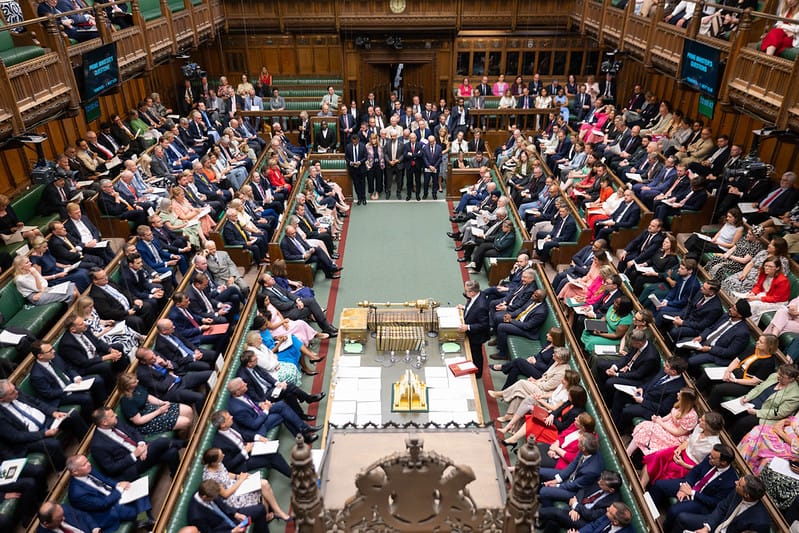
Spineless Starmer
In the midst of global crisis, the UK’s biggest concern remains arresting its own pensioners.
This June, join our friends at Equator Magazine and writer Molly Crabapple, author of the new book, Here Where We Live Is Our Country, for a four-week online seminar on the history of the Jewish Bund. For more information and to register, visit the Equator website.
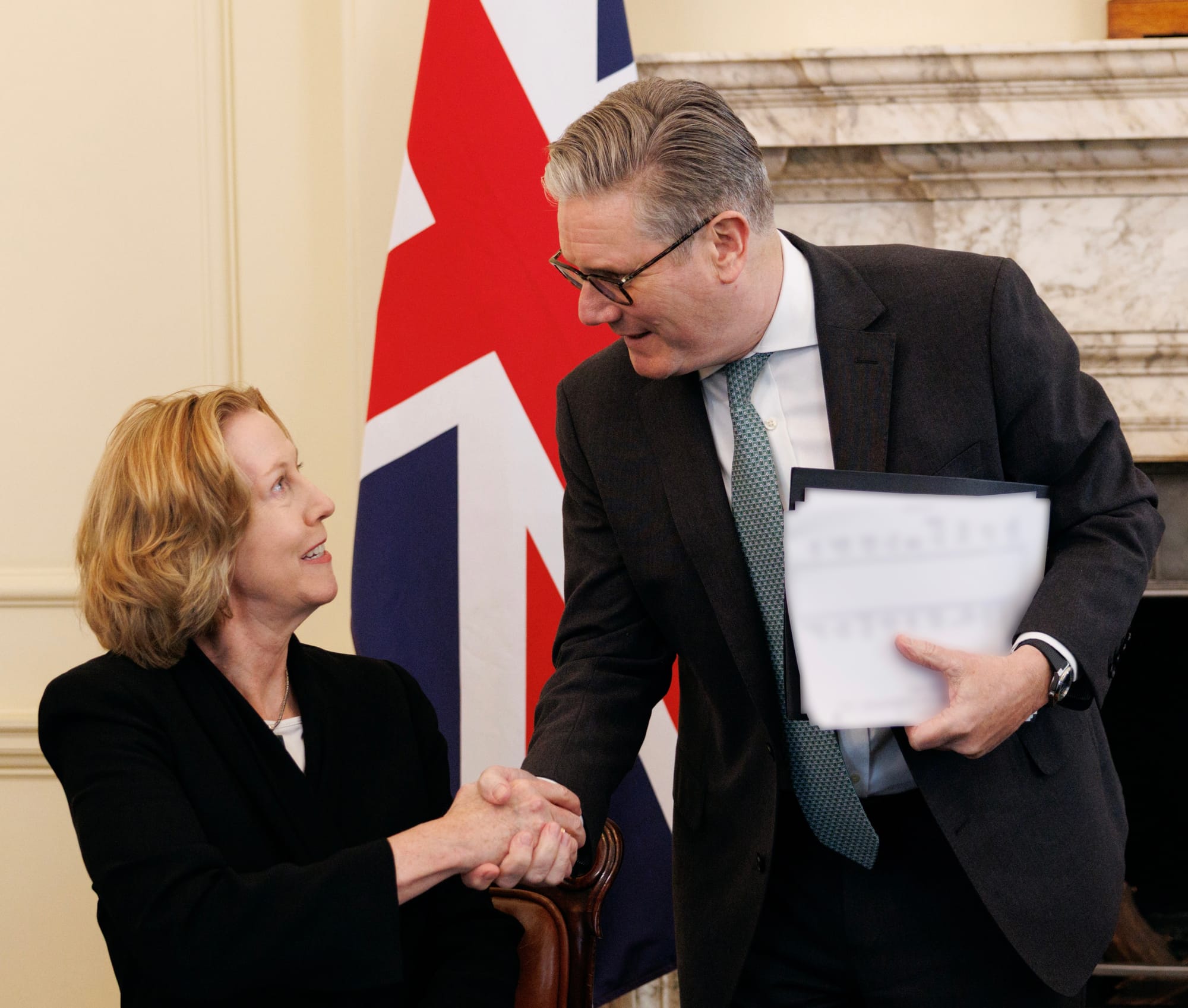
Keir Starmer ended 2025 with the unenviable new title of “The Most Unpopular British Prime Minister in Polling History.” He must be proud of this historic distinction, considering he’s been unable to seize the rare chance of making himself truly popular by standing up to Donald Trump.
In maintaining the UK’s unflinching loyalty to Israel – and ramping up domestic persecution of anyone who attempts to interfere with it – Starmer renders meaningless any perceived confrontation with Trump over his illegal war on Iran.
And that’s if one chooses to believe there was any real confrontation in the first place.
Although the Labour government maintains that the US military can only use British bases for “defensive purposes”, photos from US bases on British soil tell a different story. Before 8 April’s ceasefire agreement took effect, as many as four American bombers were taking off from RAF Fairford every day. Meanwhile, the UK is sending surveillance drones to Lebanon, to fly over cities and towns mere hours before Israel massacres them. So much for “staying” out of it.
Even now, as Starmer says he’s “fed up” with Trump and claims the UK will not join any US blockade of the Strait of Hormuz, he mounts no real challenge to Trump’s war effort, nor his broader path of destruction throughout the Middle East. Crucially, any such rebuke of Trump’s policy in the region would include cutting ties with America’s genocidal satellite state, a choice that would require Starmer to grow a spine as well as a soul.
Instead of taking any action against Israel after its military killed more than 300 people in Beirut in the span of ten minutes last Wednesday, the UK focused its ire once again on those who dare to oppose its continued support of Israel’s war crimes: Palestine Action.
Over the weekend, the Met arrested over 500 people in London for showing support for a proscribed organisation. This comes after the police indicated in February that they would stop making arrests for supporting Palestine Action, in light of the High Court’s judgement that the group’s ban was unlawful. The Met revised this guidance in late March, stating that anyone showing support for the group was likely to be arrested. Amid threats of wholesale extermination in Iran and a global economic freefall, the only decisive action taken by Starmer’s government has been against those displaying opposition to America and Israel’s genocidal status quo.
In his dedication to squashing criticism of Israel while taking no such action against Israel itself, Starmer shares common ground with some of his European neighbours. At the eleventh hour, French MPs withdrew draft legislation for a new bill scheduled for debate this Friday, which would have broadly construed anti-Zionist speech as a terror offence. Although the bill’s withdrawal is certainly a victory for the hundreds of thousands who have mobilised against it, the fight is far from over. The government has indicated that it will reintroduce a similar bill in June, though its contents are currently unknown. If the bill passes in its current form, individuals could face up to five years in prison for speech (such as the word “resistance”) that allegedly “reframes” acts of terrorism. The proposed law explicitly criminalises comparisons between Israel and Nazi Germany, even though Israel is now the first country since Nazi Germany to apply a death penalty to one race and not another.
Although France has certainly gone beyond the UK in publicly testing Israel, particularly in regards to its invasion of southern Lebanon, Middle East Eye describes the French military as still “indirectly contributing to the Israel-US war effort”. Early this month, Israel announced it would suspend arms procurement from France due to its recent “hostility”. It remains unclear how much of an impact this announcement will make, as it does not apply to private French companies or any existing contracts between the two militaries. Previously, France had restricted its military trade with Israel to “defensive” technology (a distinction that means little when most weapons can be used both defensively and offensively), and the government banned all Israel-bound exports from the French electronics manufacturer, Sermat.
Yet the fact that Israel is the one claiming to cut off France, and not vice versa, exposes the hypocrisy of France’s approach to the war. While Macron may publicly support Lebanon against the Israeli invasion, privately, his government is still fuelling American jets en route to support a war that directly contributes to Netanyahu’s “Greater Israel” project. Like the UK, France granted the US access to local military bases for defensive operations and refuelling. French Defence Minister Catherine Vautrin backed France’s decision, stating: “A refuelling aircraft is a gas station, not a fighter jet.” But if the gas station in question is fuelling the fighter jets dropping bombs on civilians, aren’t we just splitting hairs?
In this light, France and the UK’s crackdown on domestic dissent reveals their true allegiance to the American-Israeli war effort, even as Macron and Starmer attempt to say otherwise. This point is brought into even sharper relief when one considers the alternative path being charted by Spain, which has entirely closed its airspace to US aircraft involved in the war. Spain has also implemented a total arms embargo on Israel and removed its ambassador.
But Spain remains the exception in Europe, not the norm. Until the EU at the very least suspends its association agreement with Israel, Europe’s approach to the war will remain, in the words of Irish MEP Barry Andrews, “weak and pathetic”. The post-Brexit UK is in an even more humiliating position. Starmer, mocked abroad and loathed at home, continues to pretend he has not already joined the US-side of this war, provoking Trump’s wrath with nothing more than idle chatter. Although Starmer may have been dubbed the most unpopular prime minister in polling history at the end of last year, at least he could still use the title. By December of this year, I doubt he’ll be able to say the same.▼
Author

Kendall Gardner is an editor at Vashti and a doctoral candidate in political theory at the University of Oxford.
Sign up for The Pickle and New, From Vashti.
Stay up to date with Vashti.