'The go-to conspiracy narrative of right-wing intellectuals'
An interview with historian of fascism A.J.A. Woods on their new book, The Cultural Marxism Conspiracy.
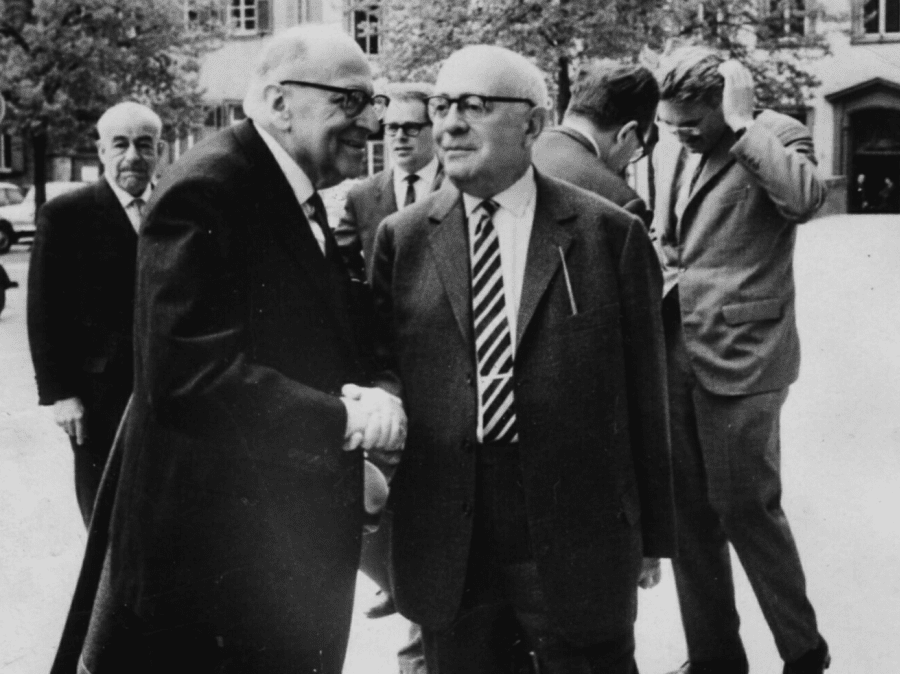
The Cultural Marxism Conspiracy, a new book from Brighton-based historian of fascism, A.J.A. Woods, explores the history of conspiracy theories surrounding the Frankfurt School, as exemplified by the modern antisemitic dogwhistle “cultural Marxism”. The Frankfurt School was a collective of mostly Jewish Marxist academics whose influential approach to the social sciences shaped the intellectual tradition of critical theory. The group sought to transform society by revealing the power relations that structure it, and their method endures as the foundation of critical theory today.
The Frankfurt School takes its name from the University of Frankfurt am Main’s Institute for Social Research, where Jewish philosophers Max Horkheimer, Theodor Adorno, Walter Benjamin, Erich Fromm and Herbert Marcuse all worked before the rise of the Nazis. After the war, Horkheimer and Adorno returned to Frankfurt, while Fromm and Marcuse continued their academic careers in North America.
In the 1960s, as countercultural and student movements were gaining ground, some within the American dissident left, specifically supporters of US presidential candidate Lyndon LaRouche, began to speculate that the members of the Frankfurt School were part of a larger conspiracy to undermine the left from within. Woods locates this moment as the origin of the cultural Marxism conspiracy theory and goes on to trace it through the end of the 60s and into the 70s, as the LaRouche movement increasingly associated with elements of the far right. Finally, they explain the term’s wider adoption in the 90s and 2000s, arguing that this period cemented the right-wing, antisemitic character for which “cultural Marxism” is known today.
I spoke to AJ ahead of the book's release. The following conversation has been edited for length and clarity.
— Sasha Baker
SB: At the beginning of the book, you say that Cultural Marxism didn't really evolve out of the antisemitic myth of Judeo-Bolshevism, even though that's often repeated as a way of explaining why cultural Marxism is also an antisemitic dogwhistle. In fact, you explain that the term actually emerged from a left-wing group, the LaRouche movement.
I'm interested in the shift that takes place as this conspiracy theory migrates from left to right. How do we go from the LaRouche Movement, who claimed that “cultural Marxism” was a problem for the left because the focus on culture distracted from class struggle, to right wingers, who use it to describe an intrusion of Marxism into cultural institutions?
A.J.A. Woods: The term cultural Marxism, in the way that it's used today, didn't really come into our language properly until the 90s, when [the paleoconservative] William S Lind started using it.
But in very strictly chronological terms, it does sort of come out of a 60s-era disagreement within the left. What you see with the LaRouchites [a movement that started in left-wing student politics, led by conspiracy theorist and frequent US presidential candidate Lyndon LaRouche] is a kind of worker-ism that insists that the cultural movements of the time – such as the feminist, Black, and gay liberation movements, along with the mass mobilisations taking place across university campuses – are kind of extraneous to the struggle that really needs to take place, and therefore, it sees these kinds of struggles as superfluous, or even in some cases, counter-revolutionary.
Part of the story is that the LaRouchites realised it might be beneficial to find allies on the right. But also, the migration of the conspiracy theory from the left to the right reflects a larger shift in American political culture, from the liberal consensus that was still kind of holding together in the 60s and early 70s, towards Reaganism and neoliberalism in the rest of the 70s and the 80s.
SB: The idea that the antisemitic part of cultural Marxism didn't come to the fore until the 90s is quite confronting in terms of how we should think about the rise of antisemitism in the present moment. How do you think the present use of the term “cultural Marxism” is both shaped by and constructive of modern antisemitism?
AJ: People who weren't right-wing only really started writing about cultural Marxism in the 2000s, after this convergence had taken place between William Lind's idea of cultural Marxism – [using cultural Marxism as a form of red-baiting to discredit the left, in response to his belief that conservatives had lost the culture war] and the more openly antisemitic discourses that were coming from groups like [the far-right think tank] Liberty Lobby.
The collapse of the Reagan-era conservative coalition allowed for certain parts of the American conservative movement, or the “new right”, to develop relationships with neo-Nazi and antisemitic tendencies in the American far right. So this is why you can see people like Lind getting involved in events or in publications that are almost nakedly antisemitic in language and character.
There is a famous – well, famous to people who study this topic – 2002 incident where Lind is speaking at what is essentially a Holocaust denial conference. And he does this whole spiel about the Frankfurt School introducing political correctness to America to bring down Western civilisation. He sort of mentions offhandedly that the Frankfurt School thinkers were Jewish.
There is continual debate about whether that remark was really as offhanded as he claims it to be, but he has expressed that the Free Congress Foundation – the cultural conservative lobbying group that he heads – does not deny the Holocaust, and would at least sort of denounce attempts to deny it.
The right – or at least certain portions of the right – have become adept at really playing with that line between respectable anti-leftist talking points and antisemitic messaging.
I don't know if you remember the time when Suella Braverman used the term “cultural Marxism” in one of her speeches, and it triggered a whole debate about whether cultural Marxism is, as a term, antisemitic or not.
What you saw on the right was an effort to sanitise this term and say: “We know that some antisemites use 'cultural Marxism' to say the Jewish people are behind the decline of Western civilisation, but we use 'cultural Marxism' to mean this other thing.” This is essentially the same kind of narrative, even though the mainstream right insists that they're not using it in an antisemitic way. The kinds of narratives that they're pushing still have the same logic: blaming an out-group for trying to undermine society or culture.
SB: Throughout the book, you talk about the rise of right-wing “alternative” media that tries to defend “family values” from mass culture, which the right thinks undermines them. The right-wing reaction to the film The Graduate is an example you cite of this process.
It occurred to me while reading the book that an implicit core demand of the right-wing drive against “cultural Marxism” is that art must be didactic and not open to interpretation.
Do you think “cultural Marxism” as an idea is inherently anti-intellectual, despite its intellectual pretensions?
AJA: It's consistently surprising to me that cultural Marxism is sort of the conspiracy narrative of right-wing intellectuals. It has never had the same kind of populist energy to it as things like QAnon, or maybe even birtherism. You don't get the sense that someone would go to a Trump rally with a placard denouncing the Frankfurt School.
Instead, it’s kind of this story that the right-wing elite tries to tell to one another when they're at places like CPAC.
Partially, I think this instinct comes from a hatred of public institutions. Right-wing think tanks are largely driven by money from foundations, or magnates and philanthropists. Meanwhile, they operate as a kind of counter-intellectual apparatus.
For the right, this is less about anti-intellectualism, and more about ownership or property. I think they're largely against the public ownership of cultural and “intellectual” institutions that (at least in theory) allow participation and expression from all walks of life.
So I think the heart of how “cultural Marxism” is used is really an attempt to restrict civil society, and also to limit who gets included within it.
You can see this very clearly in anti-trans legislation, and in the anti-DEI pushback, which seeks to prevent the participation of different ethnic minorities in public life.
The right doesn't necessarily need the narrative of cultural Marxism to do this work, but it is one of those tools that they can use to accomplish their goals.
To see this logic at work, you can even go back to the Thatcher government in the UK, which tried to prevent the Arts Council from producing open, pluralistic, and popular British cultural life, and instead, largely funded elite high-brow cultural activities.
SB: You say at the beginning of the book that you're not focused on intellectuals, including right-wing ones, who've written about cultural Marxism with a non-conspiratorial but (I would presume) still critical lens. But this distinction feels very porous in right-wing circles.
How do you draw the line between right-wing scholarship and conspiracy?
AJA: I'm not saying that anything a right-wing person has ever said about the Frankfurt School is automatically an instance of the conspiracy.
But I think I accept your point. If you look at the footnotes of say, [American far-right commentator and former White House communications director] Patrick Buchanan's The Death of the West, where he talks about how the Frankfurt School is using political correctness to destroy the West, he's drawing on people like [British conservative author and Mail on Sunday columnist] Peter Hitchens, [American far-right academic] Paul Gottfreid and [American conservative historian] Christopher Lasch. These are not the kind of people that I'm talking about in the book.
There's obviously a cross-fertilisation of these discourses, and this is partially why it's difficult to talk about cultural Marxism the way that I do – because if it's something that is shifting and moving and developing in a bunch of different directions over time, there comes a point where you could plausibly say that much of what the right talks about is cultural Marxism, or at least touches on it in some way.
Cultural Marxism is not a discrete thing; it's more like a lens to sift through a lot of right-wing discourses. For example, there were right-wing critiques of critical race theory (CRT) and critical legal studies in the 90s, but these came from legal scholars. Are these criticisms linked to the right-wing anti-CRT scare now? Are these right-wing thinkers really doing the same sort of thing? That question is more difficult to parse.
When we talk about certain ideas of conspiracy theories as though they are discrete, perfectly bounded objects, that's a totally wrong approach. The history of these kinds of ideas is much messier than the way that they're often allowed to be talked about. I think that we sort of reduce that complexity when we say that cultural Marxism is just this one conspiracy theory that has stayed the same throughout history.
SB: Within the UK, the book discusses the cultural Marxism conspiracy emerging in the 2000s or maybe even the 2010s. Do you think the conspiracy is an American import, or do you think there are endemic features of British culture and political discourse that are receptive to it?
AJA: I don't think you can have words like “cultural Marxism” work in the UK without the existing discourses from the Thatcher era about the “loony left”, or even Michael Gove's use of the of the term the “blob” to talk about the so-called “ideologically captured” civil service.
You can see how “cultural Marxism” then gets used – certainly in the late 2010s. It is building on those kinds of discursive reflexes that already exist in the right-wing British imaginary.
It’s also worth pointing out that if you are going purely on a chronological basis, the earliest use of “cultural Marxism” in the English language comes from the British Union of Fascists. It was in the 1938 issue of their magazine, as pretty much a direct translation of “cultural Bolshevism”.
That context is long-forgotten, and you can only really identify it now if you are a scholar of fascism, or, you know, working for the Oxford English Dictionary. When Lind thought he was coining the term “cultural Marxism” in the 1990s, he wasn't really aware of that history or alluding to it.
But there is an endemic tradition within the UK that demonises the left, or is preoccupied with seeing or trying to identify external threats to “natural” British culture. And so, even though I guess that you could say things like “woke” or “cultural Marxism” are born in America as it were, they settle here on very fertile ground. They can be slotted into right-wing British discourses quite easily.
SB: Do you think there's anything particular about the time period in which it came to the fore here in Britain? Like, I remember very distinctly, the strange antisemitism directed at Ed Miliband for eating a bacon sandwich, and the Daily Mail calling him “Red Ed”...
AJA: Yes – "the man who's dad hated Britain". Oh yeah. That feeds into it as well. I mean, what a time capsule.
It's sort of fascinating to see how those anti-left talking points were circulating about a project that really was incredibly mild.
Although use of the term “cultural Marxism” came into more mainstream British-right consciousness with Braverman during the Corbyn years, I think red-baiting was also key in the press attacks on Miliband. [The Mail continues to refer to him as “Red Ed” in recent articles.]
Something that I don't talk about in the book, but is obviously important if you ever want to talk about the development of the left in the UK over the past two decades, is the reaction to the student movement and its mass-mobilisation against austerity that happened in response to the 2008 financial crisis. I think that's when there was a real sense that something radical was developing. You can see that this time period is when people in more mainstream right-wing newspapers – like the Daily Mail and The Times – start taking up “cultural Marxism” as a term.
SB: Last question about the UK: a thing that felt like an interesting mirror to the development of the cultural Marxism conspiracy in the US through the LaRouche movement is the cohort of Spiked Online people. They started out in the Revolutionary Communist Party and Spiked Online was initially called Living Marxism. They then became these far-right reactionaries. Do you have anything to say about this particular trajectory – of far left to far right – that sometimes occurs in both the UK and the US?
AJA: I think that why the LaRouchites, for example, ended up shifting to the right, or at least, to being ideologically fluid, is because their sense of their own intelligence, superiority, and brilliance is what was really important to them.
Similarly, I think that what really typified the Revolutionary Communist Party/ Living Marxism group was a sense of contrarianism. That really isn't a solid ideological grounding. I think if that's the basis for your activity, you can sort of end up going either way.▼
A.J.A. Woods is a historian and author of The Cultural Marxism Conspiracy, out now from Verso.
Author

Sasha Baker is an investigative journalist.
Sign up for The Pickle and New, From Vashti.
Stay up to date with Vashti.