On Monday night, four ambulances belonging to the Jewish volunteer organisation Hatzola were set on fire. While suspects have been arrested, the investigation into the attack is just beginning.
Nonetheless, Nigel Farage was predictably quick to bring xenophobic, anti-migrant sentiment into play. “There is now a terror cell in north London. The fifth column is here”, he posted. “As I write, more undocumented young men are crossing the channel.”
For Farage, the event was a perfect moment to instrumentalise Jews in the service of his own racist ends, on the back of a larger push to ingratiate himself with the UK’s Jewish community. Last month, on 10 February 2026, Farage’s decades-long march towards Downing Street took him to the basement of the London Central Synagogue. Greeted by a crowd of over 200 people, a table of lukewarm coffee and fresh rugelach, Farage and his newly-minted frontbench team gleefully launched the Reform Jewish Alliance: a new initiative intended to boost the Jewish community’s support for Reform and represent its interests at “the highest levels of the party”.
Na’amod members quickly caught wind of the launch event from an announcement in the Jewish News, and a small organising group rapidly formed to coordinate an effective response. Within days, Na’amod members began planning an action to disrupt the launch.
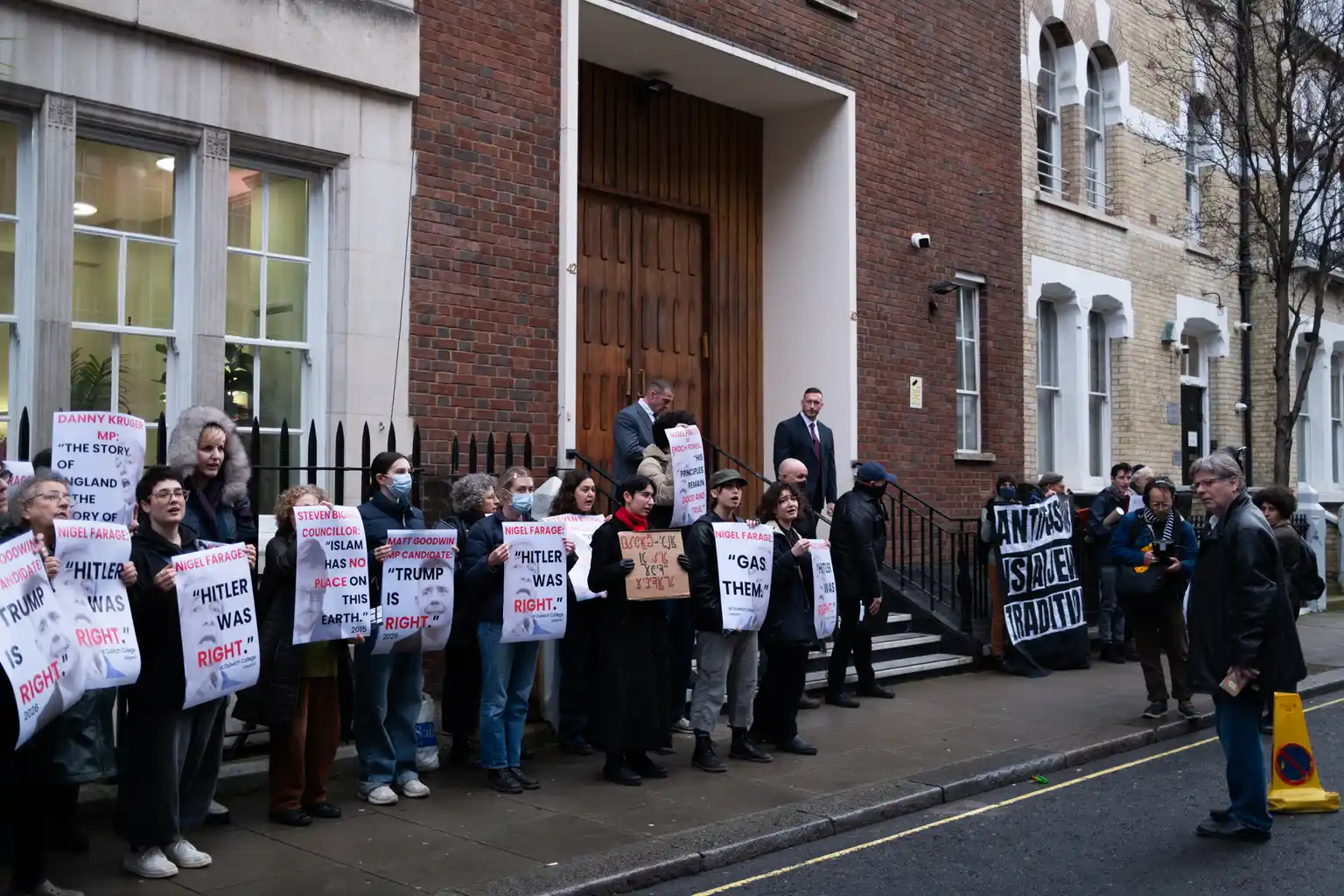
Joining forces with Jewish Anti-Zionist Action (JAZA), organisers staged disruptions both inside and outside the event. Inside, activists interrupted Farage’s speech, seizing the moment to expose the hypocrisy of Reform’s attempts to court Jewish support. In one such disruption, activist Carla Bloom invoked a family history of Jewish resistance, stating, “My mother didn’t fight the Mosley fascists in Cable Street for this.” In another, Hannah Machlin highlighted the historic implications of Farage’s policies: “My grandma fled Germany, you would deport her.”
Within moments, security violently dragged Na’amod and JAZA members out the room. Meanwhile, protestors outside the synagogue held placards containing Farage’s antisemitic and racist track record. They were met with open disdain from arriving guests.
Na’amod and JAZA’s protest of the Reform Jewish Alliance dominated media coverage in the days that followed, placing a spotlight on dramatic internal rifts facing the British Jewish community. For two decades, Nigel Farage has dominated conversations about identity in the UK. In that time, the relationship between Reform and the Jewish community has been unremarkable and unimportant – a footnote in a wider debate about white British identity, anti-Muslim racism, and Englishness.
That dynamic is beginning to shift, as Reform increasingly casts Jews as symbolic allies to justify its politics of exclusion. With Reform now looking capable, if not likely, to break 100 years of Labour and Conservative dominance, the time has come to ask what role Jews will play in its rise.
An inglorious roster
The event lineup featured a selection of Reform’s leading politicians and right-wing Jewish activists. Farage spoke last, but his zero-sum worldview dominated proceedings. Each speaker riffed on the same theme: Reform must become the new political home for Britain’s Jews because only Reform can address the issues that really matter to them. These “issues” fell into two camps. Firstly, the speakers repeatedly emphasised their virulent support for Israel and positioned this as a key convergence of Reform’s platform and Jewish interests.
Secondly, the event’s speeches peddled an implicit argument that only Reform would protect Jews from the hordes of leftists and Islamist radicals set on destroying Britain. This absurd and alarmist framing treats the position of Jews as permanently and inevitably precarious, along with suggesting that our only salvation is in alignment with the far right.
Each speaker rallied to this theme, while conveniently omitting the tenuous reality of Reform’s relationship to the Jewish community. Suella Braverman used her speech to boast about her Jewish mother-in-law’s famous chicken soup. What she didn’t mention was that her husband, Rael Braverman, who was cheering on his wife from the front row, had quit Reform in July 2025, after the party’s then chair and current shadow home secretary, Zia Yusuf, liked a series of antisemitic tweets.
Robert Jenrick also used his personal relationship to Judaism (his wife and children are Jewish) to obscure his history. Last year, Jenrick was photographed at an anti-refugee protest alongside Eddy Butler, a former member of the neo-Nazi terror group, Combat 18.
Gary Mond, leader of the National Jewish Assembly, reminded attendees that he had set up his organisation for the specific purpose of making Farage prime minister. Then Alan Mendoza, Reform global affairs advisor and former executive director of right-wing think tank, the Henry Jackson Society, took the stage. In the event’s lineup, Mendoza played the role of hype man, introducing Farage by describing recent allegations that he directed racist and antisemitic abuse at his former classmates as: “an absolute smear campaign against this man in the press”. He emphasised: “I can tell you, and all of you know this, there is not an antisemitic bone in this man’s body.”
In Farage’s remarks, he presented his party as the defender of Jews and “Judeo-Christian principles” against a leftist, Islamist plot to destroy the country. Invoking the UK’s perceived failure to protect Jews from so-called “hate marches”, taking place weekly to protest Israel’s genocide in Gaza, Farage told the crowd: “We shouldn’t even need to think about forming a Jewish alliance in this party.” He framed the event as responding to a need to protect Jewish safety, describing Reform as ready to “fight” for Jewish people’s right to live “civilly” in the country.
A receptive audience
The afternoon ended with a clear message: Jews and the populist right must unite against the forces of darkness. In previous generations, the Jewish community maintained a widespread aversion to this idea, born of a collective political revulsion to the far right over the 20th century. This memory has gradually eroded in the 21st century, as Jews from Miami to Paris to Budapest to London have found themselves entering dangerous new liaisons with the far right that they once mortally opposed.
The far right’s global courting of Jewish alliances is only possible due to the actions and agency of a receptive Jewish audience. Consider the Kushners and the Witkoffs in the United States, or Eric Zemmour in France. The Israeli government has also served as a bridge between Jews around the world and far right politics. In 2000, Israeli Prime Minister Ehud Barak recalled Israel’s ambassador to Austria when the far right entered the Austrian government. But that aversion quickly disappeared with Netanyahu, and his assiduous courtship of the far right throughout the 2020s: from hosting Santiago Abascal to cosying up to Victor Orbán. In doing so, Israel has signalled to Jewish communities around the world that such relationships are no longer taboo but strategically legitimate.
Back in the London Central Synagogue, Reform found its Jewish audience hungry for new alliances with the far right. Attendees included Yochy Davis, a key organiser in Stop the Hate, a pro-Israel protest group responsible for deplatforming two of the UK’s most senior progressive rabbis, Rabbi Charley Baginsky and Rabbi Josh Levy, at the “National March for Hostages” last August; Josh Howie, the GB News broadcaster who called LGBTQ+ people “paedophiles” and “deviants” on air; and Gideon Falter, chief executive of the Campaign Against Antisemitism (CAA), an organisation under investigation by the UK Charity Commission for pursuing non-charitable goals in its espousal of pro-Israel propaganda.
The London Central Synagogue itself has long been complaining about the Palestine Solidarity Campaign rallies taking place in the local area. The synagogue’s Rabbi Lerer told the Jewish Chronicle in 2024 that the protests have damaged the synagogue’s ability to function, as congregants have felt intimidated on their way to worship. That the same synagogue is willingly opening its doors to a far-right political group exposes a pernicious double standard within the Jewish community. Political movements aligned with a far-right, pro-Israel agenda are considered acceptable, whereas those unwilling to follow the pro-Israel status quo are considered a threat.
Disrupting from within
Faced with this lineup of extremist figures, a group of Na’amod members decided to disrupt the event, alongside a protest outside the synagogue organised with JAZA activists. The decision to plan an action inside the synagogue itself was not taken lightly.
For centuries, synagogues have been considered a mikdash me’at, or “a small sanctuary,” intended as space for Jews across the world to gather for worship and community. In this light, Na’amod members felt Reform UK’s choice of location was a deliberate, hypocritical misuse of sacred space. The Reform event was a desecration of the synagogue’s very purpose, used as a tactic to institutionally normalise a party known for its blatant racism and antisemitism.
Of course, synagogues have never been politics-free. They are living institutions and act as both places of worship, as well as spaces for debate and political organising. Rabbis often use their Shabbat morning sermon to discuss social justice issues or debate world politics – and they are certainly not shy about using this platform to promote pro-Israel rhetoric.
The Reform UK event posed a different challenge in that it brought politics out of the activities of worship, transforming the synagogue into a cynical political backdrop for the explicit purpose of conferring institutional credibility to a far-right agenda. Reform UK actively leveraged this sacred space as political cover, placing communal weight behind the party and allowing it to claim endorsement from the Jewish community. Given the virulent antisemitism repeatedly exposed within Reform’s own ranks, it is difficult to believe the party’s professed concern for Jewish safety is anything more than a calculated political strategy. Naa’mod and JAZA’s action was a clear refusal to allow our communal identity to be weaponised in service of a politics that endangers others.
When a Na’amod member asked the United Synagogue about its decision to host the event, it responded via email: “[it maintains] strict party-political neutrality at all times.” One can only imagine what the response would be if Zack Polanski tried to book out the space. As footage showed, Reform UK members aren’t shy about using violence to suppress opposition. During the event, security lined the room and quickly made their presence felt, three of them dragging felt when three of these men dragged a Na’amod protestor out of the building and throwing him onto the pavement.
Who speaks for British Jews?
But Na’amod’s action captured more attention online than the organisers predicted, skyrocketing to the number two story on the Guardian website and attracting over 661.1k views on a PoliticsUK post on X. Partly, this attention can be explained by the ubiquity of media coverage that Farage and Reform are now afforded. As Labour falters and the Conservatives struggle to unyoke themselves from fourteen years of disaster, Reform continues to dominate the polls. Recent data from the Jewish Policy Research Institute found that a total of 11% of the British Jewish community are currently considering voting for Reform. The party’s previously narrow focus on Brexit and immigration is now bleeding into a wider worldview, which encompasses how they would govern the world’s seventh-largest economy. As Reform’s ambitions expand, the party has actively begun courting Jewish voters, using Jewish alliances to soften its anti-minority image and project respectability. In doing so, it is drawing the relationship between Reform and Jews from the margins into the centre of political debate.
At London Central Synagogue, we saw how this relationship will take shape. Reform will tell Jews that only Reform can save them from the terrors of the left. Jews will be imagined as a terrified, single-issue monolith, whose only interest in British politics is delivering a government that is sufficiently kind to Israel. Islamophobia will pervade the dialogue, sometimes explicit, sometimes implicit. Jews will be upheld by Reform as a “model minority” in Britain.
Contrary to appearances, the real danger at these events does not lie in the speaker lineup, but instead, in the assembled audience. There is now a growing minority of British Jews who want to make Reform the natural home for an increasingly right-wing and reactionary community. Yochy Davis and Gideon Falter might not currently constitute the mainstream British Jewish opinion, but their voices will be amplified in the run-up to the next election, ultimately reaching terrifying new heights.
This political potential is the true reason that Na’amod and JAZA's action dominated headlines for days after the event took place. The Reform Jewish Alliance – and the resistance to it – marked a flashpoint in a deeper struggle over who speaks for British Jews, and what it even means to do so in an era of resurgent nationalist politics. It is no surprise that a new group of Jews against the far right, V’ahavta, has gained quick traction online. In their first action, the group plastered posters of Reform members across Golders Green, captioned: “it’s good to be reminded who’s really putting us and our neighbours at risk”.
Actions from groups like V’ahavta and Na’amod serve as a message, not to Farage or Reform’s leadership, but to Jews around the country. We say: the far right does not speak for our community and it does not reflect our values. The fight is on.▼
Author
Debbie Shamir is an organiser on the Jewish left. She has previously worked for justice in Israel-Palestine and against antisemitism and its misuse as a researcher and organiser.
Sign up for The Pickle and New, From Vashti.
Stay up to date with Vashti.