Will MPs ever acknowledge the reality of pro-Israel influence?
By continuing to deny the mere existence of the lobby, politicians are empowering far-right conspiracy theorists.
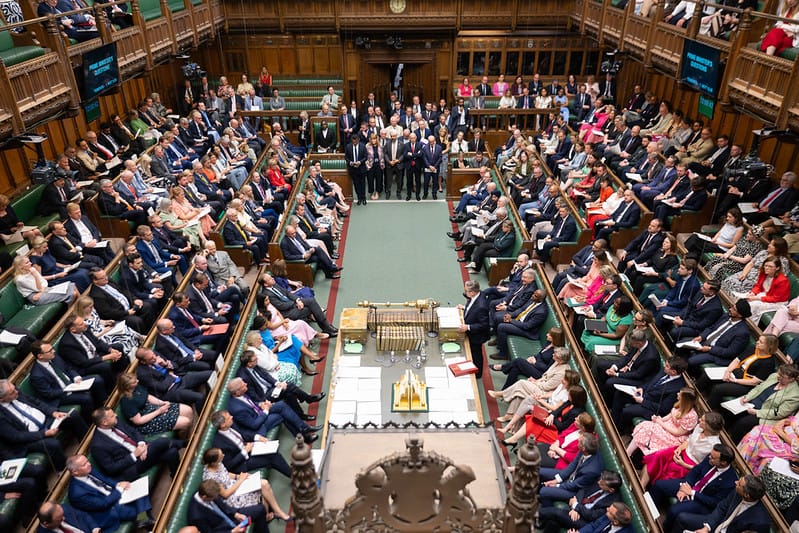
On 22 June, Parliament debated the topic of pro-Israel influence on UK politics and democracy following a call for an inquiry from the British public. 118,000 petitioners wanted to have this discussion; fourteen of the twenty MPs who spoke did not. They took up most of the session’s time to say the same thing: pro-Israel influence is an antisemitic trope unfairly targeting the Jewish state.
Labour MP Peter Prinsley, for example, compared the motion to Nazi claims that Weimar Germany had been “Jewified”, while fellow Labour backbencher David Taylor bizarrely implied that mentions of Labour Friends of Israel (LFI) conflated Jews and Israel and were irrelevant to the debate because the organisation “receives no money whatsoever from the Israeli government.” (LFI does not publicly disclose its sources of funding).
Notably, the original petition never refers to Jewish or Israeli state influence. It refers to domestic pro-Israel influence through the (mostly non-Jewish) politicians who prioritise donations and networking over constituents. Politicians like LFI member Alex Davies-Jones who, in 2024, triggered an aggressive police raid on two activists peacefully challenging her while canvassing in South Wales, later testifying in court that she was “terrified”.
Now, following Foreign Secretary Ed Miliband’s recent announcement of a trade ban on illegal West Bank settlements, this supposedly nonexistent lobby has thrown its toys out of the pram, screaming that this baby step towards compliance with international law will endanger British Jewry. Meanwhile, UK Lawyers for Israel (UKLFI) is reportedly pressuring the government to take five steps back after its inch forward, as it campaigns for the proscription of Doctors Without Borders as a terrorist organisation.
It's clear that these preposterous denials of the lobby’s existence are unsustainable, especially when support for Israel is disproportionally defended in the press, uniquely policed in the street and protected in the courts, and relentlessly justified in Westminster amidst a live-streamed genocide.
But in this context, the decision by MPs to use the antisemitic trope of secret Jewish power as a shield against accusations of pro-Israel lobbying only reinforces the trope as a seemingly plausible explanation for what is truly going on, feeding an unmistakable rise in conspiratorial thinking among those seeking any explanation for this unfathomable horror.
A non-conspiratorial and good faith approach to pro-Israel influence in the UK is badly needed, not only to undermine the lobby’s real and insidious impact, but also to counter the dangerous weaponisation of antisemitism and philosemitism that turns Jews into a partisan issue.
An Actually Existing Lobby
While the Zionist lobby has, by and large, successfully ingratiated itself with the British establishment for over a century, the last few decades have brought it to the fore. In Lobbying for Zionism on Both Sides of the Atlantic, historian Ilan Papé puts the post-1980s expansion of the lobby down to a shift in focus from influencing individual politicians to controlling the narrative as a whole amidst worsening public perceptions. Over time, the lobby solidified into a self-preserving, self-aggrandising network at the centre of parliamentary politics.
As a power-seeking institution, the lobby has opportunistically worked with political actors in the post-Corbyn era to turn Zionist philosemitism into a core component of anti-left politics. The true origins of this can be seen in New Labour. Former LFI chair and gambling lobbyist Jon Mendelsohn celebrated the 1990s transformation within party leadership:
Blair has attacked the anti-Israelism that had existed in the Labour Party. Old Labour was cowboys-and-Indians politics, picking underdogs to support, but the milieu has changed. Zionism is pervasive in New Labour. It is automatic that Blair will come to Labour Friends of Israel meetings.
Blair didn’t just court donations from pro-Israel philanthropists like Trevor Chinn in order to reduce dependence on trade union funding. Here, Zionism stands in for moving past student politics, in the derogatory sense, and a willingness to side with the powerful rather than cosplaying revolutionaries in aid of hopeless losers, be they miners or Palestinians. This approach would go on to be a core part of the anti-Corbyn counterrevolution in the party. Zionist philosemitism combined rightist amoralism with deceptively moralistic language, making it perfectly suited for the era of liberal identity politics.
LFI and Labour Together, a think tank funded and for eight years governed by Chinn, were central to Morgan McSweeney’s takeover of the party, both as a means to undermine the Corbyn wing as racist and as a site for organising Starmer’s campaign. This carried into Whitehall. At the time of Starmer’s resignation, 12 of the 24 cabinet ministers had taken money from LFI. But the Israel lobby didn’t bully Labour into submission. Rather, elements within the party used it, and the weighty accusations of antisemitism it enthusiastically delivers, for their own means.
Constructing a Racialist Worldview
At this point, antisemitism has been a near-daily headline story for a decade. Over that time, British society has received an insidious definition of antisemitism that is capacious beyond credibility, an assault on civil liberties, and dangerous rhetoric that not only pits Jews and Muslims against each other but which displaces classic formulations of antisemitism onto Muslim communities by delegitimising their concerns as voters and accusing them of being more loyal to a Middle Eastern political project than their country of residence. “Jewish safety” and “Jewish fear” are now bywords for government repression.
Yet even after attacks on Jewish people and religious sites, and amidst the rise of both an electoral and masked far-right, these politicians still instrumentalise claims of antisemitism to beat back the truth of the lobby, ensuring that the concept of antisemitism is drained of any useful meaning. One can only respond with cynicism when these same politicians talk about their deep affection and concern for the Jewish community in the press or at functions of communal institutions.
Ultimately, it’s neither anti-antisemitism nor a genuine love for the Jews that’s driving their deranged behaviour. It’s a politically contingent philosemitism, manifesting in an obsession with a vision of particular Jews as useful subjects for their right-wing, racialist project. This, of course, cannot accommodate dissenting sections of the Jewish community. In 2020, for example, Luke Akehurst, the non-Jewish head of We Believe Israel and Labour right pitbull, accused Marxist Jews of abandoning most of their Jewish identity besides chicken soup. Although it was embarrassing that this remark became public, it didn’t harm Akehurst’s career, revealing the boundaries of the philosemitic political project.
But the state’s calculated embrace of the Jewish community won’t last forever. Despite the lobby’s painstaking construction of a Judeo-Bolshevik conspiracy with Muslims, instead of Jews, as the fundamental evil, and queer-friendly pro-Palestinian socialists as the conniving front, much of the far-right is unimpressed. Just look at what's coming around the bend from the US.
Over the last year, the “America First” wing of the Trump movement has increasingly split from the more traditional neo-conservative base within MAGA around Zionism. With the administration’s blanket support for Israel, close ties to AIPAC, and the rising material cost of Trump’s Iran quagmire, there is an acute feeling of betrayal among large swathes of the American right. Tucker Carlson, the leader of the right’s anti-Israel camp recently released a 10 point manifesto for America to overcome Trump’s failures. Unlike neo-Nazi streamer Nick Fuentes, who represents a shock-jock approach to Jew-hatred, Carlson offers a more careful and compelling brand of political antisemitism – pointedly referring to America as a slave of Israel and lamenting usury and the degeneration of modern art. He pairs this, naturally, with a similar animus towards migrants and reproductive justice, among other far-right concerns.
For years, the conflation of Israel, the lobby and Jews has worked as a defence against anti-Israel criticism, but if all three become equally unpopular, this strategy is dead. While we don’t have British Tucker Carlsons yet, the conditions are ripe for such individuals to emerge. With them will come a powerful new right-wing culture that the left is not prepared to take on.
Our task, then, is to bring down the lobby the non-fascist way, and to break away from both the philosemitism of imperial sponsorship and the antisemitism of conspiracy theorists. 118,000 petitioners wanted to have this discussion, but our MPs failed them in an embarrassing display of self-righteous obfuscation. We must keep pushing for the lobby's destruction on our own terms.▼
Author

Louis Goldberg is a writer and filmmaker. His latest project is The Rise of the Anglofuturists.
Sign up for The Pickle and New, From Vashti.
Stay up to date with Vashti.