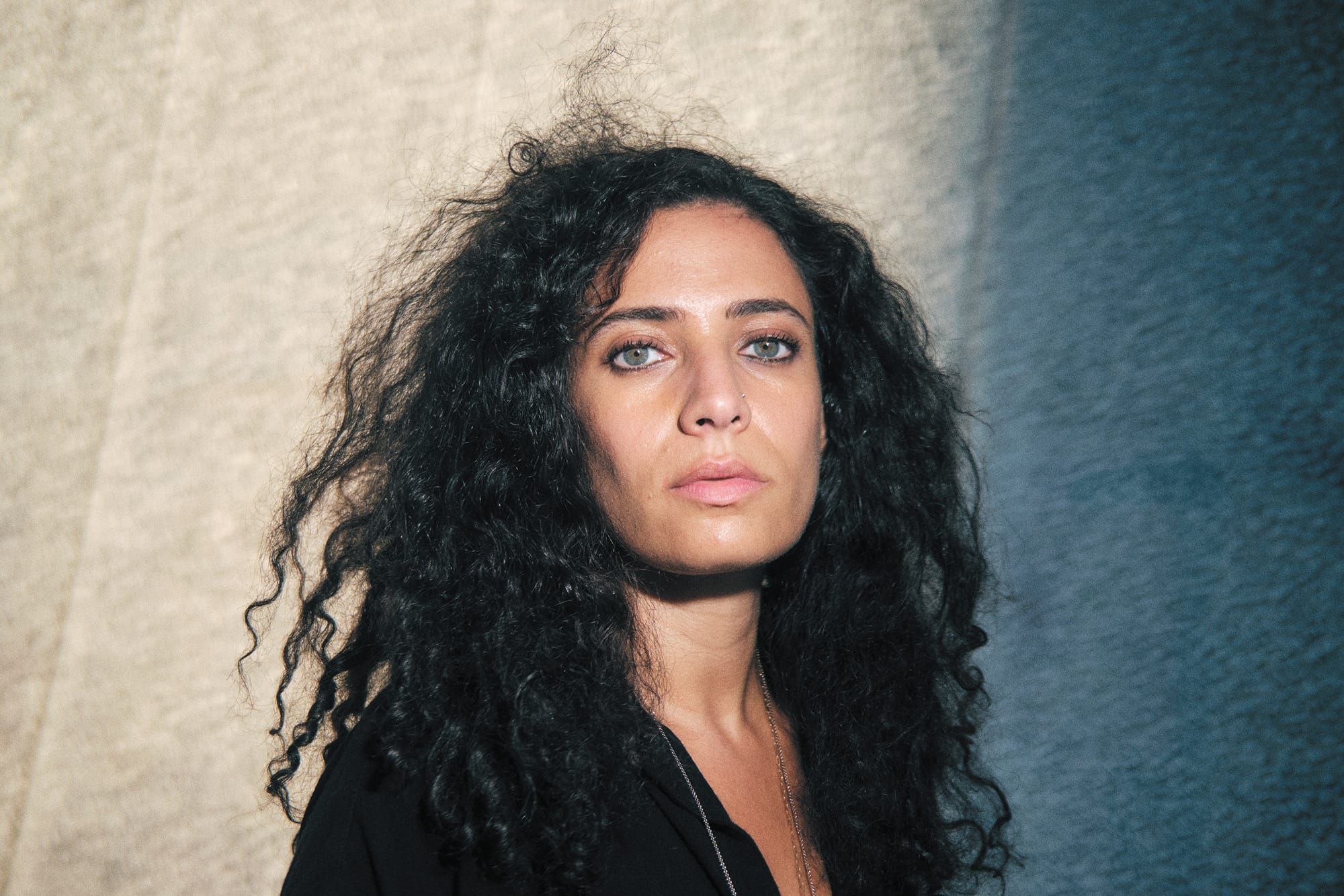
I met Hala Alyan – award-winning Palestinian-American author, poet, clinical psychologist, and NYU professor – earlier in this sweltering summer, during the UK and Ireland tour for her memoir I’ll Tell You When I’m Home (Saqi Books, 2026), weeks after it was named a finalist for a Pulitzer prize. Our Zoom conversation roamed and flowed, punctuated only by Hala calling off-screen, “Leila, mama, khalas ” – “enough” – as her 4 year-old daughter Leila, with us on the call, danced, sung, swept, chatted away, and reached for snacks; she was agitated to go to the park in this exciting new city on the tour.
I’ll Tell You When I’m Home is, in one sense, a journey to Leila’s birth via surrogacy. It is also a tapestry. Hala’s tapestry. As her daughter grows in the body of the surrogate, the nine months of pregnancy become the structural container for Hala to trace her own life. She deftly weaves together vignettes of addiction, codependency, parenthood, exile, displacement, and home. One of the thick threads, standing out, saturated in colour, is her family’s displacement from Kuwait during the mass expulsion of Palestinians in 1990, through Iraq, and into Jordan when she was just three. Within its pages, the memoir bears the stories of more than just Hala and Leila.
This is an encounter that I struggle to edit down and call an interview. To call, even, a conversation. The pages-long transcript is pockmarked with half-finished sentences ending in a simultaneous “mmm. Yes!” and countless moments of wordlessness that appear to be us simply grinning at each other.
I am unsure, still, how this happened. I wonder if it is due to the fact that Hala is a teacher or a psychologist. I wonder if it’s because we are both writers, both poets. I wonder if it’s because I can tend towards a particular intensity.
It could have been kick-started by my decision to open our call with the transparency that, despite being sent the proof copy over a year prior, I couldn’t get myself through the book for most of that time. It met me when I couldn't take it. And that, as a result, we were looking at each other across screens mere hours after I had consumed the entirety of her book – a story of her life – all in less than 48 hours.
“Wow. It’s like you’re living inside it right now”, Hala beamed, when I told her how I had devoured it. This time around, I couldn’t put it down. The rawness met me right where it hurt, in a good way. “I’m also grieving it” I say, testing some kind of emotional water. “Yes. Yes of course” she smiles, gently. And we go from there.
Our conversation reaches far and wide, but returns in many ways, explicit and not, to ideas of surrogacy – wielding, witnessing, bearing, birthing, on someone or something else’s behalf. This memoir is itself an act of surrogacy for so many. In touring it, Hala has also played surrogate, a political witness, someone who can (must) say things others can’t, particularly in the face of the intensified repression of speech about Palestine.
We hope that our paths cross again, sooner rather than later. And that is the closest I can get to describing how this hour and a half felt. A crossing of desire lines. Hala’s and mine, but also dear Leila’s, and all that Hala opens herself up to in this memoir. To converge in this way is a gift. As is I’ll Tell You When I’m Home.
This conversation has been edited for length and clarity.
Hala: I didn't set out to write a memoir. This project was sold as a collection of essays that had nothing to do with any of this, and it was bought by a US publisher on a partial. We were supposed to massage it into shape and I was writing against a deadline that had already been moved. All of our other attempts at a [nonfiction] project were failing. We were about to shift the contract to a novel when I was at the point of a total Hail Mary and said to [my agent] on a call "Ugh, I had this one dumb idea of doing it around the months of pregnancy.”
And bless her – her face lit up and she said, "Wait, that's interesting. Try that. Just go try." At that point I had hundreds of pages written. Some were essayistic, and that's why the book is so fragmented in so many ways because there were things that were vignettes and there were things that were kind of narratively interrupted. I was writing about the past, I was writing about the future, I was writing about a kid, I was writing about a marriage, attachment theory, codependency, addiction, etc. And she encouraged me: "Just try. Now that you have this home, so to speak – a frame – see what happens if you try to fit things in it."
And I did it. She [Hala points to her daughter Leila] was two or three months old when we talked about the frame. Again, it had just happened. That's the other thing - everything had just happened. And it worked. It worked.
Asha: It does work. It's a very captivating structure. I felt a kind of swelling or growing. And that makes sense – yet it’s not twee.
H: Yes, it's not packaged neatly.
A: It's not like, “this is the month where we're talking about addiction”. “This is the month where we're talking about…” Every part of it felt like a vignette and it's because of that that you can weave and stitch them together. I so much loved the exposure of yourself as a storyteller in it and the feeling of your self-awareness. It's very inviting to read.
A: I’ll Tell You When I’m Home is being shortlisted for awards in the memoir/autobiography categories. While it could be your story of yourself, it actually feels to me like a memoir on behalf of others.
H: The act of making it sort of broke my spirit, but this book also really taught me how to live. It taught me so much about what I wanted. But to your point, it wasn't the sections or the parts that were about me that did that. It was in thinking about my story vis-a-vis my family or thinking about the ancestors versus the next generation.What have I learned from the elders? What do I want to pass down?
And then at some point I had to be like, “Wait, I was there too.” I'm also in that picture. Especially with the story of my mum leaving Kuwait, and, locating the child [in that story], really having to be like, “She was in the picture the whole time.” That was you. That three-year-old was you.
[Gestures to Leila] Miss Leila just turned four, and that has been an astonishing experience to suddenly see what four scared looks like and what four excited sounds like. You know what I mean? And then to understand that I was four. I was four in that context. I was four and there was a war.
[Hala pauses to listen to Leila]
H: She's saying, "Nobody can yell at me if I touch the sky." Well, it's not private. [To Leila] You're screaming it. We can hear you.
A: She's a poet already.
A: There is no real apex in the book, that's one of the best parts of it. I didn't have a pen when I was reading it, so the bottom corners are all turned up, and then last night I turned to my partner and said: "Give me a pen."
It was exactly what you just described. It's when your parents are finally willing to tell you the story of when you went from Kuwait through Iraq into Jordan. We're waiting because this story of you fleeing is in parts – it's been split up alongside all of the other vignettes in the book.
It says in my margin: "collapse, collapse, collapse, collapse”. It felt like you had this moment of realisation that you are your mother and your grandmother and you are Palestine. It was just this collapsing inwards.
H: Yes. And, to your point, there could have been no other way to end the book, except to say that when I hold her I'm holding her for everybody, and when I'm singing, I'm singing for everybody.
It's always made intuitive sense to me that I'm part of this larger collective, and certainly this larger lineage of women. But I think there was a way in which Leila being born crystallized something, in that suddenly I had the thought, oh my grandmother will never see this phase. And so I have to see it enough for all of them.
It ties in with these larger ancestral echoes of sorrow of all the things that have been lost or all the things that have been taken across so many years of displacement, of exile, and occupation, and all the things that different people in my lineage have not gotten to see or access or touch. Then of course, the book came out just after 7 October into a world in which it's televised in a way it hasn't been before. All the things that are robbed and taken away became so salient.
A: I was thinking about this in relation to the ways in which you call out your own subjectivity as a narrator.
H: Yes!
A: There's something about you saying, “You know what? I'm laying it all out here so she [Leila] won't have to think about these truths.” But in a way it’s a cheeky invite, because you've also said throughout the book: "I-I have lied so much."
H: Exactly. I don't know what the truth is. “I don't know if this is true.” Stories are stories, you know? It’s funny to work on something where you're like, “I want you to know that I'm not a reliable narrator, and now here's a story.”
A: Near the end, you invoke a quote from Ben-Gurion’s diary in 1948: “We must do everything to make sure they never do return.” You write: “Ben-Gurion wasn’t just talking about physical return…the fantasy he has was the diasporic not returning even in imagination”.
Was this an intention with the book? Is having that quote close to the end a way to reassert that collecting truths, memories, and stories, and being a vessel for them, is ultimately a resistant act, not just in the face of this erasure via imagination, but also in general?
H: Yes. I do think so. In some ways the Israeli government has proven, and the Israeli propaganda and Zionist ideology in general, has proven time and time again that the biggest threat to it is Palestinian existence – it's simply Palestinian breath. It’s children.
An indicator is what they destroy with the most impunity. You look at places like hospitals, you look at places like schools, you look at places like libraries, you look at things that hold archives, things that hold memory. You look at the number of children that have been slaughtered.
The threat is a Palestinian telling a story, a Palestinian taking up public space, and a Palestinian remembering. And if you destroy the archive, the biggest threat would be people orally telling that archive, making sure that that archive isn't forgotten, making sure the language isn't forgotten.
I certainly wasn't doing it that intentionally, but there is a resistance in a Palestinian telling any story, you know, much less a story that spans as many generations. I have a daughter who is half Palestinian and I want to think about the ways that I can make sure that she understands her lineage. That's the sort of the foundational thesis statement, so to speak, of the book. From a Zionist perspective, that’s a very threatening thing to do .▼
Author
Asha is an interdisciplinary writer and filmmaker and an Editor at Vashti.
Sign up for The Pickle and New, From Vashti.
Stay up to date with Vashti.