After the demolition
Five Palestinian families struggle to rebuild their lives in the occupied West Bank.
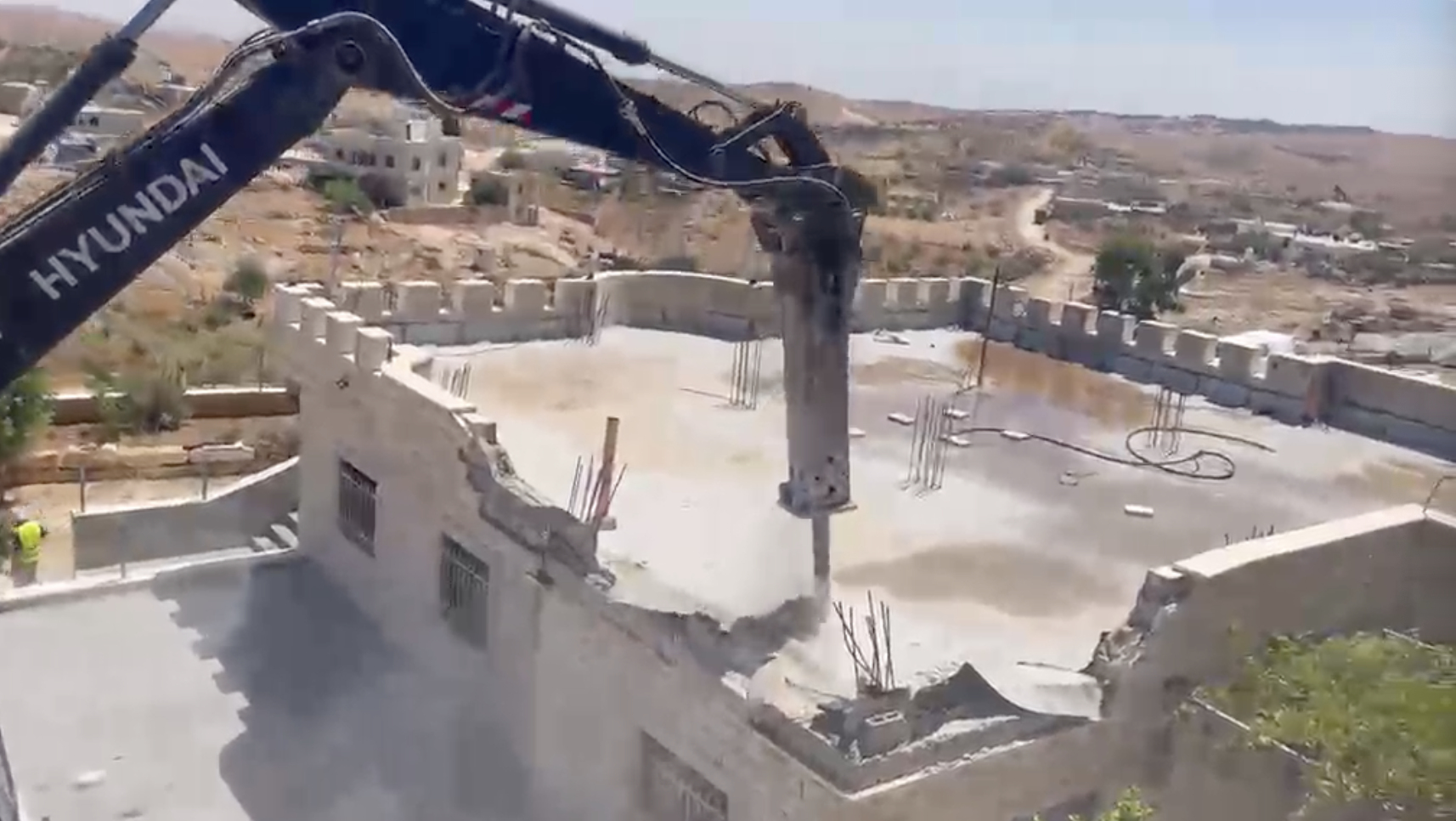
“Dad, when will we go home?”
This is the question that Alaa* keeps asking her father. Every time she looks at him, she waits for an answer that will bring some peace of mind. But her father has no words. The house she longs to return to is gone. Her room, her toys, her clothes, every detail of her small life, were reduced to rubble in minutes.
From 4 May to 14 July, Israeli forces carried out a series of demolitions in Deirat, located in the Masafer Yatta region of the occupied West Bank, less than 10km from my own village. Now, five families – including 25 children – are suddenly homeless, surrounded by the ruins of their lives.
Before the demolition began, the families were given only ten minutes to retrieve what they could carry. Ten minutes isn't enough to save a home, years of memories, or a life built with patience and toil over many decades. In the end, most of what they owned remained buried under the rubble. Standing in front of what had been his home just hours before, Alaa’s father told me, “I spent years working and saving every shekel I could. I deprived myself and my family of so much so I could build a house to shelter us. I didn’t build it all at once, but brick by brick, and every wall told a story of hardship.
Then the bulldozers came, and in minutes, it was all gone.”The families, who are cousins of my friends, told me that the worst part wasn't the sound of bulldozers demolishing walls, but the ring of emptiness that followed. For one mother, Umm Mohammed*, “The hardest moment wasn't when the walls collapsed, but when my children asked me where we would sleep tonight. I didn't know what to tell them. I tried to appear strong, but I felt like everything inside me had crumbled.”
There was no temporary housing or shelter to accommodate those now homeless. Instead, relatives opened up cramped rooms in their homes, despite their own difficult circumstances. Today, each family of five remains crowded into these rooms, sharing the living room, kitchen, and bathroom after having once had a home that offered them privacy and stability. The children were the biggest losers. They lost everything that constituted their world in a single day. They lost the place where they felt safe. Today, many of them still live in fear and panic, waking up terrified at any loud noise, thinking the bulldozers have returned.
It wasn’t just the houses that were destroyed. The bulldozers also demolished rainwater harvesting wells – a vital water source in an arid region – and a sheep pen. The families lost not only walls and a roof, but also their livelihoods.
What struck me as I walked through Deirat is how the demolitions impact every house in the village. Since witnessing what happened to their neighbours, many residents have been unable to live normal lives. They now go to sleep expecting to wake up to the sound of bulldozers any morning and be ordered, just as their neighbors were, to leave their homes within minutes.
Tragically, many families have begun gradually emptying their homes, not because they have decided to leave, but because they are trying to salvage what they can before the bulldozers arrive. Furniture, clothes, official documents, family photos, and valuables are being moved little by little to relatives’ homes or to safer locations in the nearby Area A city of Yatta.
They are, in other words, experiencing the demolition before it even happens. The houses are emptied of their contents while still standing, the roof imagined as rubble. It is another form of displacement – a displacement that begins in the soul before it reaches the walls.
Despite all they have lost, these families do not speak of leaving. Their next step is not to search for another place, but to return to the same place. They plan, when the opportunity arises, to remove the rubble with their own hands, stone by stone, and then pitch tents on the ruins of their homes. They know that the tents will not protect them from the summer heat or the winter cold, but for them, it is a declaration that they will not leave their land, that they will not give in.
The story of the demolition doesn’t end when the bulldozers withdraw. It begins.▼
*Names have been changed for their protection.
Author
Ahmed Jundeya is a social activist and human rights defender from the village of Tuba in the South Hebron Hills, occupied West Bank.
Sign up for The Pickle and New, From Vashti.
Stay up to date with Vashti.