Tuba was designed to be our refuge – now we risk displacement from there too
Years ago, my grandfather dug caves and a well into a mountain, knowing that the land itself has always been the only thing we can truly depend on.
Our family's roots go back to before the Nakba, when my grandfather lived in the Qaryatayn area in the South Hebron Hills. With the events of the Nakba, he was forcibly displaced along with the rest of the population, and moved to the eastern hill of Tuwani, where he settled near the only water source existent at the time. There, he began a new life based on simplicity, working in agriculture and raising sheep.
In 1976, sensing the signs of renewed displacement, my grandfather decided to establish a village on a remote piece of land, which he called Khirbet al-Tuba after the high and towering mountain that overlooked the entire surrounding region of Masafer Yatta. Until today, from that mountain, all the other villages and towns and even part of the nearby city of Yatta can be seen.
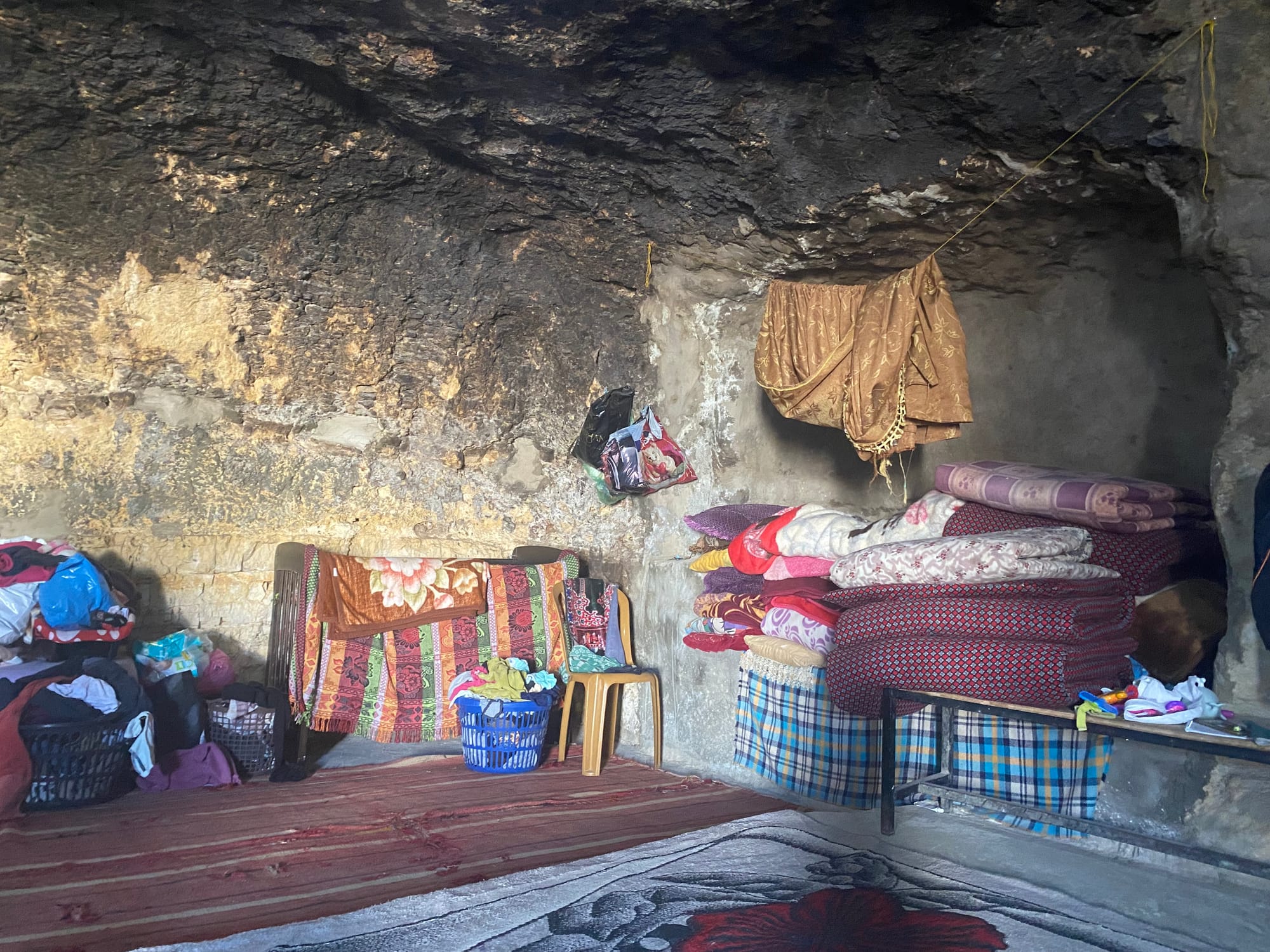
He dug two caves and a well there in order to provide a safety net for the family and ensure a source of long-term stability, if the need were to arise. The cave is one of the oldest shelters known to humankind, serving throughout the ages as a place of dwelling and protection. They are cool in summer and warm in winter, thanks to the thickness of the surrounding rock, which acts as a natural insulator, preventing the interior from being affected by external weather fluctuations. The cave remains a symbol of nature's genius, providing humans with a balanced environment without the need for any modern means, like a house carefully designed by time.
At that point, my grandfather and the family were still spending most of their time in Tuwani, in order to be closer to amenities. But his decision to create an emergency refuge for us in Khirbet al-Tuba had been a prudent one. By the beginning of the 1980s, the occupation had entrenched itself in the land, with the construction of bypass roads, settlements, and cultivation of Palestinian-owned fields, including on the hill where my grandfather lived in Tuwani.
This reality forced him to move permanently to Khirbet al-Tuba, where he continued his life as a simple farmer, tilling the land and tending sheep despite the harsh conditions. He continued this way of life until his death in 2000, passing the land and responsibility onto his two sons, my father and uncle, who maintained those traditions, clinging to the land and working it.
Yet the beginning of the millennium witnessed an escalation in harassment, as settlers expanded beyond the boundaries of their settlements. In 1996, an illegal outpost was established near our mountain, followed shortly after by large-scale demolitions by the Israeli military inside Khirbet al-Tuba, that left us with just one of the caves to house two families.
Despite this, our family immediately began to rebuild what had been destroyed, and remained in the village. But in 1999, we were forcibly displaced once again back to the village of Tuwani, where my grandfather had previously lived. We returned to Khirbet al-Tuba four months later, by order of the Israeli Supreme Court.
With our return, the suffering did not end; rather, it intensified.
In 2002, the main road connecting Khirbet al-Tuba to Tuwani and Yatta, where basic services are available, was closed. We were forced to travel long and arduous routes on foot or by donkey. My father and uncle would make these journeys every week to collect supplies, but they were frequently attacked by settlers along the way. One attack resulted in the theft of everything our family owned, leaving us without provisions for a whole week.
The settlers’ attacks ranged from physical violence and harassment to attacks on our livelihood. Sheep were stabbed or slaughtered, our donkeys stolen, and our crops burned to ash. In 2004, my father's entire harvest was burned after two months of hard work.
With the onset of the covid pandemic, the situation worsened. Settler shepherds, intent on copying our way of life, constructed two grazing wells that encircled the village from the north and south. These wells tightened the noose around us, allowing settlers to graze their sheep on our land and seize control of what remained of our agricultural areas.
With the outbreak of the war in 2023, attacks on our village have escalated to unprecedented levels. Crops and vehicles have been burned, and the contents of homes have been destroyed, all without any pretence of protection from the state. The latest of these attacks occurred on 11 April 2026, when settlers stormed the village and stole five sheep after assaulting residents.
Despite all the displacement, demolitions, and ongoing attacks that our family has endured, Khirbet al-Tuba remains a testament to a story of unwavering resilience. For us, the land is not merely a place to live; it is our identity and our very existence, ingrained in us as our caves are ingrained in the mountainside. Despite all the challenges, we remain steadfast in our determination to stay, whatever the cost.▼
Author
Ahmed Jundeya is a social activist and human rights defender from the village of Tuba in the South Hebron Hills, occupied West Bank.
Sign up for The Pickle and New, From Vashti.
Stay up to date with Vashti.