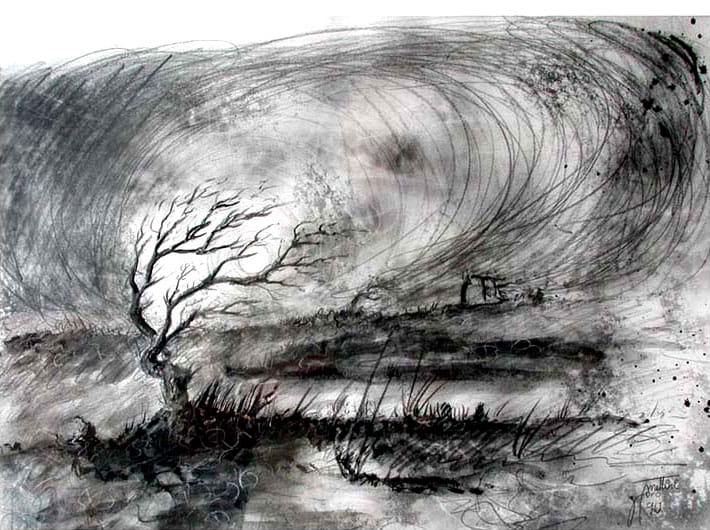
The curtain slowly lifts: the first thing we see are the bare feet of octogenarian actress Illona Linthwaite. She swings back and forth, mesmeric, her skin luminous against the sooty tones of the set and the belching fumes of a furnace. For almost the full four hours of Siegfried she remains on stage as an incarnation of Erda, Mother Earth. She swings, she sits, she gathers flowers. She is entirely naked. With us, she watches Siegfried forge his sword, kill the dragon and get the girl, while gods and dwarves scheme and machinate around him. And the attention she pays to their actions becomes the prism the show is refracted through.
This is Australian director Barrie Kosky’s second full staging of Wagner’s Ring Cycle, and the third installment of the tetralogy at the Royal Opera House, following the first two parts, Rheingold and Die Walküre, which he directed there in 2023 and 2025 respectively. A Wagner veteran, Kosky has previously reckoned with the contradiction of being drawn to the work of a renowned antisemite. His confronting production of Die Meistersinger von Nürnberg (2017), staged in the heartland of Bayreuth at the composer’s own purpose-built opera house – Kosky being the first Jewish person to direct there – dramatised the tensions of Wagner the man vs Wagner the musician. Wagner’s antisemitism is fact: he said to Liszt that “this resentment is as necessary to my nature as gall is to the blood”, and wrote extensively on how Jewish society was impeding the overall development of humans. Bitter descriptions of Jewish features sit beside arguments that their contributions to musical culture were “trivial and absurd”.
More keenly contested is whether those beliefs are embedded in his operas. Kosky’s 2017 Meistersinger production put Wagner, literally, on trial. He drew out the tropes that recur throughout the canon, using a large and grotesque puppet to further caricature Beckmesser – a character widely considered to be based on the Viennese critic, Eduard Hanslick, whom Wagner attacked in his essay Jewishness in Music. But Kosky also used the production to demonstrate his view that despite everything, the music can and does stand apart from those concerns. Whatever beliefs Wagner held, a chord cannot be propaganda. However monstrous the man, and whoever his operas have been co-opted by, the works themselves welcome complexity and invite multiple interpretations.
The interpretations have indeed been multiplicitous. Almost fifty years before Hitler claimed Wagner as an icon of the far right, George Bernard Shaw hailed the Ring as a radical critique of capitalism, which predicted the catastrophic consequences of being motivated by profit and private property. Some productions have leaned into its fairytale qualities (borrowed from Brothers Grimm, born of Germanic and Norse legend), while others have been coloured by psychoanalytic theory. As with Shakespeare, academics have rushed in to pin down single correct meanings and then defend their fields; cordoning it off as the epitome of German romanticism, or a Marxist allegory where humans throw off the ancien régime of divine rule. Arguably the cycle can contain all these threads, and sustain all these interpretations.
Kosky does something different still. Feeling, post-Meistersinger, relatively free of the burden of dealing with Wagner’s legacies, his deft production of Siegfried puts earth and ecology centre stage. As the director has explained, he began work on this Ring in the aftermath of the catastrophic 2019-20 bushfires that ravaged his native country, and the thematic and aesthetic starting point was a reflection of this and the “Immolation Scene” that concludes the entire cycle, with Mother Earth “dreaming and remembering what we were… dreaming of what happened, which is that the world burnt, there was a conflagration.”
The care of Mother Earth
Siegfried was intended as the perfect hero, guided by instinct and uncorrupted by civilisation. Among other influences, Wagner drew on a Brothers Grimm fairytale about a boy who has never known fear. Although the boy in that story eventually wins the confidence of a king and the hand of a princess, he never demonstrates bravery. This dissonance makes its way into the opera, for however rousing the leitmotif horn that accompanies Siegfried’s entrances and bold deeds, the libretto makes it hard to escape his more boorish qualities. Andreas Schager’s Siegfried is above all an adolescent – highly-strung and petulant, one moment full of high sentiment and the next racing round making snow angels, as he waits for a fight to turn up. He’s bent on chasing thrills, all in his search to feel fear. You pity him, kept in the dark as to his true identity by his dwarf guardian Mime (Peter Hoare) who has never shown him love. But despite Mime’s cruelty, it is still frustrating to see Siegfried using his strength to bully him, tapping the Nibelung rhythm out percussively on his tin cap.
All the performances are nuanced: Fafner the giant-turned-dragon (a very compelling Solomon Howard) is splendidly proud of his hoard (his dazzling gold costume is one of the visual highlights of the show) but also, you sense, tired of all the years guarding it. Wotan, Chief of the Gods (Christopher Maltman) seeks to give an impression of omniscience, but also wears his authority lightly – munching on a packet of crisps, and offering them to an enraged Alberich (Purves).
But the most striking aspect of the staging remains Mother Earth. It’s not that the nudity is shocking (except that, on the Covent Garden stage, it actually is); it’s the discomfort we project upon her. It is an entirely visceral production, with the music inducing a bodily affect from the first rumbling of the timpanis and Pappano’s extraordinary conducting sustaining the intensity throughout. This affect is compounded by her presence. Each act takes a different toll on her body: the furnace's industrial smog from Mime’s furnace in the first, and the very realistic snow in the second, which she has to tread very carefully through, putting out a hand so she doesn’t slip. The metaphors are obvious – the pillaging and plundering of Mother Earth that humans have taken part in, and all its devastating effects. But the discomfort operates on another level too. Mother Earth very rarely engages with anyone else on stage, forced, instead, to silently witness. Which means, at least for the first act, watching men talk. She bears this burden with dignity, but the audience feels the impotence painfully.
The last scenes of the third act offer release and relief, with Siegfried awakening Brünnhilde, and the two falling in love. In each act, a different tree has taken up a portion of the stage; in these final scenes it stands giant, a towering and craggy Yggdrassil. At this zenith the music shifts, becomes sweeter. Mother Earth can move round the stage in relative comfort, gathering flowers in the saturated meadow. For the first time, in the face of this immensity of feeling, Siegfried tells us he feels fear.
What does it mean, after all, not to have fear? It means to not care. It means one can operate within one’s own interest, without taking responsibility for others, or for the earth itself. Siegfried plunges his way through danger, and his sword Nothung makes its way through the heart of a dragon bedecked in blistering gold, and the throats of conniving dwarves. He wants to feel fear because he thinks it sounds thrilling, brightly telling us near the beginning “Bold or reckless, what does it matter?” And yet it does. It must. There is hope, at the end, that he has realised this. But of course, there is another, final part of the Ring Cycle to come – Götterdämmerung.
As Kosky says in an interview, in Götterdämmerung, “everything goes horribly wrong, in a catastrophic way, and we know that Mother Earth is going to have to bear witness to that… I find it heartbreaking. And if you can’t be heartbroken at what happens to Mother Earth, then you’re not reading the news at the moment.” This production forces us to be alive to that heartbreak. It makes it our own fear, and thus our collective responsibility: the first step in doing something about it.▼
Siegfried runs until 6 April at the Royal Opera House, and will be screened in cinemas across the UK from 31 March through to 8 April.
Author
Siofra Dromgoole has written for theatre, film, TV, radio and opera. Her debut novel will be published in 2027 by Serpent's Tail.
Sign up for The Pickle and New, From Vashti.
Stay up to date with Vashti.