The Qibya blueprint
Israel has been massacring civilians, and lying about it, since its inception.
“It's Bibi, not Israel.” No phrase better encapsulates the liberal Zionist response to the destruction of Gaza following October 7th.
While most Zionist Jews inside and outside of Israel genuinely believe in the justness of Israel’s war on Gaza, liberal Zionists have had to walk a tight rope: disavowing Israeli actions in the strip while at the same time defending the legitimacy of the state of Israel. And to absolve Israel and Zionism for the destruction of Gaza, there is no better culprit than Benjamin Netanyahu. Israel’s atrocities in Gaza do not reflect who we are, the common refrain goes; it’s Bibi and his far-right coalition. The problem is not Zionism, it is a version of Zionism that has been corrupted by messianic extremists. In other words, what the IDF has done in Gaza since 7 October does not represent the “real” Israel.
Yet, a look at history shows the opposite: the indiscriminate murder of Palestinian civilians has been inseparable from Zionism since at least 1948. And few events demonstrate this better than the Qibya massacre of 1953, when, in retaliation for a Palestinian attack, the Israeli army killed dozens of innocent Palestinian civilians in a carefully planned massacre. Qibya demonstrates that the Gaza genocide is consistent with Israeli history from its beginnings – that the destruction of Gaza differed only in degree, not in nature, from earlier Zionist policies and actions.
A systematic extermination
The early 1950s were a time of frequent military confrontations and skirmishes between Palestinians and the newly independent state of Israel. These clashes stemmed from the fallout from the 1948 war, in which over 700,000 Palestinians were forced out of their homes and villages. Declassified documents from the Israeli army show that Palestinians overwhelmingly left because they were expelled by Zionist militias, and, in the aftermath of the war, this population was yearning to return home. In response, Israel enforced a strict policy to prevent these now-refugees from returning to their villages, regardless of the context in which they left or whether they took part in hostilities. David Ben Gurion, Israel’s founding father and first prime minister, left little room for ambiguity when he proclaimed in April 1949 that the “government line is that they may not return.”
In the years that followed, thousands of Palestinians crossed the armistice lines from Lebanon, the West Bank (under Jordanian control) and Gaza (under Egyptian control) into the territory now controlled by Israel. Most of these “infiltrators”, as Israel called them, sought to return to their homes, visit relatives, or retrieve possessions left behind. Given the few economic opportunities in the refugee camps, many crossed over simply to attend to their fields. A small number were armed militants. A researcher at Israel's foreign ministry wrote in March 1953: “The infiltration is, in most cases, the result of dearth, a separation from sources of income [i.e. fields on the wrong side of the border] or from family members, and of the reality of the refugee camps near the border.” The civil servant concluded that “only in rare cases is it aimed deliberately at revenge and murder.”
In 1953, four instances were recorded of Palestinians crossing the border from Jordan and throwing grenades into Israeli homes. Three civilians were killed. Then, on the night between the 13 and 14 October, a new attack took place, following a similar pattern: Palestinians crossed the border, made their way into the Israeli settlement of Yehud, and threw a grenade into a house. A woman and her two young children were killed.
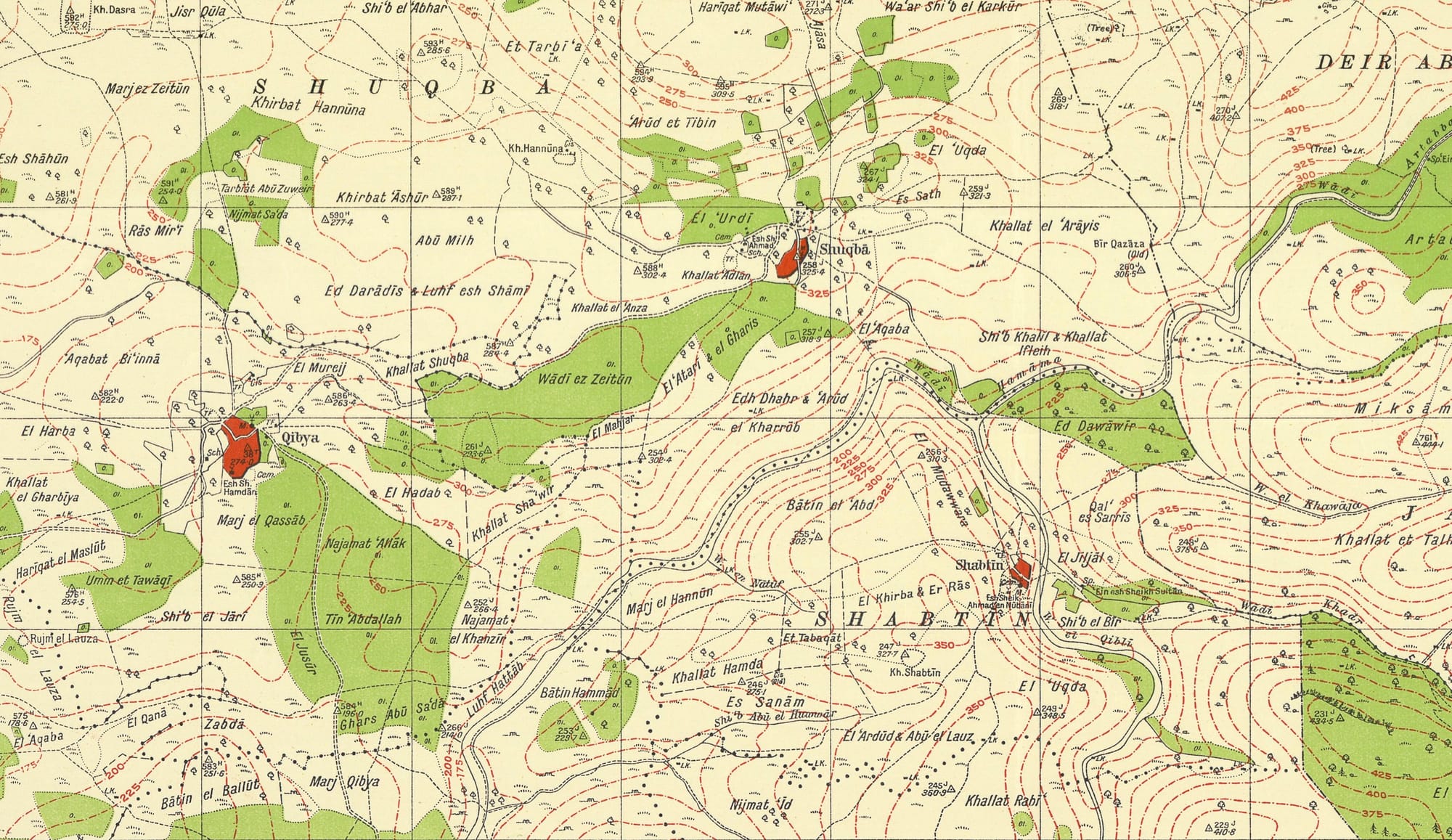
Immediately following the attack, Jordan offered to support Israel in tracking down the perpetrators, even allowing Israeli troops onto Jordanian soil to investigate. Investigators tracked the attackers to the outskirts of the village of Rantis, where they lost their trail. Rather than continue the search for the perpetrators, prime minister Ben Gurion, in a meeting with the defence minister and top military leadership, chose a different path: that of revenge and deterrence. The target of this reprisal was the nearby village of Qibya, where army units were ordered “to attack and temporarily occupy the village, carry out destruction and maximum killing, in order to drive out the inhabitants of the village from their homes.”
Indeed, on the night of 14 October, 130 IDF troops entered the village of Qibya. Under the command of future Israeli prime minister Ariel Sharon, the army moved from house to house, first killing the inhabitants, then blowing up the houses. By the end of the operation, 69 Palestinians were dead, most of whom were women and children. 45 houses, a school and a mosque were also destroyed.
American diplomats in Amman relayed events to Washington in no uncertain terms, reporting that “Israelis systematically exterminated people in houses before blowing them up.” Their counterparts in Tel Aviv cabled that the IDF “opened fire on all buildings, shooting through doors and windows, throwing grenades into buildings and riddling with bullets any villagers who attempted [to] run from houses”. Such accounts were further corroborated by a US naval officer who served as chairman of the Jordan/Israel Mixed Armistice Commission, present in the region at the time, who later recalled in his memoirs:
“an Arab woman perched high on a pile of rubble. Here and there from between the rocks you could see a tiny hand or foot protruding. The woman’s stare was blank . . . . She was sitting on the pile of rocks that held the lifeless bodies of her six children. The bullet riddled body of her husband lay face down in the dusty road before her.”
The “real” Israel
The Qibya massacre was in line with the dominant position, among Israeli policymakers, over how to respond to Palestinian infiltrations. Despite some internal dissent, Israel’s political and security establishment, led by Ben Gurion and future IDF chief of staff Moshe Dayan, supported large-scale retaliation aimed at overwhelming Palestinian resistance with violence. A minority, like foreign minister Moshe Sharett, advocated for targeted military operations coupled with diplomatic outreach to achieve long-term peace. But this minority was systematically marginalized and sidelined. Though Sharrett was acting prime minister at the time, he was not even invited to take part in the discussions leading to the Israeli operation against Qibya.
Moshe Dayan had outlined in 1950 why he supported direct attacks against civilians.
“The only method which has proven itself effective, not that it could be justified or ethically condoned, but effective when Arabs lay mines among us… [is that] we disturb the neighbouring village tranquillity, including the women, children and elderly; [and] then they wake up and complain to the government about the border crossings, and in this way the Egyptian and Jordanian governments are motivated to prevent incidents of this nature…. And they must prevent deeds of this sort, that is, they must stop them on the Arab side. The method of collective punishment has up till now demonstrated its effectiveness.”
The Qibya massacre, then, was well in line with Israeli strategy up to that point. This explains why Israel didn’t change its plans after receiving the Jordanian offer to help track down the perpetrators: Israel’s security doctrine called for the attack against Palestinian civilians.
The global response to the Qibya massacre was unanimous. Jordan saw extensive protests around the country calling for retaliation. Iraq offered to deploy troops to the West Bank. The UN Security Council condemned Israel, while the United States froze its allocation of foreign aid. Britain contemplated deploying troops to support and reassure Jordan, with the vice chief of the Imperial General Staff saying that the British “did not want to fight the Israelis, although we would obviously have to do so, if they made a direct attack on Jordan”. Israel had never faced such universal condemnation.
Faced with this diplomatic crisis, Israel decided to lie. On Ben Gurion’s insistence, Israeli diplomats told the world that the massacre had not been committed by the Israeli army but by Israeli civilians from a nearby settlement. In a televised address, Ben Gurion made the story public, telling Israelis that after “the patience of some of these frontier settlements was exhausted”, they attacked the village. “We have carried out a searching investigation and it is clear beyond doubt that not a single army unit was absent from its base on the night of the attack on Qibya.”
This version of events was so preposterous that even Moshe Sharett, Israel’s foreign minister and acting prime minister at the time, wrote in his diary: “This is a completely implausible story which would make us a laughingstock. It is clear to any observer that the IDF had a hand in the matter.” And indeed, few in the international community, including among Israel’s allies, took the story seriously.
Deceit wasn’t something new for the government of Israel. The expulsion of 700,000 Palestinians in 1948 had been documented in the Israeli army’s own documents, yet Israel claimed again and again that Palestinians had left willingly and Israel held no responsibility for their departure.
But in the case of Qibya, the truth was evident to the entire world. And yet, even when Israeli leaders themselves found the lie to be fantastical and absurd, Israel was willing to shamelessly invent facts to shield itself from accountability. Over the years, and until today, this type of boldfaced lie would become a defining feature of Israeli public relations in the face of global criticism.
Qibya was not the first nor the last massacre committed by Israel in those years. But it was the first time that mass murder had been perpetrated by Israel’s official armed forces following an explicit order from the political leaders of the state. Previous massacres of this scale, such as at the King David Hotel in 1946 or the village of Deir Yassin in 1948, had been committed by Zionist paramilitary groups.
The government that ordered the massacre and lied to cover it up was typical of Israel’s early days. The governing coalition was led by the Labor party, which dominated the Jewish Yishuv before 1948 and Israeli politics for the country’s first three decades. The government was headed by prime minister Ben Gurion and included ministers such as Moshe Sharett, Golda Meir, and Levi Eshkol – all of whom would serve as prime minister in the following years. Moshe Dayan, revered as a military hero, was the army’s chief of operations and was appointed chief of general staff just two months after the Qibya massacre. And Ariel Sharon, who would become prime minister half a century later, was the head of the military unit that executed the massacre. In short, the Israelis who approved, planned, and executed the massacre at Qibya could not better represent the Israel of its founding fathers.
Unity above all else
The willingness to murder civilians as a matter of policy wasn’t restricted to Israel’s political and security establishment. The Israeli press, political parties, and supporters abroad showed almost unanimous support for the IDF’s operation in Qibya.
This was most evident in the Israeli press. With the sole exception of the fringe, non-Zionist paper Kol Ha’am, which ran the headline “Mass Murder Committed in Arab Village of Qibya”, every major Israeli newspaper toed the government’s line – from outlets aligned with the ultra-Orthodox and nationalist right, to centrist, independent and left-wing papers like Haaretz and Davar. All expressed support for the Qibya operation and for Israel’s policy of retaliation. In the days and weeks after Qibya, none used the word “massacre”, instead referring to the Qibya “incident” or “event”. None cast doubt on the government’s narrative that the massacre had been perpetrated by border settlers. Most, after paying lip service to the “unfortunate loss of life”, blamed the massacre on Arab or western governments for doing too little to curb the infiltrations. The few criticisms of the raid focused on the damage the massacre caused to Israel’s public image. Francis Evans, the British ambassador to Tel Aviv, struck by the extent of popular support for the Qibya operation, commented that “the Government of Israel has not very often received from the Israel press so wide a measure of unanimity in their support as on this outstandingly unworthy occasion.”
Nobody was surprised at the Zionist centre and right wing’s unconditional support for Israel’s military actions. But one may have expected those among the left to condemn the massacre, given their claim to stand for universal human rights. Yet, after the Qibya massacre – as after 7 October – leftists closed ranks with the Israeli government, setting aside their criticisms of Israel in order to shield the Jewish state from accountability.
Few cases are as revealing as that of Moshe Sharett. Sharett, despite being foreign minister and acting prime minister at the time, only learnt about the plans to attack Qibya at the last moment. Sharett’s objections were overridden by Ben Gurion. Upon hearing of the massacre, Sharett expressed shock and disbelief, later writing in his diaries that “the fact that we are capable of such killing has been deeply engraved upon the memory and will not be erased. This fact cannot be excised.”
And yet, despite his disgust for the massacre, Sharett fell into line: as foreign minister in what became the country’s most severe diplomatic crisis since 1948, Sharett continued to act as a restless defender of Israel. Sharett went so far as to revise and polish the lies that Ben Gurion read in his address to the Israeli public about the perpetrators of the massacre. Loyalty to Israel and Zionism ultimately superseded any moral qualms about the massacre.
Sharett may have been the most high profile figure to morally object to Israel’s actions while continuing to defend it, but this position was the norm, not the exception, among liberal Zionists in Israel. Mapam, the Zionist party furthest to the left of Israel’s political spectrum (and predecessor to the present-day Meretz) also kept its criticisms to a minimum, focusing on how the massacre gave Israel’s “enemies an excuse to present the victims as the aggressors.”
This contradiction between moral principles and political response to Qibya was nowhere more visible than among US Jewry. American Jews were outraged by the massacre. Rose Halprin, a leader in Hadassah, the powerful women’s Zionist organization, said that the raid “was against the ethical and moral forces of our tradition. There was not a Zionist nor a Jew who was not mortally wounded by Qibya.”
Abba Eban, Israel’s ambassador to the United States, reported that “this operation was the first since the establishment of our State that world Jewry refused to identify with.” Such a strong reaction was in line with American Jews’ commitment to political liberalism and human rights in the US and abroad.
And yet, like their counterparts in Israel, liberal Zionists in the US quickly overcame their moral qualms and ran to Israel’s defence. A delegation of prominent Jews, including United Synagogues of America president Maxwell Abbell and B’nai Brith president Philip Klutznick, quickly met with state department officials to attempt to reverse the freeze on aid to Israel. The scale of the diplomatic crisis even triggered the creation of new Jewish organisations to better defend Israel's interests – including the American Zionist Committee for Public Affairs (AZCPA), which would later become AIPAC. In many ways, Qibya led to the creation of the US pro-Israel lobby as we know it today.
From Qibya to Gaza
Some Jews, albeit few, stood against the depravity of Israeli atrocities. Yeshayahu Leibowitz, an Israeli public intellectual and Orthodox Jew, called Qibya a “cruel mass punishment of innocent people for the crimes of others” and wondered “what produced this generation of youth, which felt no inhibition or inner compunction in performing the atrocity”. Isaac Steinberg – a Territorialist who during the Holocaust had looked for places for Jews to settle other than Palestine – condemned not just the massacre, but the “indifferent or satisfied reaction to this event on the part of the Jewish population in Israel and almost everywhere else in the world”, adding that the events “has been made “kosher” by all possible strategic, political, sentimental arguments – and the moral issue has been completely ignored.”
Steinberg’s words ring truer than ever in the face of liberal Zionists’ unshakable support for Israel post-7 October. But those arguments – above all shifting the blame to Netanyahu and his far-right coalition – ring as hollow today as they did in 1953.▼
There’s no corporation or big advertisers behind Vashti – we're a workers' cooperative and rely on small donations to keep running. Support our journalism to help break the consensus.
To donate once or monthly, click here.
Author
Raphael Mimoun is an activist based in Los Angeles. He writes about Zionism at One Small Detail. He's published on Israel/Palestine in the Washington Post and appeared on Al Jazeera and the BBC.
Sign up for The Pickle and New, From Vashti.
Stay up to date with Vashti.