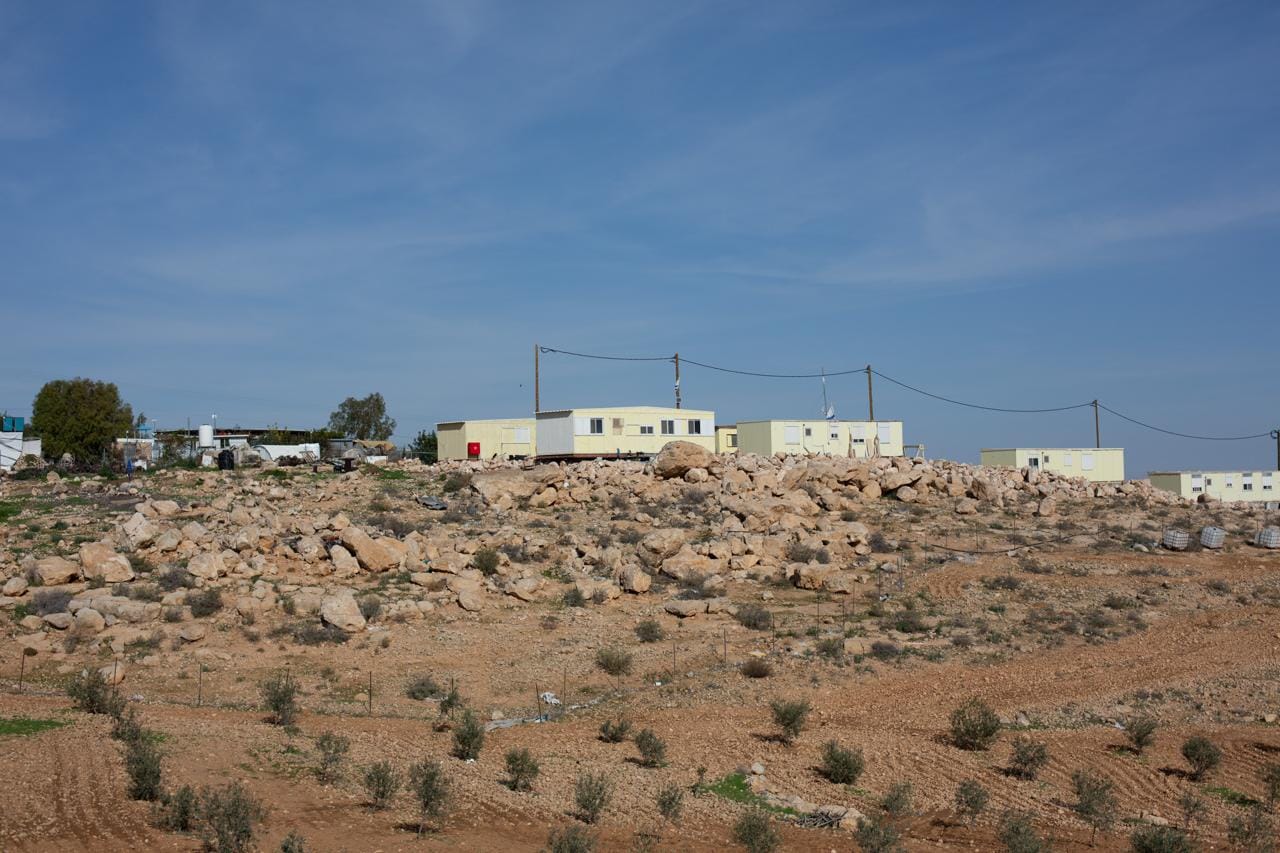
Control over land does not always begin with tanks, nor does it always arrive through declarations of war, televised speeches, or political announcements.
Sometimes it begins with something so small that it barely attracts attention.
A caravan, a modest metal structure placed on a rocky hilltop.
A single door.
A single window overlooking a valley.
At first, it appears temporary, an insignificant detail in a vast landscape.
People pass by and assume it will soon disappear.
Here, the caravan never arrives alone.
It is followed by a dirt road.
Then a water tank, electricity, surveillance cameras, armed settlers, another caravan,
and another.
It is witnessed from kitchen windows, grazing fields, village paths.
It unfolds in front of families who have lived on this land for generations.
Masafer Yatta may appear as a scattered collection of small communities spread across dry hills and valleys.
But it is something far deeper.
A landscape shaped by memory, a place where every path carries a story, every cave recalls a family history, and every field reflects years of labor and attachment.
The relationship between people and land here was not created by political agreements or administrative boundaries.
For visitors unfamiliar with the region, the hills may seem empty.
But for us those same hills are filled with meaning.
They bear grazing routes passed down through generations.
Ancient wells.
Seasonal trails.
For the people of Masafer Yatta, survival is measured in whether a shepherd can reach a grazing area that his family has used for decades.
In how many olives a farmer can harvest without obstruction,
how far a child can walk to school without fear.
In Masafer Yatta there is rarely a single dramatic event, no headline large enough to capture the cumulative reality, no single moment to explain the transformation.
Instead, change advances gradually, a road here, a restriction there.
A newly established outpost on a nearby hill.
Another obstacle between a family and its farmland.
Memory is a powerful force shaping life in Masafer Yatta and so Masafer Yatta must be understood through the language of memory.
Masafer Yatta lives in the names people give to hills and valleys.
Hills and valleys survive because of family stories passed from grandparents to grandchildren.
We endure in the knowledge of where a particular flock once grazed
and in the location of a shade under which a family gathered during harvest season.
From a distance, insistence on staying may appear irrational.
But from within, it is inevitable.
In staying is the belief that a people and a place belong to one another,
is continuity,
is constantly rebuilding,
is children going to school,
farmers tending fields.
Shepherds leading flocks across rocky hillsides,
families celebrating births and weddings.
The caravans arrive,
life continues.▼
Author
Ahmed Jundeya is a social activist and human rights defender from the village of Tuba in the South Hebron Hills, occupied West Bank.
Sign up for The Pickle and New, From Vashti.
Stay up to date with Vashti.