Partners by design
The AI platforms now being taken up by the NHS started out as, and remain essential tools of US warfare.
In late February 2026, OpenAI announced that it would give the US military access to its suite of artificial intelligence capabilities, including ChatGPT. The deal arrived amid a public dispute between the US Department of War and OpenAI’s primary rival, Anthropic, after the company refused to give the government similar access to its chatbot, Claude.
Consumers rallied behind Anthropic’s decision, with Claude overtaking ChatGPT on Apple’s app store, as over four million people pledged to uninstall ChatGPT in a coordinated boycott of the OpenAI-Pentagon deal. Yet this strong signal from consumers did not stop other AI giants from aligning with the US military. In May 2026, the US Department of War announced agreements with seven tech companies – including SpaceX, Google, NVIDIA, Microsoft, Amazon and Oracle – allowing the government to use their AI models on classified servers.
Consumer boycotts like QuitGPT rely on market forces for their effectiveness, presuming that if demand for a product drops drastically enough, the company in question will alter its behaviour to regain its customer base. In other words, if enough customers drop ChatGPT, OpenAI will have to cease its dealings with the Department of War to continue making a profit.
But the US Department of War is no ordinary business partner. Instead, the current AI boom shows the modern US military-industrial complex (MIC) at work. Through significant investment in research and development (R&D), the US government essentially placed a down payment on its unrestricted access to ChatGPT over 20 years in advance.
Existing theories of the US MIC are divided on whether the state or private sector is the primary driver of modern military innovation. Yet, as the AI boom shows, neither understanding captures how both the state and private sector are part of a broader, global cycle. Tech capitalists developed artificial intelligence by cycling the technology between the military and consumer sectors over time. Emerging military technologies in the US are often the product of military R&D and subsequent refinement through sale on consumer markets the world over, including here in the UK.
The military-civil fusion
Increasing collaboration between big tech and the American defence community is not surprising, given its decades-long history. In fact, after the Cold War, the integration of consumer technology into military systems constituted a key strategy, eventually forming what scholars would call “military-civil fusion”.
Until the end of the Cold War, the military and commercial technology sectors operated according to different logics. Military defence contractors collaborated with the government to develop new technology for military use. Then, years later, those advancements would sometimes be incorporated into consumer products.
In the 1990s, the boundary between military and consumer technologies became increasingly blurred due to several factors – including the proliferation of so-called “dual-use technology” with both commercial and military applications; the increasing cost of advanced weapons systems; and a short-term contraction in US defence spending following the dissolution of the Soviet Union. At the policy level, both the Clinton and Bush Administrations promoted what Evron and Bitzinger call “military-civilian integration”, which they define as “the process of combining the defence and civilian industrial bases so that common technologies […] can be used to meet both defence and commercial needs.”
These efforts to increasingly intertwine the commercial and military technology sectors reformed the military-industrial complex in two significant ways. First, while the Cold War MIC relied primarily on government-led R&D, the post-Cold War MIC became much more interested in private-public R&D collaboration. Second, the Cold War MIC was primarily a domestic affair. Now, the US military is heavily integrated in the industries of other countries, particularly Israel. In the mid-20th century, Israel was primarily a recipient of American weapons; today, it is one of the US’ main collaborators in the development of new military and consumer technology. Of the 300 foreign-invested commercial R&D facilities in Israel, two thirds have been established by US companies. And the F-35 fighter jet – the US’ weapon of choice in strikes against Iran, and Israel’s in its continued genocide of the Palestinian people in Gaza, was developed through a US-Israeli research collaboration.
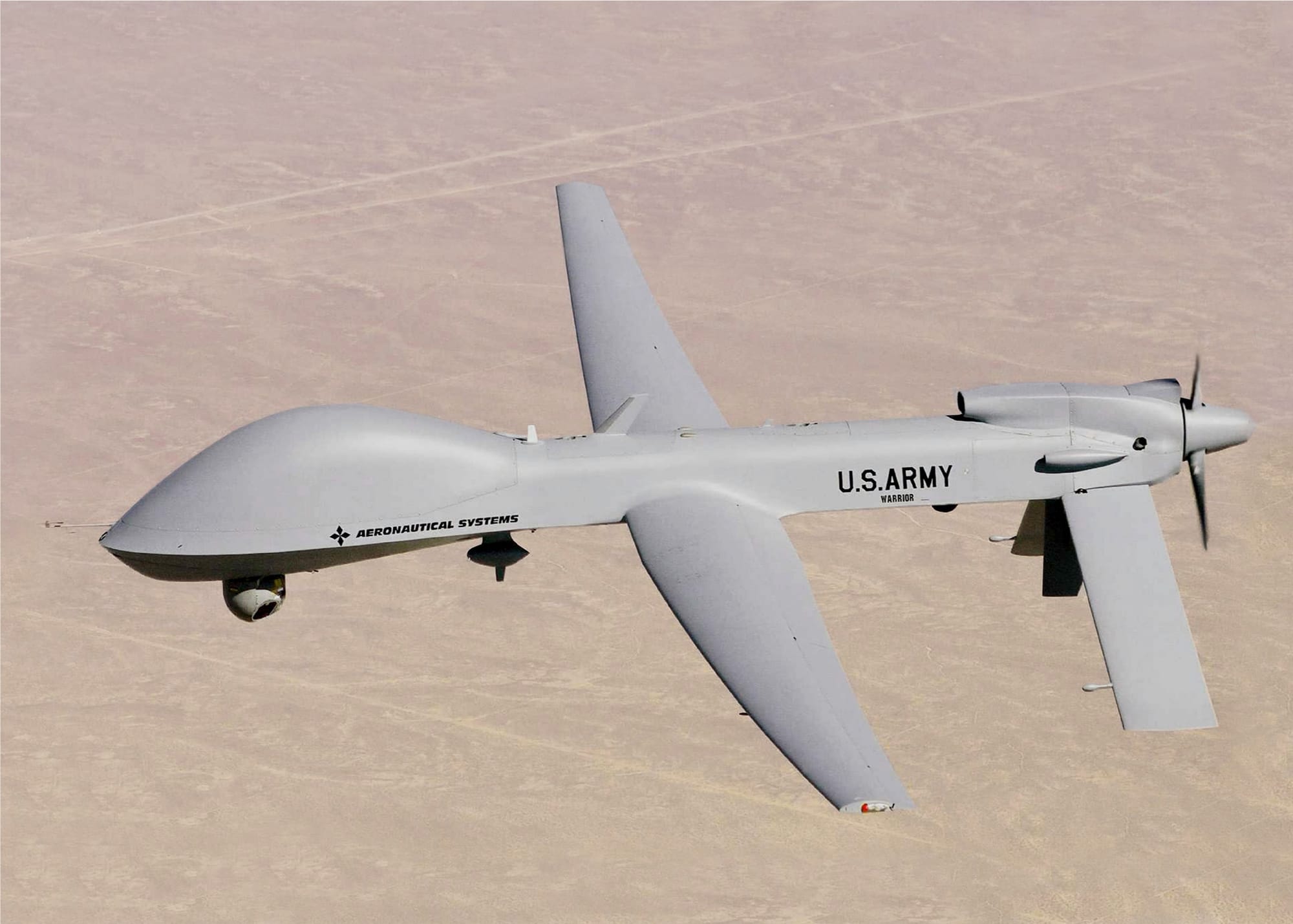
Many of today’s technological advances, from drones to AI to mass surveillance technologies, represent the fruits of this long-term collaboration between the military and the commercial tech sector. Most crucially, the military has begun using consumer markets around the world to innovate and refine technological advances. In turn, the commercial technology sector has recognised that it can make further profit by leveraging military battlefield testing to refine new tech before it hits consumer markets.
A cycle of carnage
Building on classic formulations and more recent research, I argue that today’s MIC is best conceptualised as a cycle, composed of four steps. First, defence departments, like the US Department of War, use public money to fund R&D, giving research grants to universities and private companies. Second, private companies transform these technological advances into consumer products, where they are refined through large-scale use by global consumers. Third, these technologies are integrated into the US military, where, Anthony Loewenstein argues, they are further refined through “battle testing” on oppressed populations around the world. Finally, private companies re-commercialise this technology, turning technological gains built through murder and exploitation into profit.
Using this heuristic, we can understand today’s chatbots, image generators, and virtual girlfriends as the initial commercialisation of military R&D initiatives – or step two in the process. For evidence of this claim, we need look no further than the origins of the AI boom itself. In the early 2000s, the Defence Advanced Research Projects Agency (DARPA) issued a grant to Stanford graduate student Ian Buck. Historically, DARPA has been (and in some ways, still is) the key military R&D arm of the US government, at least partially responsible for developing some of the world’s most important consumer technologies, such as the internet, GPS, personal computers, and weather satellites.
With DARPA’s financial support, Buck discovered that the graphic processing units (GPUs) initially designed to power video game graphics could process code much more efficiently than traditional central processing units (CPUs). NVIDIA quickly hired Buck to develop a new GPU-driven software, “CUDA”, which unlocked higher levels of computing power. Released in 2006, CUDA attracted the attention of software developers and investors, including a certain Sam Altman, who would go on to found OpenAI in 2015.
In 2018, OpenAI used a network of NVIDIA GPUs – designed by Buck and funded by the US military, to develop GPT-1, the precursor to today’s ChatGPT. Since then, AI chatbots have become ubiquitous. Meta, Alphabet, Microsoft, and Anthropic all use NVIDIA chips to power their AI systems, skyrocketing NVIDIA’s valuation and making it the world’s most valuable company.
According to economist Jason Furman, investment in AI infrastructure accounted for 92% of US GDP growth in the first half of 2025. If true, this would mean that the US economy is primarily driven by technologies born from military R&D. The AI boom represents the apex of military-civil fusion: the same technology used to commit genocide and wage war abroad is the largest source of economic growth in the US today.
From AI to Palantir
However, the AI boom is not a singular event, and recognising that most commercial technology today is a product of military collaboration from the outset allows us to more effectively target the full range of actors complicit in imperial violence. The whole picture shows us that the root of the problem is not a single opportunistic company, or even a group of them, but a cyclical process that develops and refines technology through carnage.
Take for example the recent pushback against Palantir’s £330 million contract with the NHS. The contract, first signed in 2023 and up for renewal next year, deploys Palantir’s Foundry platform to streamline the NHS’ Federated Data Platform (FDP). MPs and NGO leaders have raised concerns about Palantir’s history of collaboration with the US and Israeli governments to develop mass surveillance technology.
Now, after over a decade of developing these military technologies, Palantir is marketing a civilian-focused product to the NHS. Palantir’s latest entry into the civilian tech sector represents the final stage in the MIC cycle, in which private companies re-commercialise military products after decades of collaboration between the civilian and military sectors.
Peter Thiel openly admits that he founded Palantir to incorporate commercial fraud detection technology into military surveillance infrastructure. Before Thiel started Palantir, he co-founded PayPal, an online transaction company whose early fraud detection algorithm, Igor, would go on to form the basis of Palantir’s “terror detection” software.
In the early 2000s, Igor was considered revolutionary for its ability to identify fraud in real-time, processing large amounts of data, such as user location, type of purchase, and time of day. Ironically, part of the need for a software like Igor came from the prevalence of fraud from PayPal’s global consumer user base, including hundreds of countries. While its popularity is declining today, the UK used to be PayPal’s second-largest consumer market behind the US. As early as 2001, FBI agents consistently stopped by PayPal’s offices to compare the results of their own fraud detection software with Igor’s.
But Igor itself was only possible through technological advancements funded by military R&D. Igor had to quickly perform a series of complex calculations, requiring a level of computing power that had only recently become commercially available through DARPA funding in the late 1980s. The same DARPA-funded microchips which went on to enable personal computers also supported Igor’s initial calculations.
Thiel transformed Igor – which itself was made possible by military R&D – into the basis of Palantir’s 2008 military surveillance platform: Gotham. This technology aggregates data from wide-ranging sources to help US intelligence and law enforcement communities target people they suspect of crimes. About a year after its release, Palantir began selling the software to the US military. Sociologist Anthony King argues that Palantir’s co-founders refined their understanding of military surveillance through working with American soldiers stationed in Afghanistan. And, after this process of military refinement, in 2015 Palantir released its flagship civilian product, Foundry, a platform like Gotham designed for use by NGOs, private companies, and welfare databases, including the NHS.
Disrupting the plan
The current NHS-Palantir contract represents more than a dispute about healthcare data. It is the latest stage in a decades-long cycle. In the 1980s, publicly-funded military research helped create the computing infrastructure behind Igor, a revolutionary technology in commercial data analytics. Palantir then adapted this consumer technology for military surveillance, in part through partnerships with intelligence and defence agencies. Now, the result of this “battlefield refinement”, Foundry, is being sold back to a civilian institution.
The creators of QuitGPT are right to be concerned that AI could be used for building deadly military products. If the past is any indication, the incorporation of refined civilian AI products into military systems is already well underway. The Israeli military has used technology developed by US AI giants like Microsoft, Amazon, Alphabet and Palantir to murder Palestinians during the ongoing Gaza genocide. Prior to their current dispute, the US military used Anthropic’s Claude, to pick bombing targets for the war on Iran and to facilitate the kidnapping of Venezuelan president Nicolas Maduro. In late May 2026, the US House introduced a bill to further integrate the US and Israeli militaries for the purpose of bilateral research and the development of new military technology.
Because the military-industrial complex is a cycle measured in years, we are often unaware of how today’s consumer tech will go on to help produce the violence of tomorrow. If we want to disrupt the military-industrial complex, we must recognise that alliances between big tech and the US military are not opportunistic anomalies, but part of the plan.
A broader struggle is required: against not only tech companies’ complicity in genocide, but against the logic that turns daily consumption patterns in the US, UK, and elsewhere into insights used to enact violence. Technology can and should be developed in service of human need, rather than imperial carnage.▼
Author
Jacob Ostfeld is a PhD student in Political Science at the University of California, Berkeley.
Sign up for The Pickle and New, From Vashti.
Stay up to date with Vashti.