Why does Israel want to further privatise the genocide?
An interview with political economists Shir Hever and Khem Rogaly.

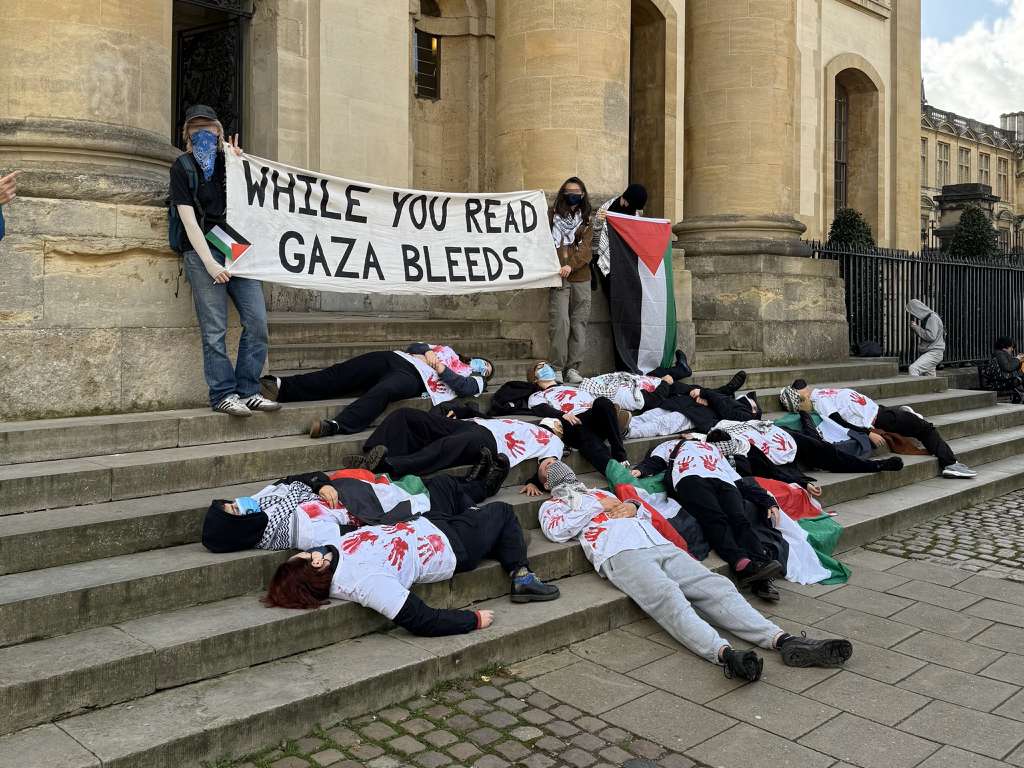
Two and a half years into the genocide, coverage of Israel’s atrocities in Gaza has all but disappeared from mainstream media.
This willful ignorance – to roughly 1,500 Israeli violations of the October “ceasefire”, to attacks that regularly murder children, but also to the long arm of genocide that kills through man-made famine and malnutrition, continued restrictions on shelter during a devastating winter, and the total destruction of Gaza’s medical infrastructure – is both a product of the media’s inherent tendencies and the result of a successful PR campaign by Israel, the US, and its European collaborators.
Lawyer and writer Selma Dabbagh captured the core of this effort last November: “After two long years during which use of the word ‘ceasefire’ was enough to put you at risk of losing your livelihood or political career, after resolutions calling for a ceasefire were blocked repeatedly by the US at the UN Security Council, ‘ceasefire’ has become something we are expected to be grateful for, now that ‘ceasefire’ means continued genocide.” What we’ve seen, in the words of journalist Bisan Owda, is genocide rebranded.
To counter this branding-induced silence, The Nation magazine (where, I should say, I also work) turned its website over to writers and photographers from Gaza earlier this week in a series called “A Day for Gaza”. Through diary entries, photoessays, and catalogues, these entries document what has been lost, what remains, and what will never go away. It’s worth reading in its entirety if you’ve not already done so.
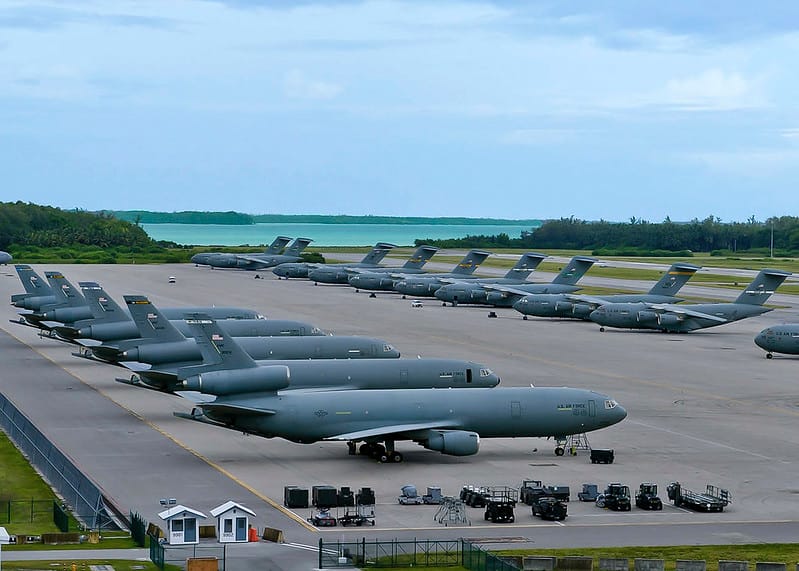
As the genocide continues apace, so too, by necessity, does the development of the Israeli war machine. Already in 2026, a number of reports have surfaced about potential changes to Israel’s military-industrial complex, including prime minister Benjamin Netanyahu’s declaration that he supposedly intends to wean Israel off US aid over the next decade, as well as more immediate plans to privatise two of Israel’s largest state-owned arms companies.
Taking the issue of privatisation as a starting point, I spoke to political economists Shir Hever and Khem Rogaly about the underlying crises within the Israeli war economy, the continued complicity of asset managers and venture capitalists, and paths ahead as the UK and Europe reconsider their relationships to the US.
Dr. Shir Hever is the author of The Privatization of Israeli Security, published by Pluto Press in 2017. He is the Managing Director of the Alliance for Justice Between Israelis and Palestinians, a member of the Jewish Voice for a Just Peace in the Middle East, and until recently was the coordinator of BDS’ military embargo campaign.
Khem Rogaly coordinates the day-to-day research programmes of the Transition Security Project and is also Principal Research Fellow at Common Wealth, where he has led work on militaries and their associated industries since 2022.
This conversation has been edited for length and clarity.
– Evan Robins
ER: A few weeks ago, Reuters reported that Israel plans to begin the privatisation of Rafael Advanced Defense Systems and Israel Aerospace Industries (IAI), two of the country’s largest state-owned defence companies. According to the story, the government intends an initial sale of 25 to 30% of the companies on the Tel Aviv Stock Exchange sometime later this year.
Following the recommendation of McKinsey consultants, Israeli defence privatisation has been on the table for over twenty years. In 2018, then-defence minister Benjamin Netanyahu approved the privatisation of IAI, though it did not proceed to an IPO. IAI again received approval in 2020, but ultimately remained fully state-owned.
Can you explain, Shir, why the Israeli government is trying this again now, and whether major defence privatisation might be more likely to actually take place this time?
SH: I think we should be very careful with the word “trying”. They’re announcing — the same thing that they did before. This has value in itself for their own political purposes.
Let's put things in this perspective: the Israeli government is trying to create the impression that it’s preparing for an upcoming election. There’s no date for the election yet, but everything that the government does right now should be seen within this framework. So what we have to ask ourselves is who stands to profit from privatisation? Who stands to lose from it? This would give us an idea of what's really happening.
IAI and Raphael have very concealed debts. These companies are boasting that they're making tremendous revenue because of the war, because of the genocide, but in fact most of what they do is provide weapons for the Israeli forces, and, according to early 2025 reports, the Israeli government is not really paying them on time; it's all done on credit.
That means that all of the operating costs are being paid now, but the revenue is not coming in. So there’s a cash flow problem. And at the same time, the [Bezalel] Smotrich ministry of finance is plundering every possibility for revenue that he can find, because Israel as a whole has a very serious debt problem.
I think we should also pay attention to the fact that there's a new candidate for chairman of IAI, Silvan Shalom, who has been accused of sexual assault. Nevertheless, they're promoting his candidacy because he’s from a wealthy family and brings in a lot of money.
He’s also very connected to the Likud Party, and Likud is also extremely involved in IAI. The chairman of the board of IAI is a member of the party, and makes sure that every member of IAI registers as a member of the party.
This [the number of IAI workers] is enough people to make a big difference in the party’s internal primaries — Likud is the only party in Israel that has an internal primary. This means that Netanyahu can give them a list of who to vote for, and IAI does what he tells them to do in exchange for something, like some kind of bonus.
In my assessment, we’ve seen something like this before. In 2020, during the war between Azerbaijan and Armenia, Israel provided IAI suicide drones to the Azerbaijan military. Netanyahu brokered the deal through then-foreign minister Israel Katz, a Netanyahu lackey. This was framed as a generous gesture to Azerbaijan, even though the drones are very expensive and inefficient compared to other weapons. IAI likely made a big profit (the actual contracts were erased from their financial reports) that enabled it to pay its workers a big bonus. And then, just ahead of the election, Netanyahu got his people into the right places in the party, and was able to make sure that he gave the ministries to his most loyal supporters.
I think this is probably what's happening right now. Netanyahu is happy to talk about privatisation, which is something that they very much want because the workers will get a massive bonus if the company is privatised. They’ve already indicated that this would happen.
However, I don't know how much the workers and the government are buying into the hype that the company is profitable. I think the government at least must know that this is hype. If they try to sell it now, who will buy it? That’s part of the problem, so I'm not so sure that it’ll actually be happening very soon.
ER: Right, that’s a key question. Khem, do you have a sense of who might be potential investors should these IPOs go ahead?
KR: If you look at the privatisation of the military industry in the UK or the ownership of military contractors in the US, what you see is that the companies are mostly owned by index investing funds and institutional investors like BlackRock, Vanguard, and State Street – your typical asset manager that will invest across the whole economy. Asset managers extract consistent payouts from these arms companies based on revenue from the government and from the wider network of subsidies they receive.
In Italy, you have the example of Leonardo, in which the state still holds a 30% stake. Asset managers are now some of its most significant shareholders. In that case, which has been studied by the economist Simone Gasperin, a company that had been doing both military and civilian work basically consolidated into its most profitable military activities, to the benefit of those shareholders – and lost the technological benefits provided to the rest of the economy from its civilian work by gradually selling off more and more of its business.
Venture capital and private equity represent another group of investors in today's global military industry that’s very powerful, most of all in the defence tech sector, that’s coming to wider prominence in the US and in Europe. This is a much less transparent type of investment because they're private funds. You often don’t know where the money is coming from and it's hard to trace their investments.
In the case of Israel, it will likely be institutional investors who take ownership at the IPO, but I'm wondering if Shir thinks there might be large investors who have a kind of political alignment with the government?
SH: Israel has very strict controls and regulations about privatisation and, generally, the involvement of business people in national projects. Everything that’s considered to be strategic, whether it's about infrastructure or energy, or of course, the military industry, is overseen very carefully by the Shin Bet (the secret police), which makes sure no foreign investor with a possible conflict with Israel's national interest would be buying.
I think right now is a unique moment in the fragility of the Israeli institutional structure because Netanyahu is calling the Shin Bet part of the deep state, and he appointed one of his own supporters as its new head.
There has been talk in Israel for many years: what if Saudi Arabia or the UAE just decided to take over a company like IAI or Raphael? What would stop them from doing so? Well, it would be the secret police conducting an investigation. I think that there is actually a possibility for the government to go around it if they decide that they just need the money. Then I can also see the logic for the government of the UAE or Saudi Arabia. Even if they don't believe that they're going to make a lot of money from this deal, it would give them tremendous political leverage.
KR: To that point, it's very hard to trace who is investing in the venture capital and private equity funds that have overseen the rise of defense tech in the United States. But, in the tracing that has been done, researchers have connected some of the investment funds run by Gulf Monarchies with investment in the Silicon Valley defence tech companies that are now trying to take a much greater share of the US military industrial complex. [In addition, reporting in late 2025 indicated that the Saudi sovereign wealth fund was in “advanced talks” to invest in Italy’s Leonardo arms contractor.]
ER: Let’s talk about arms privatisation in the context of the Israeli economy at large, now nearly two and a half years into the genocide. Shir, you’ve written about how this is a real moment of crisis for Israel, evidenced by bankruptcies, emigration, and labor shortages. At the same time, we see headline after headline about how the Tel Aviv Stock Exchange has performed better than any exchange in the world since 2024. How do you make sense of this?
SH: I think that the level of crisis of the Israeli economy is severely underestimated because the Israeli government is working hard to try to hide the information.
For example, when there are reports about the emigration of the upper middle class and the educated elite, the Israeli government will say, for example, that this is all fake because the totality of emigration is of Ukrainian Jews who are leaving Israel because they're going back to Ukraine.
The number of people who’ve left is much, much higher than this. The lowest estimate published for 2025 was a 70,000 net emigration. But people aren’t counted as having emigrated unless they’ve completely cut their ties to Israel. If they still have an address in Israel, if they still pay their health insurance, they're considered to be residents of Israel. Even if they haven't set foot in Israel for, for over a year. And if they have cut all these things but left less than a year ago, then they're still considered to be residents of Israel.
This means, of course, a direct impact on Israel's education and technology sectors, every year. Since 2023, the number of students that enroll in university every year is much smaller than the rate of population growth. So statistically, Israelis become less and less educated every year.
If you look at the Israeli tech sector, you see big exits which Israelis celebrate as successes. But actually what it means is that those companies are leaving Israel. They’re finding a buyer like Google so they can leave. That's certainly not what makes the Israeli tech sector stronger.
You mentioned the stock market. I just received the report of the government’s chief accountant on Israel's debt situation. It's unbelievable that they're not reporting all the weapons that Israel buys on credit. This is about $120 billion that Israel has spent on weapons after 7 October just, from foreign companies, not from their domestic companies.
If you go through the list of those deals, they always say, well, this deal is worth, let's say $2 billion. And out of those $2 billion in the first year, we pay zero, meaning it's all on credit. I believe that these companies will want to be paid, so it's debt and all this debt is just not reported.
Another thing that the Israeli government did in order to deal with the shortage of soldiers was to bribe reservists with a much higher pay than they’ve ever paid before. They've been paying $8,800 per month, which is more than twice the average wage and more than four times the minimum wage. If you think about these reservists, especially the younger ones who don't support a family and who are serving in Gaza for hundreds of days, they get all this money and they have nothing to do with it except put it in the stock exchange. And then you have this hype in share prices when there's no economic activity behind it.
ER: What do you see as the timeline of the crisis?
SH: When I started to see this unraveling in front of my eyes, I didn't think Israel would make it through 2023. Then I didn't think there would be a state of Israel in 2024.
My mistake was to underestimate the complicity of the west and the willingness of international actors, especially the United States but also the European Union and the UK, to ignore international law and to take a hit domestically in order to support Israel.
So the question is how long can this go on? Will the US be able to somehow sustain the Israeli economy, the Israeli military forever? I don't think so. There is a growing price and Trump has already indicated that in many ways he's not too happy to pay this price.
It’s also a question – that I don't know how to answer – of how long people can lie to themselves and ignore the reality in front of their eyes. It's hard to say because the technology that can create very believable, very realistic false facts and bombard us with those has advanced tremendously in the last few years.
ER: Khem, have you see seen any change in the willingness of asset managers and other funders to continue to invest in genocide, particularly as the Israeli war economy struggles in these ways?
KR: There has been movement in areas where the financial system is somewhat more democratic. That's primarily in pension funds where there has been divestment, whether it's local or regional government pension funds or far bigger funds in Norway, for example.
When it comes to the asset managers, there hasn't been major divestment from Israel. Israeli companies really need that capital, and they’re advertising genocide to the west as an opportunity for profit. Privately owned funds or asset managers within the traditional financial system are likely to see profit-making opportunities in Israeli arms companies that are “battle-tested” in providing technologies successfully implementing genocide or wider regional war. There has been massive spending on these companies, and it unfortunately continues to provide an opportunity for investors to profit.
ER: To wrap up, I have something of an absurd question. In terms of organising efforts against the genocide, is it preferable, from that perspective, for these state-owned arms companies to become privatised or to remain within their current economic conditions?
SH: These are criminal companies and we want them not to exist at all. But the issue of privatising externally or internally is the key. If the company is state owned, or like Elbit Systems privately owned by Israeli hands, then I think it makes very little difference. If the company is owned by foreign investors, then this opens the door to more complicity.
This complicity is the reason that the genocide has been able to continue for so long. So this would be a bad thing. I think if there are suddenly investors who are just normal people, institutional investors, and their pension funds depend on Israel killing Palestinians, then they're less likely to protest the killing of civilians.
KR: I think there's another point to be made here, which is that when these companies have more external liabilities, that creates more points of leverage and more points at which they can be protested.
However, I would be sceptical that major institutional investors coming in, like BlackRock or Vanguard, would really provide much space for democratic pressure. I don't think that's particularly likely or a route to stopping the Israeli war machine.
Ultimately, I think the question of how to stop the Israeli war machine is a question of external aid. The economist Stephen Stemler recently estimated that the US has provided $263 billion in military aid to Israel between 1950 and the present day.
What you have, then, is a genuine collective class interest among people living in the US against this military, because you don't have a functioning healthcare system or social security, and there are many Americans living in poverty, while they're giving out billions of dollars every year in free weapons to Israel. I think that there's really the potential to build a wider democratic politics around that.
At the same time, you also see citizens on the continent of Europe and in the UK protesting this complicity. In particular, the awarding of public contracts to Israeli arms companies is a clear target of protest and can be undermined.
I think that for the European and UK context, a key contradiction now emerging, beyond their direct relationships with Israel, is their relationships with the US. As those countries disentangle their relationships with the US, it would open space for them to disentangle their relationships with Israel as well.▼
Author

Evan Robins is an editor at Vashti.
Sign up for The Pickle and New, From Vashti.
Stay up to date with Vashti.