How to cross a road under apartheid
The army’s new gates outside my village are a catastrophe.
Before the war, I would walk to Juwaya with my two daughters, spending time together, laughing together. Me and my girls, and just a 30 minute walk.
Juwaya is the village where I grew up. It’s just across the road from the village of Tuwani, where I now live with my husband Zakaria, and four children. Before the war, I would cross the road every two weeks to see my parents and siblings. Now, I go every two or three months; sometimes it’s even longer.
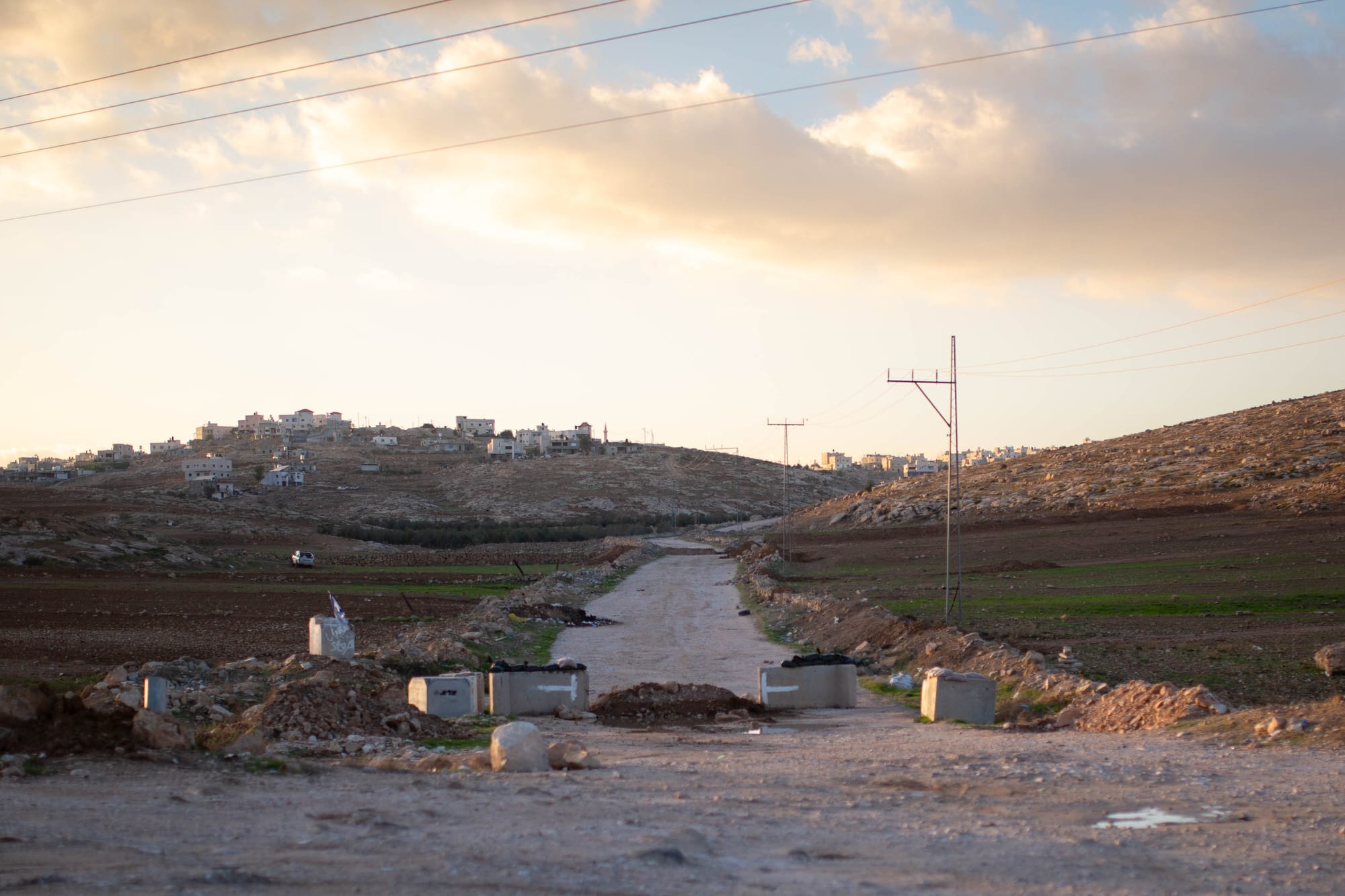
A week into the war, soldiers installed a new gate on the road opposite Tuwani, which leads to the village of Birke in one direction, and to Juwaya in the other. And four months ago, in September, they installed another one on our side of the road, in Tuwani. The two gates are big, yellow, and can block the entire road if the army decides to close them. When the gate is closed and there are soldiers, we don't go. When the soldiers leave, we enter the village on foot. Our gate is not closed very often, but the one at the entrance to Juwaya has been closed since the war began.
My family still comes from Juwaya to visit me sometimes, but not like before. It used to be very easy for them to jump in the car, but now they have to walk, come on a donkey, or drive a long way around the gate to reach us.
Sometimes, before the war and before the gates, Zakaria would walk with me and our daughters. But now, Zakaria can’t walk the whole way and he can no longer hold the children.
It feels like a disaster. A catastrophe. I feel like life goes on and I’m just standing, not doing anything. No work, no visiting families, no leaving the village.
After the war, my cousins got married and I couldn’t go, because of Zakaria and my children.
To go visit my family now, I need to book a taxi, so I can take my four children and Zakaria with me. We must first cross the road and walk past the closed gate leading to Juwaya, where the private car picks us up and takes us the rest of the way to my family’s home for 15-30 shekel. Then we spend another 15-30 shekel on a taxi for the way home. If we want to go to Yatta or Hebron, we must pay more.
When I go to my family in Juwaya, or to see the doctor, or to run some errands in the nearby city of Yatta, Zakaria is always thinking about me and asking if I’m on the other side yet, wondering if I’ve arrived. He’s very afraid for me.
But I cannot stay at home.
A few days after the war began, Zakaria was shot in the stomach by a settler. It happened as he stepped out of the mosque after the Friday prayer. The bullet was an illegal “dum-dum” bullet which exploded inside his abdomen, causing severe damage to multiple organs. Since then he has undergone thirteen operations. Two years later, his condition is much improved, but he still cannot walk or get medicine and food for our children. So I must go instead of him.
Since the attack, he has been sentenced to lifelong suffering and disability. The doctors told him that his four broken ribs will take years to heal, that he will not be able to work for ten or more years. Because of his experience, he is always afraid for the kids and for me. Just recently, settlers from Havat Maon, the settlement where the settler who shot my husband came from, drove through our village and attempted to ram into women crossing the road.
If I didn’t have to worry about my children and my husband, I would walk home to my family right now, I would cross the road and go. I wouldn’t care if something happened to me. But I am very afraid for them.
I have a real connection with the road. I feel like when I walk, I remember the old days. The road is unpaved and rocky, starting at the main traffic road, highway 317, and continuing on to the nearby city of Yatta. You can use it to get anywhere.
It used to be very beautiful. In the winter there was once much rain and snow, and it was very cold. I studied in Tuwani from sixth grade until the end of high school. When I would walk, at least twice a winter I would come back drenched with water. When I arrived home, my mother would look at my clothes and shout, “take them off!”, bring me to the fire, and bring me new warm clothes.
All my problems felt like they disappeared with the rain. It calmed me to walk in it.
It would wash away my problems, any stress inside me, my thoughts, my sadness and anger. When I would walk, especially in the rain, it would clear my mind. I would feel renewed. I loved myself with a smile, laughing all the time, thinking positive thoughts. I didn’t want any of that to change, I knew that sometimes life can change, but I didn’t want that.
In the spring, Juwaya is very green, full of poppies. We’d walk around our mountain to pick the flowers to bring to my mother and to admire their beauty. When I was walking on the road, I felt like I was in an animated movie. It’s full of flowers and grapes and greenery. I would walk and enjoy the nature.
In the summer, it’s like a desert, but it’s so lovely. In the fall, it’s cool, there’s a beautiful breeze.
I would love to go back and walk from Juwaya to Tuwani. My brothers and I would race to see who could get to the other side first. We would get excited to make the crossing and there was nothing we feared or were nervous about. Now, in spite of everything, two of my younger sisters walk that same road to come to Tuwani for school every day. They come by after school to visit me for a short while.
The road also brought me to my husband. I would come from Juwaya to the school in Tuwani, and he would work in the store. I saw him in the shop and was shy. I was 17. One day, as I was going to my family home, he also walked in that direction and said hello. After we got engaged, he told me that he came just to say hello to me.
But there’s a big difference between now and then. Now I have four children, including twins who are two years old. Now it’s very dangerous to cross and I’m afraid that a car will hit us as we run to the other side. Now the settlers and soldiers can kill, shoot. Ben Gvir has empowered them, and given them permission. I know this very well because it happened to us, to my family.
Always being inside, I feel strangled. The kids cannot go wherever they want and they are not comfortable. It’s a very difficult feeling when you’re stuck and you can’t do anything. Life passes before your eyes and you can’t do anything.
The children want to go out, to play, to be children.
My home is not too big, not too small. There are two rooms, one kitchen, one sitting room with a TV. My children watch cartoons and I watch them watching.
We try to play together, exercise, do anything to change our routines. Because the twins are so small, and because they are just two of four, I’m always surrounded. Sometimes I feel alone because I can’t get out to see my cousins, my aunts and uncles, my friends from before.
It’s been so long since it was a 30 minute walk. Also since it rained.▼
Author
Shoug Al-Adara lives in the village of At-Tuwani in Masafer Yatta with her husband and four children.
Sign up for The Pickle and New, From Vashti.
Stay up to date with Vashti.