Hollow Oscar
A year after No Other Land won international acclaim, the world remains content to sit back and watch.
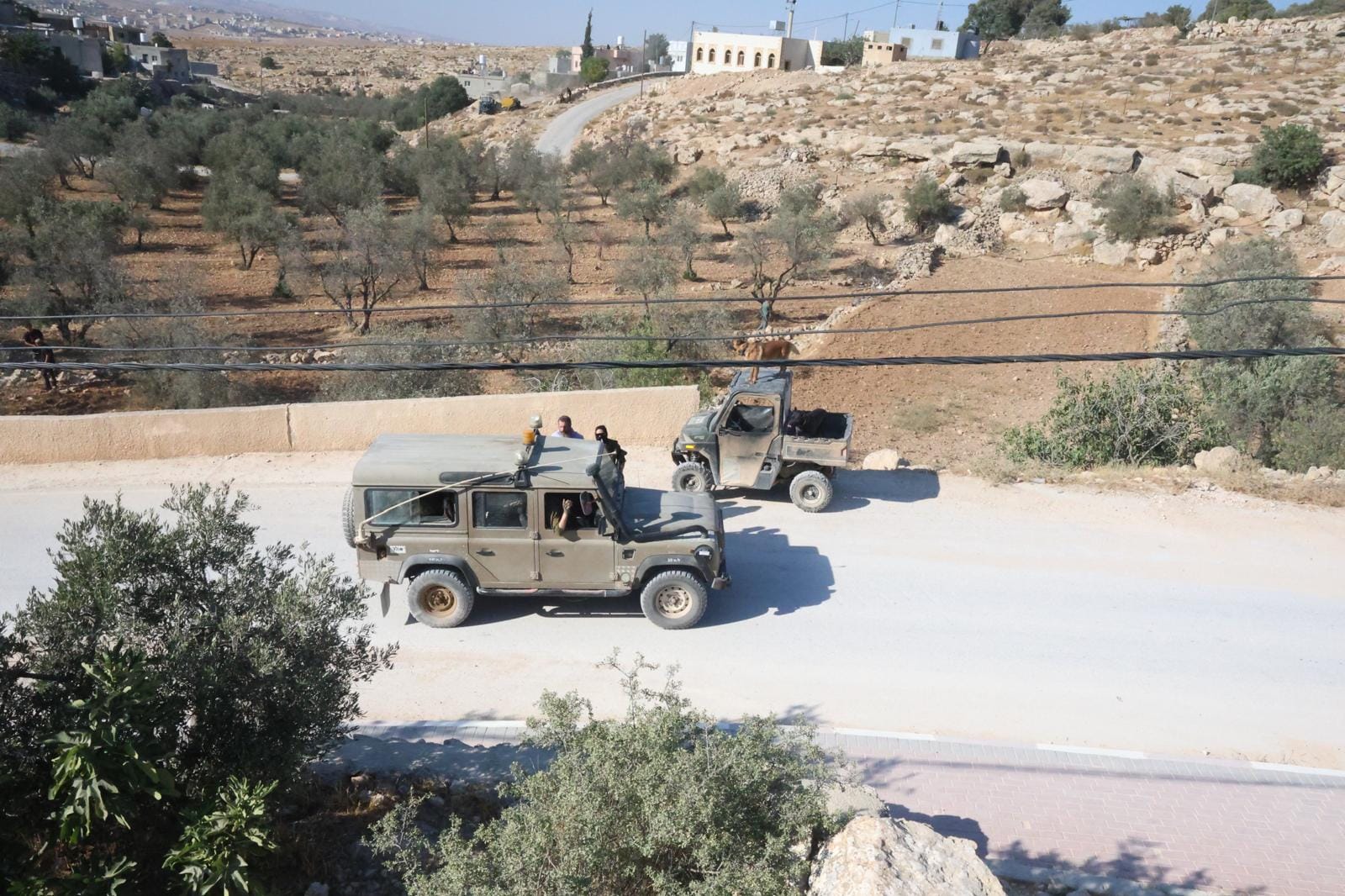
It is now exactly a year since my brother Basel Adra won an Oscar for his documentary, No Other Land, about our life under Israeli occupation in Tuwani and the larger region of Masafer Yatta. In the weeks afterwards, I remember seeing a map of the West Bank on the BBC that included not only the names of the major cities, but also our small village. Recalling that map now, it’s difficult not to wonder: if the whole world knows our name and our story, has seen the Israeli military demolishing our homes, and watched settlers beating and killing us – how are we still under attack?
Last March, I decided at the last minute to accompany my brother and parents to the awards ceremony in Los Angeles. Before I had even left the West Bank, Israeli occupation forces stopped me at the “container checkpoint”. First, they asked for my ID, then searched my phone. They found photos and videos showing Israeli forces demolishing homes and attacking Palestinians. After that, they beat me and insulted me. They eventually let me back into my car, but only after instructing my own father to continue beating me.
Unlike others before me, I made it in one piece into the US. A few days later, in Los Angeles, I experienced an indescribable joy when they called out our family’s name at the awards ceremony. It was a moment charged with hope and deep emotion. We thought that maybe the world would at last see the truth, and that the reality on the ground might finally change. But at the back of my mind, I was already worrying about being arrested at the border on the way home, and that we would return to find the whole situation not better, but in fact the opposite.
Our nonviolent resistance
From a very young age, mine was a life surrounded by settler violence and the oppression of the occupation against my community and my family. My family, despite being subjected to attacks on a daily basis, have always rejected all forms of violence.
I was constantly exposed to army raids, settler attacks, and home demolitions. I lived through terrifying moments and was unable to sleep. The army behaved in a brutal and barbaric way, forcing us out of our home at night during the cold winters. In those moments, I felt intense cold and fear, and because of the severity of those feelings, I could not sleep or speak for some time.
My parents have shown me what perseverance means. My father has been arrested more than 18 times. On one occasion, in 2009, he spent 40 days in Al-Maskobiya prison in Jerusalem, where he was subjected to all forms of torture. At that time, I was a child not older than four years old. When our father was home, we would sit with him as he told us about the events and hardships he had endured in this life while living in constant struggle under the occupation. My father was born in 1967, and my mother in 1973. My mother’s famous saying to us was: “Smile to make the world confused.” From our parents, we learned important lessons – lessons from their experience in nonviolent resistance, and how a person can obtain their rights and achieve their goals.
The film was our form of nonviolent resistance. By revealing on the big screen the daily violence, humiliations, and injustices faced by our community, we thought we might have a hand in getting the world to do something. But to our dismay, nothing has changed, and the violence has not disappeared.
On the contrary, settlers and occupation forces have continued to harass, attack, demolish, raid, and brutalise our families and villages. In fact, the film's recognition saw violence increase in the region, especially against the filmmakers and their families, as a clear act of retaliation against us.
In March of last year, not even a month after the Oscar was awarded, one of the film’s directors, Hamdan Ballal, was brutally attacked by settlers and then kidnapped by soldiers from his house in Susiya village, ten minutes down the road from us. The soldiers left him bleeding and blindfolded for the entire night in a nearby military base. His dangerous condition was potentially life threatening, but the settlers responsible faced no detainment or even reprimand for their actions. They continue to move freely.
It is disturbing that the Academy failed to do anything to show their support for Hamdan, beyond a silly Instagram story that did not even mention his name. I thought to myself, you don’t care about the partners who walked on your red carpet. I suddenly understood that no matter what you write, what you win, or what you do, it will not protect you.
Zero accountability
As Basel’s brother, the violence has fallen on me too. On 13 September, 2025, settlers attacked me on my family’s own agricultural land. They destroyed our trees, using their sheep to decimate our crops. We went there, my brother and I, with other activists, to film and try to defend the land and trees. At this point, settlers attacked me. They pushed me to the ground and attempted to steal my phone. While I was on the ground, they beat me, kicking and punching me everywhere. As they often do, soldiers followed, and while they forced the settlers to leave, nothing else happened. Even though the soldiers witnessed me being beaten, the settlers faced no charges or arrests.
A couple months later, on 27 November, Mohammad Ballal was arrested in the same house, in the same village where his brother Hamdan had been beaten last year.
Just three days later, on 30 November, my father was once again arrested, this time in the village of Mufagarah. In the evening, a settler began raiding the village with his sheep (sheep he had stolen from Palestinians), set on destroying whatever crops he could. Soldiers then came and detained my father for three hours before arresting him. They arrested him because my father was standing steadfast on Palestinian land, trying to defend himself and the people of the village in the only way he could, in the way our family has been doing for years, long before winning the Oscar, and apparently, long after: by holding up his phone and filming.
The occupation forces declared the centuries-old village “a closed military zone”, and for a full day none of us were permitted to leave our homes because we, too, would face arrest. But once again, the settlers did not face detainment or arrest.
A few months later, on 16 February, another major attack took place against Hamdan’s family. Settlers were grazing sheep on Hamdan’s land next to his house, while his brothers were at home. They called the police, but before the police arrived, the army came accompanied by other settlers, among them, Shem Tov Lusky, the same settler who had assaulted Hamdan in March last year. As usual, the army paid no attention to what was happening; the settlers escalated their assault on the land and on Hamdan’s brothers, beating them until they were blue and sending them to hospital. Meanwhile, the settlers remained, and remain still, at their outpost.
For my family and for Hamdan’s family, our week in Los Angeles feels like a long time ago. Today, the soldiers continue to come, knocking on our doors and smashing up our windows whenever they want. The Oscar has made our story known, but the world has done nothing to prevent violence against us or to hold the settlers accountable for their actions. It continues to sit comfortably and watch.▼
Author
Adam Adra is a photographer and human rights activist from Tuwani, Masafer Yatta.
Sign up for The Pickle and New, From Vashti.
Stay up to date with Vashti.