A pattern that must be broken
Jewish assimilation at the expense of other minorities continues to threaten an anti-racist future.
At the February launch of Reform’s new Jewish Alliance (RJA), Na’amod activist Carla Bloom interrupted proceedings with the declaration: “My mother didn’t fight the Mosley fascists in Cable Street for this.” Her particular choice of protest embodies a larger rhetoric circulating among the Jewish left in the wake of the alliance’s announcement. Namely, that a Jewish alliance with Reform directly contradicts the resistance undertaken by our anti-fascist forebears. Certainly, many of us on the Jewish left share Bloom’s horror that Jews would align themselves with a party whose leader not only faces over thirty allegations of overt antisemitism, but whose stance on immigration would have prevented our ancestors from seeking refuge in Britain in decades past.
And yet, the notion that Jewish people have always inherently adopted anti-fascist and anti-racist politics in the fight against antisemitism is both ahistorical and selectively blind. At the same time that Bloom’s mother and tens of thousands of others marched through London’s East End to oppose Oswald Mosley’s British Union of Fascists, many Jews across the Atlantic engaged in anti-Black racism as they attempted to assimilate into American whiteness, falsely hoping that white culture would protect them from antisemitism.
The tense historical relationship between Jewishness and Blackness allows us to recognise the Jewish Reform Alliance as part of a broader pattern, one in which Jews perpetuate harm against other minoritised groups in the name of self-preservation – a pattern that must be broken, both to terminate a history of white Jewish racism in the name of anti-antisemitism and to open up the possibility for meaningful anti-racist action.
One place we may turn to reckon with this complex past is cinema. Film and television reflect real life, shaping and being shaped by our lived realities. As such, they offer a unique record of social and political dynamics of the past as well as facilitating the imagining of alternative realities. Through cinema, we can both identify Jewish alignment with the far right as part of a historical pattern and inspire a different antiracist project.
Jews and the colour line
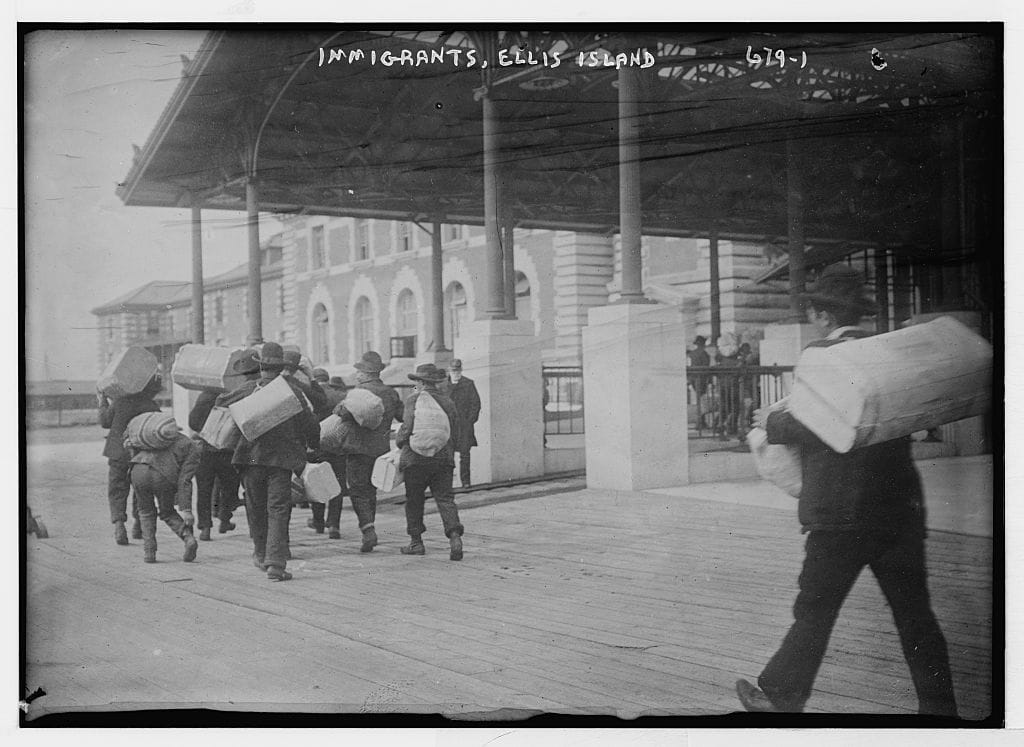
In the late 19th to early-20th centuries, the US saw a large influx of Jewish migrants fleeing decades of oppressive laws, violence and pogroms across central and eastern Europe. Those venturing to the US settled into largely insular, working class communities within major cities, until a series of immigration laws from 1919-1929 greatly decreased the number of Jews migrating to the US. These laws specifically targeted non-English-speaking refugees, introducing restrictions based on national origin.
Following the abolition of the transatlantic slave trade, only officially codified in the US constitution in late 1865, Jewish migrants entering the US were greeted by a country still festering with anti-Black racism and staunch racial hierarchy. Jim Crow laws gripped the American South, solidifying white supremacy within every aspect of daily public life. Even in the supposedly “liberal” North, anti-Black racism persisted both explicitly and through the more subtle diversion of resources away from Black education, housing and employment. The country’s reductive, binary understanding of race rendered Ashkenazi or white-presenting Jews in a position of precarity, alongside other European migrants like the Italians, Irish and Slavs who were also not considered fully white within this structure.
Common understandings of these groups as “racially in-between” or “off-white” in the words of Charles Mills, incentivised Jews to associate with whiteness, primarily by distancing themselves from Blackness. The 1920s presented a pivotal moment of racial re-stratification for Ashkenazi Jews as migration laws grew increasingly Anglocentric and xenophobic, and Jews faced the implicit and explicit demand for integration into the country’s reductive Black/white binary.
In Eric Goldstein’s 2006 book, The Price of Whiteness, he argues that Ashkenazi Jews migrating to the US assimilated into white American culture largely by distinguishing themselves from America’s “principal racial outsiders”: African Americans. He explains that the 1920s and 1930s were decades marked by white racial hostility and anti-migrant suspicion, partially fueled by anti-Soviet panic and the widespread perception that war-time opportunities had unreasonably advanced the status of African Americans. After fleeing racialised terror in Europe only to witness the persecution of Black people and immigrants in the US, many Ashkenazi Jews were determined to assimilate into white American culture for security and self-preservation against the violence of the colour line.
It must be made clear, however, that there were certainly Jews who themselves held anti-Black beliefs and participated in systems of anti-Black oppression because it aligned with their values and desires, rather than for the purposes of self-preservation or resisting antisemitism. As Goldstein identifies, there were indeed Jews in the American South who enslaved Black people, and who continued to profit from their exploitation and brutalisation after the abolition of slavery. Regardless of their motivations, Ashkenazi Jews were increasingly accepted into the category of American whiteness, often as a result of direct participation in structures of anti-Black oppression.
Race-making in cinema
In the US especially, cinema and its capacity for identity manufacture helped to position Jews as both a unified racial group, and one with a proximity to whiteness. In a country built upon anti-Black segregation and discrimination, any assimilation into whiteness, including on screen, required anti-Black racism. For example, Jewish performers like Al Jolson and Eddie Cantor engaged in Blackface, donning burnt cork makeup and exaggerating Black cultural and physical stereotypes – aligning themselves with white racial dominance in the process. In the film Kid Millions (1934), Cantor is shown applying burnt cork backstage at a theatre. With part of his face still uncovered, he turns to the Black employee holding his makeup and says, “This is tough to put on… and take off. You know you’re lucky?”. These early 20th-century Jewish performers were often shown applying or removing their Blackface, clearly delineating between the false comedic mask of Blackness and the “true” white performer beneath. By participating in minstrelsy, Jewish performers could not only claim autonomy over the manufacturing and perception of their racial identities, but firmly position themselves as white in the process.
In the century since Jolson’s The Jazz Singer (1927), attitudes towards Blackface minstrelsy have significantly shifted in line with social, legal and political moves towards racial equality. The Civil Rights Act of 1964, which outlawed discrimination in public places, encouraged largely successful anti-Blackface protests and campaigning by groups like the National Association for the Advancement of Colored People (NAACP) and the Congress of Racial Equality (CORE).
Through the second half of the 20th century, Blackface became more widely recognised as unacceptable, solidified sixty years later by the Black Lives Matter (BLM) movement in response to the murder of George Floyd. Floyd’s murder provided further stark and violent evidence of the persistence of anti-Black racism in contemporary society, re-energising public demand for accountability for Blackface and Black cultural appropriation. In film and television, this manifested in the removal or termination of shows like Little Britain from the BBC, Family Guy and the Simpsons announcing they will no longer have white actors voicing non-white characters, and a slew of performers making public apologies for previous instances of Blackface and other forms of racial impersonation or cultural appropriation.
However, this shift did not result in the complete termination of minstrelsy. While the progress in racial equality from the days of Cantor’s tap-dancing Eddie Wilson Jr is undeniable, anti-Blackness remains a structuring force in society. Within film and television in particular, claims of humour, satire and fictionality are used to justify the persistence of Black cultural mimicry on screen. And where Blackface persists, so too does Jewish participation in it –whether through performance or a creative direction. For example, Robert Downey Jr. famously wore Blackface as Kirk Lazarus in Jewish director Ben Stiller’s 2008 war comedy Tropic Thunder.
While the UK may find comfort in downplaying its participation in present and historical anti-Black racism, particularly by citing the British abolition of the slave trade and succumbing to what Will Poulter terms “colonial amnesia”, it is necessary to recognise the UK’s culpability in upholding global structures of racism. Part of the UK’s own legacy of white supremacy also includes British Jews, who, similar to our American counterparts, have continued to participate in Black cultural mimicry on screen into the 21st century. Jewish actor Matt Lucas donned Blackface for his role as Precious Little, a Jamaican coffee kiosk manager, in the television series Come Fly With Me as late as 2011. And even without makeup, the practice of Jewish performers embodying exaggerated Black stereotypes persisted through cultural appropriation, as exemplified through Sasha Baron Cohen’s role as Ali G in Ali G Indahouse (2002).
We cannot say that these instances remain linked to a project of 21st century Jewish assimilation into whiteness or that they are misleadingly fuelled by a desire to avoid antisemitism. However, viewed in relation to 20th-century Jewish minstrelsy, it is possible to identify these modern iterations as part of a lineage in which participation in systems of racial oppression becomes a justifiable consequence of quests for anti-antisemitism. In the contemporary alignment of British Jews with Reform UK, we can see that this participation has not ceased: it has merely mutated to fit the present moment. There is still a move to engage with structures of racial domination in the name of anti-antisemitism.
For those able to meet the physical and cultural expectations of British whiteness (crucially, a privilege many Mizrahim, Sephardim and Jews of colour will never be afforded), the project of assimilation appears to have largely succeeded. And yet, the far right’s continued antisemitism proves this quest to be a fruitless one. As the RJA launch suggests, Jews are continuing to turn to racist oppression in order to obtain an elusive status of whiteness – one which the far right will never truly bestow on Jewish people – with migrants, Muslims and non-white communities at large now bearing the unrelenting brunt of the consequences.
Towards anti-antisemitism as antiracism
Aligning with white supremacy has not saved American Jews from the violent claws of antisemitism, and it will not save British Jews from the recent increase in antisemitic attacks that our community is experiencing today. Lest we forget that turning to the far right does not only harm the non-white and migrant communities relentlessly targeted by Farage and his minions, it harms Jews too. As if Jews of colour and migrant Jews will magically find themselves exempt from Reform’s xenophobia and racism now that the party supposedly values and represents the needs of (read: white) Jewish people.
Meaningful antiracist and anti-antisemitic action necessitates grappling with the complicated history of Jewish antifascist resistance. For those of us Jews who benefit from systems of white supremacy, we must reckon with our complicity and participation in racist practices of the past and present. We must turn to a project of anti-antisemitism that resists white supremacy as a guiding principle and that prioritises cross-cultural solidarity through accountability, empathy and a meaningful negotiation of power structures.
The film industry has yet to undertake this project. We see attempts at this kind of cross-racial co-navigation in Kenya Barris’ You People (2023) where the romantic relationship between a white Jew and Black Muslim in Los Angeles stages important questions about violent cultural legacies, victimhood and multiculturalism. However, the Netflix film overall prioritises romantic comedy clichés and a happily-ever-after, over radical, critical anti-racist commentary.
Even if we are yet to see this type of representation on our screens, we can look instead to the solidarity-based organising on our streets. For example, Jews for Racial and Economic Justice (JFREJ), a New York-based interfaith and interracial activist group, demonstrates the kind of antifascist resistance necessary for radical change. JFREJ’s decades-long campaigning spans from anti-Zionist and anti-apartheid work to fighting migrant deportation to combatting wealth and healthcare inequality. The organisation is founded on solidarity across race, gender, class, sexuality, disability, age, and citizenship status, with members recently joining Desis Rising Up & Moving – a community social justice organisation of working class South Asians and Indo-Caribbeans – for a joint Iftar/Shabbat celebration, and hosting a street seder titled MELT Pharoah’s ICEy Heart, which combined Pesach celebrations with anti-ICE protest.
Indeed, our forbears did not fight in Cable Street for Jews today to pander to the far right. However, we must complicate the notion that the Reform Jewish Alliance is a distressing novelty. Distressing, yes. But a novelty? No. All efforts made by or on behalf of Ashkenazi Jews to assimilate into systems of white supremacy are at the expense of black people and migrants, and at the expense of a radical anti-racist, anti-facist project. Refusing association with Reform and the alliance, a contemporary and public-political manifestation of this dynamic, is not sufficient opposition to its harm. So long as Jewishness is weaponised in the service of racism, fascism and xenophobia, we Jews who benefit from these systems of oppression – those of us who pass as white and benefit from whiteness – have a responsibility to resist those systems, on all fronts.▼
Author

Jessie Sumroy graduated from Kings College London with the Jelf Medal in arts and humanities for her work on interdisciplinary approaches to race, biopolitics and security within film and literature.
Sign up for The Pickle and New, From Vashti.
Stay up to date with Vashti.