I wake from a fever dream to find I have no fever. Reaching for my phone, the nightmare’s loop repeats in my waking.
A figure runs towards me with their forehead bowed. It is shaved. So are all the heads of a crowd behind them. They’re all running too, surging. There is red smeared across the foreheads. It’s blood, but it’s not their own.
I can only see this one person in detail. They run up and reach to me with both arms as if I am holding a camera. I might be holding a camera, I can’t remember. They scream, but not in distress – it seems they’re trying to insist on something. I know that all of these people running across the scene have matching bloody smears. A blurred X, like a quick kiss at the end of a card.
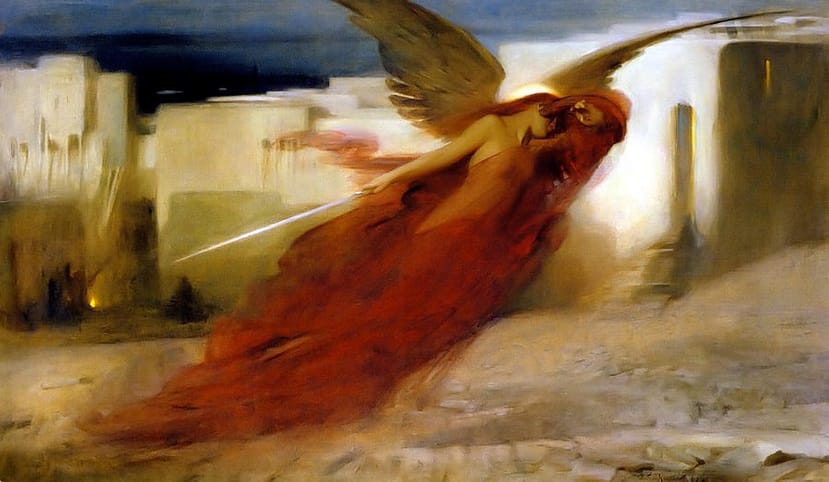
They are running from something hot, like fire. Except we all know it is coming from the sky. It is also not a bomb; I know in my waking that everyone in the dream knew it was not a bomb. Or a drone or a missile. It is less physical than those, and it reaches across the sky rather than comes down from it, like a low, racing cloud.
I know the dream is set not in the past, maybe in the very near future, and I have a choice to make. The ground and walls and buildings are a dark orange sand. All the people running are Jews. The blood of a paschal lamb drips across their foreheads.
Many readers (Jewish or fans of the Prince of Egypt) will recognise images from the story of the tenth plague. Following the first nine plagues, each of which fail to convince Pharaoh to liberate the Israelites from their generations-long enslavement, an “angel of death” is sent to kill the firstborn of every Egyptian household. This is a retributive loop to the beginning of the Pesach story when Pharaoh kills the firstborn Israelites in an effort to reduce their population growth; he fears they will grow in strength and unity under oppression, and ally with Egypt's enemies to overthrow his rule.
Before the tenth plague is sent, the Israelites are instructed to mark their doorposts with the blood of a sacrificed lamb so that the angel of death knows to “pass over” their homes and spare their children. This plague, perhaps the only one of the ten that materially reaches the Pharaoh himself, leaves his son dead, and prompts him to release the Israelites. (However, he changes his mind soon after and their freedom is only solidified when an entire sea parts for them, before it closes and drowns the pursuing Egyptian army).
Throughout Pesach I ruminate on my mind’s chaotic perversion of the plague. Do I also have this bloody mark on my head? Who does the cloud have in its sights? Who sent it? Will the mark protect me? Am I seeing this vision because I bear the weight of genocide and haven’t risked enough to do something about it? Am I seeing what happens when a lifetime of suckling on the teat of intergenerational trauma paves the way to the apocalyptic destruction of the present, in our names, by our hands? Am I holding a camera because this armchair journalism does nothing? Why is this dream different from all my other dreams?
I cannot remember if this dream occurred shortly before or after a dear friend and comrade confided in me that he didn’t know if there is a future for the Jewish left, on the left, in the US or in the UK. He reminds me that, statistically, the overwhelming majority of Jews remain, in his words, “overtly genocidal”, so in spite of many Jews’ committed insistence on the separation of Zionism and Judaism, this conflation is increasingly accepted as reality on both the right and the left.
Although he knows that his own political home shrinks with such a conflation, he understands why the left is moving in this direction. Why, to them, Jewish life and Judaism itself increasingly become synonymous with Zionism. What else, he asks, can one reasonably take from the “nearly negligible" shifts in the Jewish community over the last two and a half years of genocide? My friend senses this is leading us (leftist Jews) to an inevitable choice. There is no going back, he said, at least for our generation. I think he is right and it occurs to me that, perhaps, this is the choice I am faced with in my dream.
Our conversation, otherwise entirely normal for us, had this indescribable weight, like an anvil dragging along behind us while we tried to swim towards each other across Whatsapp waves. I haven’t told him about the dream, though I suppose he will read it now. It is clear neither of us are doing very well.
I often question the value of talking to him from Torah. He’s a secular Jew in the sense that Judaism isn’t part of his toolkit for comfort, respite or guidance. He is almost sage in his belief that Torah has the potential to be both an opiate and a rousing liberatory resistance guide; it’s not his thing but he supports people’s use of it. A safe consumption kind of approach.
When I do speak and write from Torah, I feel his admiration and deep respect. And, I sense, this may be the best way for me to express my response to him. That it might be the only way – that for me, Jewish text prevails as the antidote to its exploitation everywhere – is a confusing feeling, because I don’t believe the answer to despair is faith. Rather, it’s almost always some form of material action. But because the Exodus story gave my distress its language in dreams, it also provides a script for beginning to confront the impossibility of this choice he foresees ahead of us.
Psalm 118:5, recited both during Hallel (prayers of praise on holy festivals), and at times of despair, begins Min Ha-meitzar karati Yah. From the narrowest place, I call out to God. (“Ha-meitzar” – the narrow place – derives from Mitzrayim, the name for Egypt; the place of ancestral bondage, enslavement). And then Anani b’merchav Yah. God answered from within the expanse (“merchav” a wide-open expansiveness, or liberation, perhaps).
The psalms, as the largest collection of ancient Israelite poetry, are known for their use of parallelism, a literary device which contrasts or pairs to create emphasis and pattern. Psalm 118:5 couples the deepest oppression with the truest expansive freedom. The latter must always answer the former – but that answer alone isn’t a simple blueprint to its realisation.
When we call out from the narrow place, we do not hear a promise of future liberation calling back to us. We are not provided with examples of such a freedom in the past, for our world has not yet known a true liberation for all. Nor does the answer come from a distant, abstract God, leading the way. When we take Godliness to be that which is divine within and between all people, this psalmic coupling instructs us to answer ourselves. And between us, there is an internal and collective knowing that an interconnected liberation is the eternal and only answer to such narrowness. We must draw on this knowing when we despair in the face of catastrophe; the psalm solidifies the call and response.
So too does the Seder remind us that we have a transcendent knowledge of oppression and liberation. Where Psalm 118:5 might connect this opposition in poetic terms , the Seder solidifies our obligations to action. At the centre of this ritual meal we are, year after year, generation after generation, obliged to retell the story of our ancestors’ liberation from slavery, such that we are reminded to fight for the liberation of all in our lifetime and beyond.
The Exodus and the embodied, time-transcendent “I too was once a slave in Egypt”, underpins all of Jewish practice. It is not a radical lefty remake, grappling for “good Judaism” – and its enactment at the Seder is not an insulting theatre, in which we perform the role of those who are, right now, truly enslaved, captive, or oppressed in order to empathise enough to act. That is to say, the Seder does not ask us to frame Palestinian suffering in terms of Jewish suffering, failing to understand the Palestinian experience on its own terms while continuing to insist on Jewish identification with victims rather than perpetrators in our own time.
Rather than placing all suffering in Jewish terms, the Seder puts all of Judaism in liberation’s terms; ritualising the oppression that our ancestors suffered and that we have inherited makes us specifically responsible for actually bringing about collective, expansive liberation.
In spite of this, an unfathomable number of Jews are perpetrating the gravest violence in the name and language of Judaism, while the bulk of liberal Jews are soothing their discomfort with their own material support for this violence with impotent waffle, unrigorously leaning on Jewish texts and values. Yet I cannot distinguish the fight for the collective liberation of all people from the Judaism that insists on liberation as my life’s work and guides me, persistently, to its realisation.
Towards the end of the Seder, a final cup of wine is filled right to the brim and the front door opened, to welcome in the prophet Elijah. Adults around the table shake it, causing the wine to spill over as if Elijah has come in to drink. As a child, I did not think that this was because some Santa-eqsue spirit had arrived and drunk from the cup. I saw everyone shaking the table, the glee of passing on tradition filling the room. I understood that this was because one day it would become very important that I was going to shake the table, and that such things were not silly jokes but somehow very important practices of make-believe. We are instructed by the Haggadah to open the door to Elijah because the prophet represents the coming of redemption (collective and true liberation for all); a physical practice of repeatedly orientating ourselves toward the indefinite but earthly and material fight that will bring such redemption about.
I do not think of dreams as prophecy, though they hold the truth close. Perhaps a choice will soon face those of us for whom a commitment to Judaism and liberation are intertwined, testing the saliency, the viability or even the permissibility of a left Judaism. But, I know that every spring, I will still be filling a cup to the brim and spilling it, blatantly, in front of my children’s eyes as they return from opening the front door into the night for Elijah. I have no choice but to pass on this inheritance, which knows no other names. If it is a lost cause for our generation, let it not be for the next.▼
Author
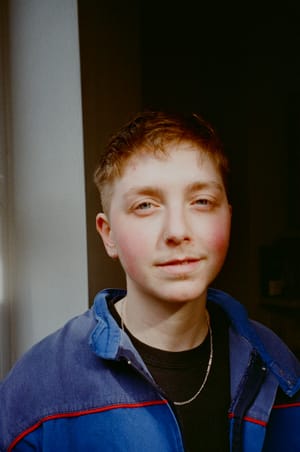
Asha is an interdisciplinary writer and filmmaker and an Editor at Vashti.
Sign up for The Pickle and New, From Vashti.
Stay up to date with Vashti.